Tuesday, August 20, 2019

Humboldt Bay Half Marathon


Humboldt Bay Half Marathon
Eureka, CA
11 August 2019

Believe and achieve.” – Deena Kastor

During my fifty-state journey, I had a lot of time and miles to think and reflect upon life and the world around me.  I can simply summarize one of the fifty things I learned on my journey as, “Run a marathon (or half) in your hometown.  Show your family and friends what you’re about and be proud of your achievement.”

Those who live in the coastal regions of Humboldt County are blessed with an abundance of wildlife, forests, fishing, swimming, great outdoor destinations and a relaxed small-town vibe.  As a former Humboldt County resident, I can honestly say that July, August and September are the most pleasant months of the year with temperatures frequently topping out at 65°F.  Sure, the weather can vary from gray overcast skies one day to warm and sunny the next, but that’s what makes this area unique and the perfect place to stage a marathon.

I grew up in Eureka and have family still residing there and I always look forward to traveling to this annual event.  It’s a great way to visit, get out of the valley heat, and to squeeze in a run at the same time.  Being able to pace is putting extra icing on the cake.

I’m always humbled and honored to volunteer as a pace leader.  I take my job seriously and try my best to commit to my assigned time; but, at times, I have failed – mostly at the full marathon distance.  That’s why I choose to remain in my comfort zone and take the easier option, pace half marathons.

Obviously, I enjoy pacing, or I wouldn’t do it.  It’s a very rewarding experience and I’ve utilized pacers in various marathons.  I don’t do it just for the complimentary race entry.  I don’t do it to run my race.  I do it to run the race for others.  It makes me happy to help other runners achieve a milestone.  I enjoy engaging in the many conversations as I learn pieces of the lives of others.  However, just like at a race, serving as a pacer is always a little bit nerve-wracking.  It’s a huge responsibility and the last thing I want to happen is to disappoint some other runner counting on me for inspiration and encouragement. 

When pacing, the mile markers play a major role in successful performance.  Ideally, pacers must cross the finish line within one minute of their goal time.  For me, I need to cross the finish line between 2:14:00 and 2:15:00 — not even 2:15:01.  It doesn’t matter when my Garmin chimes in at 13.1 miles — it only matters when I cross the finish line.  So, pacing necessitates continual mental math, muscle memory, and careful consideration throughout the race.

Course route
Running a 2:15 half marathon equates to a 10:18 pace, but because marathon and half marathon courses tend to show up long, I actually have to sustain a pace window between 10:05 to 10:15 per mile to meet my goal time.

Generally during a smaller race, pacers seem to be running alone.  Even when I’m not running with anyone and it seems like I’m the only one on the road, it’s vitally important to keep that pace, since other runners ahead or behind me may covertly use me as a guide, whether they are trying to stay in front of me or keeping me in sight.

The Expo/Packet Pick-up

The Manila Community Center at the Redwood Coast Montessori School in the hamlet of Manila played host to the small expo (if one could call it that) and packet pick-up.  I picked up bibs, shirts and goody bags for myself and for two other half marathon pacers who were traveling from afar and unable to arrive before closing time.

Goody bags include a tech shirt featuring unique indigenous landscape designs by a local artisan only found in Humboldt County, a packet of hemp seeds and hemp seed protein bars.  It’s Humboldt, what can I say? 

It was a quick in and out with zero time spent perusing the two or three vendors who decided to make their presence known.

Let’s do this

This is my fourth time serving as a pace leader for the Humboldt Bay Marathon – once as a full marathon pacer during its inaugural run and thrice as a half marathon pacer.

I was happy to get enough sleep and rest the night before the fifth running of this event.  I felt rested and eager to take on the 13.1-mile challenge.

The full marathon begins a couple of blocks east of the Madaket Plaza (finish line) at 0700 sharp with the half marathon beginning at 0900 at Klopp Lake at the Arcata Marsh.

Race organizers contract with the Blue Lake Rancheria for shuttle bus serve to transport half marathon runners from the finish line area at the Madaket Plaza to Klopp Lake.  Unfortunately, some sort of snafu or misunderstanding caused a minor interruption in shuttle service.  Since we're runners, I suggested to the race director that if buses fail to show, we could always run to the start line.  Hey, it’s only eight miles.  My suggestion wasn’t well received by those waiting in line.


I arrived on the first bus to the start line staging area.  I milled around the Klopp Lake Bird Sanctuary parking lot area as I waited for the other pacers to arrive, in the meantime, observing loons, scoters and mergansers lounging around the brackish ponds preening themselves.  I lathered up my neckline, arms, face and legs with sun screen.  The soft mucky bay mudflats gave rise to a low tide, and the sun hovered above the coastal mountains illuminating wisps of residual moisture clouds from Saturday morning’s short-lived rain event.  The temperature was crisp but not too cold – perfect for running.  

I was granted the honor of being the half marathon pacer leader, and with that, comes the responsibility of dispensing the pace signs to all pacers as they arrive.  One-by-one pacers showed up in their distinctive bright yellow shirts and before long I was holding my one and only sign.

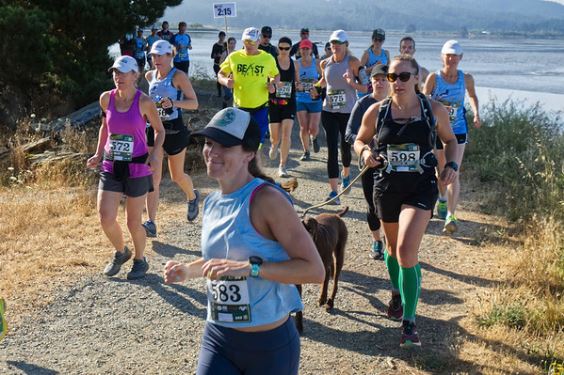
Armed with my chic, trendy, fashionable, high-quality handmade pace band accessorizing my Garmin, I was ready to get this show on the road.  More than one hundred runners lined up on the gravelly pedestrian trail flanked by the bay and the brackish waters of Klopp Lake, eager to start.  But wait…the race director announced that the final bus had yet to arrive with only one passenger.  Are you kidding?  As that runner jogged around the bend to join the starting queue, everyone erupted to a round of applause. Apparently, the half marathon’s protagonist of the day.

I’d be lying if I said I wasn’t a little nervous before the start of the half marathon.  I had a reason to be nervous.  I considered the fact that the pace I committed to running would be slightly faster than many of my recent longer training runs.  

Training in the San Joaquin Valley is a tough endeavor during the summer months – it’s hot and, at times, a little humid during the monsoon months.  Sometimes, throw in some wildfire smoke as it chokes off the air quality.  Because of the summer heat and my body still convalescing from my 50-state quest, my “long” runs have been slower than they would have been otherwise.

Following some final instructions and announcements, the race director performed the traditional countdown and we were off and running – thanks to the late bus, a couple of minutes past 0900.

I began my run with a sense of energy and enthusiasm.  Two local runners decided my pace equaled their abilities and chose to run with me.  One was an environmental scientist and the other worked as a botanist/forester.

Before I knew it, the first mile flew by with a time of 9:45.  Oops, a little too fast.  By conversing with others, I have the tendency to run faster as it takes the focus off my task at hand.  I told those around me, “it doesn’t hurt to bank a little time, anyway.  We may need it for aid stations and the bridge.  Besides, the miles usually run long.”

At around Mile 2.5, runners leave the sidewalks and bikeways of Arcata to real estate subjugated by sloughs, dairies, cattle and hog farms giving runners diverse visual, audible and odorous stimuli.  Mud, manure and rough broken pavement sections are common features creating hazards for anyone propelling themselves on foot.  I focused on a steady 10:05 pace simultaneously paying attention to my footing.   The aromatic air and sounds of agriculture provided me with a constant aide-mémoire of where I live. 

Around Mile 5, runners leave the flat fertile farm lands and merge onto Samoa Boulevard (aka State Route 255) and views of the bay.  At this point, runners have free reign on the coned-off southbound lane and are not required to hug the shoulder area.  I found myself running alone.  The two runners I had at the beginning charged out ahead, but within sight distance.  Perhaps they were clandestinely using me as a guide.  Possibly not, but I like to think so.

I sustained my consistent pace only slowing briefly at an aid station near Mile 7 to consume an energy gel pack and some water.  Feeling good and refreshed, I maintained my pace for the next three miles leading to Vance Drive as it looped underneath and back around to the Samoa Bridge.  

Feeling as if my pace began to relax, I stopped to sip a few cups of Nuun and resupplied my energy reserves at the aid station near Mile 10.  With some added zest, I began my run across the Samoa Bridge – and the signature part of the course.  

1928 St. Francis Dam failure - Santa Clara River
But, for some reason, an eccentric feeling came upon me as if I was a reawakened William Mullholland running from one of his most colossal and failed Southern California waterworks projects, and how easily hubris and complacency can lead to disaster.

With my walk break extending farther than I had planned, I felt a bit apprehensive and found it difficult to maintain my obligatory pace as I ascended the first incline.  I was confident coming into this event up to this point, and the last thing I needed was to encounter another disaster.  My calf muscles began to tighten, my legs felt heavier, but I had to keep running, as if I was running from failure, so to speak.

Being fearful of a disastrous performance similar to my previous half marathon in Napa Valley, I rolled up my sleeves, gritted my teeth and pushed away the pain and discomfort overwhelming my legs as I trudged over the “hills” of the bridge.  I was determined.  I was focused.  And, I was not about to let that little internal voice screaming at me to admit defeat once again.  The final hill of the third bridge segment loomed large, daring me to run up it.  I banked enough time, so in an effort to avoid exhausting my energy reserves, I quickly walked up the rather short section, resuming my run back down the hill with a sub-9:00 pace to make up for lost time.

As I descended the final hill onto Third Street, I was within my pace window, but with much less flexibility.  It hurt, but with around one mile remaining, I pushed it up the final slight incline towards the backside of the Carson Mansion, cresting at the inlaid paver stones of the Second and M Street intersection. 

With the Carson Mansion behind my back, I thought, “It’s all downhill from here.  Let’s do this!”

I had a sense of solitude.  I glanced around, I had no one with me.  The two people I had at the start maintained a 50-yard gap.  I looked at my watch, did some mental calculations and concluded it was going to be close.  I wasted precious time by walking the bridge’s final hill and I was thankful I banked some time at the beginning.

As I pushed my pace, my left calf began a spasmodic episode quickly forcing me to alter my gait, hobbling along like some injured soul.  The last thing I wanted was a sapping calf muscle spasm, so I relaxed my pace to that fine line between cramping and not cramping.  It seemed to work.

Trying not to expose my limp, I made a right turn onto F Street towards the Compass at the Boardwalk constantly monitoring my time.  A course marshal directed me to the sidewalk, observed my pace time and said, “You’re cutting it close.  You may not make your time.”

First of all, how does he know?  And second, thanks for the inspiration.

That certainly didn’t sit well with me.  I rounded the corner onto the Boardwalk and saw the inflatable finish line banner about two hundred yards in front of me.  My Garmin read 2:13 and change. “I’m going to make it!” I thought.

I burned through the final mile in 10:01, dashing over the timing mat with a time of 2:14:25. It wasn’t pretty, but close enough for government work, and in the realm of admirable pacing.

RACE STATS:

Distance: Half marathon (13.1 mi).  My Garmin measured 13.17 miles.
Date: 11 August 2019
Bib No.: 502
Weather at start: 63°F, clear sky with northwesterly breeze at 5 mph
Gun time: 2:14:38
Chip time: 2:14:25
Average pace: 10:12 per mile
Average cadence: 159 steps per minute
Overall rank: 57 of 107
Gender rank: 35 of 47
Division rank: 2 of 3
Elevation: 190 ft gain / 180 ft loss
Age graded score: 50.67%
Age graded time: 1:55:13
Garmin splits: 9:45, 10:01, 10:07, 9:56, 10:09, 10:01, 10:21, 10:10, 10:03, 10:28, 10:18, 11:30, 10:01, 9:22 (remaining 0.17±)

LIKES / WHAT WORKED:
  • The cool temperatures and fresh air.
  • Very well-organized event from packet pick-up, the well-stocked aid stations along the course to bag drop and pick up.
  • Super friendly volunteer support.
  • Scenic.
  • Great traffic control and course monitors.
  • No significant climbs.
  • Easy parking race morning.
  • FINISHING!!
DISLIKES / WHAT DIDN’T WORK:
  • Very little spectator support.
  • Delayed shuttle bus transport.
  • Derelict roads throughout the farm lands.
As I review my split times, I pretty much ran the race I had hoped.  But, most importantly, I satisfied my committed time goal.  Hubris seemed to get in the way in the beginning, but my physical reservations balanced out everything as I established my groove.  

Given my physical circumstances, I was pleased with my performance.  After consuming a banana, some snacks, and guzzling a carton of chocolate milk, I walked around, stretched and applied some topical pain-relieving analgesic on my aching calves.  Sure, I was a little stiff, my quads ached, but I felt better than expected.  

If the day’s half marathon mileage wasn’t enough, for the first time ever, I ran back along the course in the opposite direction to intercept my wife’s path who was pacing the full marathon. 

I caught up to her as she assisted another runner near Marathon Mile 24.5 just past the Woodley Island Marina access road.   Our job was to encourage him to keep going, exceed his time goal and to finish with a smile.  I made certain he remained ahead of me during the final mile, and in the end, his two young children each took a hand and escorted him across the finish line.  I’m sure that put a smile on his face.

At the end of the day, we both dialed-in our finishing times, thus capping a successful day of running.

Final thoughts:

Now that my blog reviews chronicling my fifty-state quest have come to an end, I’m turning my attention to half marathon reviews perhaps with an occasional marathon thrown in here and there.  I have only one review of a half marathon to my credit, but now I’ve decided to take on the challenge of writing more.

I enjoy traveling to my former home town, visiting family and running this marathon or half.  It was a little disappointing to learn that the course route changed from its debut layout, but I still enjoy running the peninsula and challenging the Samoa Bridge.

After completing four rounds of Humboldt Bay, one thing concerns me.  The running field doesn’t seem to be growing – only remaining stagnant.  There are dozens of local runners and a large running club in the Humboldt-Del Norte County area.  Why they don’t turn out to support a local event, is puzzling and perplexing to me.  It’s a USATF sanctioned event, a fairly easy Boston qualifier course and a great course for those aspiring to qualify for the Olympic trials.

Avenue of the Giants and the Humboldt Redwoods Marathons both draw a descent size field of runners.  Perhaps because of their reputable histories.  I get that Humboldt Bay is not as picturesque as The Ave; but, in my opinion, the cool weather and easy access of HB makes it much more attractive.

I sincerely hope that Humboldt Bay continues into the future and I wish it nothing but success.

In the meantime, it’s back to training for two more half marathon pacing jobs – Two Cities (Clovis) and Bakersfield in November.

As always, onward and upward.

Wednesday, June 19, 2019

State Number 50 - New River Marathon


State Number 50 – New River Marathon
Fleetwood, NC
8 June 2019

“It’s very hard in the beginning to understand that the whole idea is not to beat the other runners.  Eventually you learn that the competition is against the little voice inside you that wants to quit.” – George Sheehan, M.D. 

This is it!  State Number 50 and the conclusion to my fifty-state quest.

It’s a bitter-sweet moment as I complete this milestone in my life.  During the past six years, my journey has taken me to seemingly unknown parts of the country and to places I’ve never dreamed I would ever visit.  

Over the course of my seven-year expedition, I’ve met some wonderful and amazing people and heard many stories and experiences I would not have heard otherwise.  Now, I can tell some of my amazing stories and experiences to other runners who may embark upon a similar adventure.

Some may say that I’ve done the unthinkable and some may say, “No big deal.  I’ve done it several times through.”  Now, that it’s over, I can honestly give a shout out, “What a journey!  What an accomplishment!”  Now, I can call myself a Fifty-Stater.

The years, my profession and intermittent injuries piled up, and yes they’ve been a heavy weight on my shoulders, but I kept going.  I kept moving forward.  Kept running, and sometimes I didn’t even know why I ventured out on such a journey, but I kept going.  That’s what I’ve done – go, go, go; day by day; week by week; run by run and marathon by marathon.

Beginning at a point not too distant from Lat 37° 09’ 58” N; Long 119° 26’ 58” W somewhere south of the Mt. Diablo Base Line, I’ve blazed my path and closed out my survey traverse back to the point of beginning and now it’s time to sit back, relax, analyze my course and write about my incredible fifty-state quest and the lifetime of memories it has afforded me.

Now that my fifty-state quest has come to an emotional close, my question is – what’s next? 

I may not know that answer, but I will continue to run, train and run.  All I know is that completing another round of fifty states is not in the cards; however, I may visit other states to run a marathon that strikes my fancy.  Who knows, the addictive nature of this sport can draw a runner anywhere at any time.

In the Blue Ridge Mountains of North Carolina’s High Country, the quaint hamlet of Fleetwood and the spectacular New River Valley is the site and backdrop for the New River Marathon.  The marathon boasts more than twenty miles along the New River, one of only fourteen American Heritage Rivers, with picturesque views of horse farms, hillsides of Christmas tree farms and the spectacular surrounding river valley.  

I’ve read that the New River Marathon is a rather challenging course with seemingly non-stop rolling hills, long hills, short hills, steep hills and other hills ranked beyond category.  Whoever said that my fiftieth state would be an easy task is living somewhere in la-la land.

Course profile
I went into this marathon with some fatigue and soreness from Thursday’s Mockingbird Marathon.  However, with a day of rest between the two races, I felt as if I could run faster than my performance at Erwin – even with the hilly nature of the course.

Following an adventurous rain-soaked drive from Johnson City, heavy tropical-like rains greeted us as we pulled into Boone.  With the weather forecasts all indicating periods of heavy rain showers for the next few days, I came to the realization that the marathon will be one wet and soggy race.  

We soaked in the hotel’s hot tub, cleaned up from our fun day running in Erwin and satisfied our appetites with some comfort food at Cracker Barrel before turning in for the night.

Friday was a much-desired day off from any sort of running activity.  The unyielding rain and less than ideal weather threw a wet blanket, smothering our planned local activities as the door pretty much slammed shut on the Grandfather Mountain and Blowing Rock attractions.  We drove to Blowing Rock only to find dense fog and drizzle at the visitor center.  We also phoned Grandfather Mountain to inquire if they were open, they were, but it was recommended not to visit the popular attraction due to dense fog on the mountain and any kind of photographic and supplementary visual imagery would be nonexistent.

Blowing Rock entrance
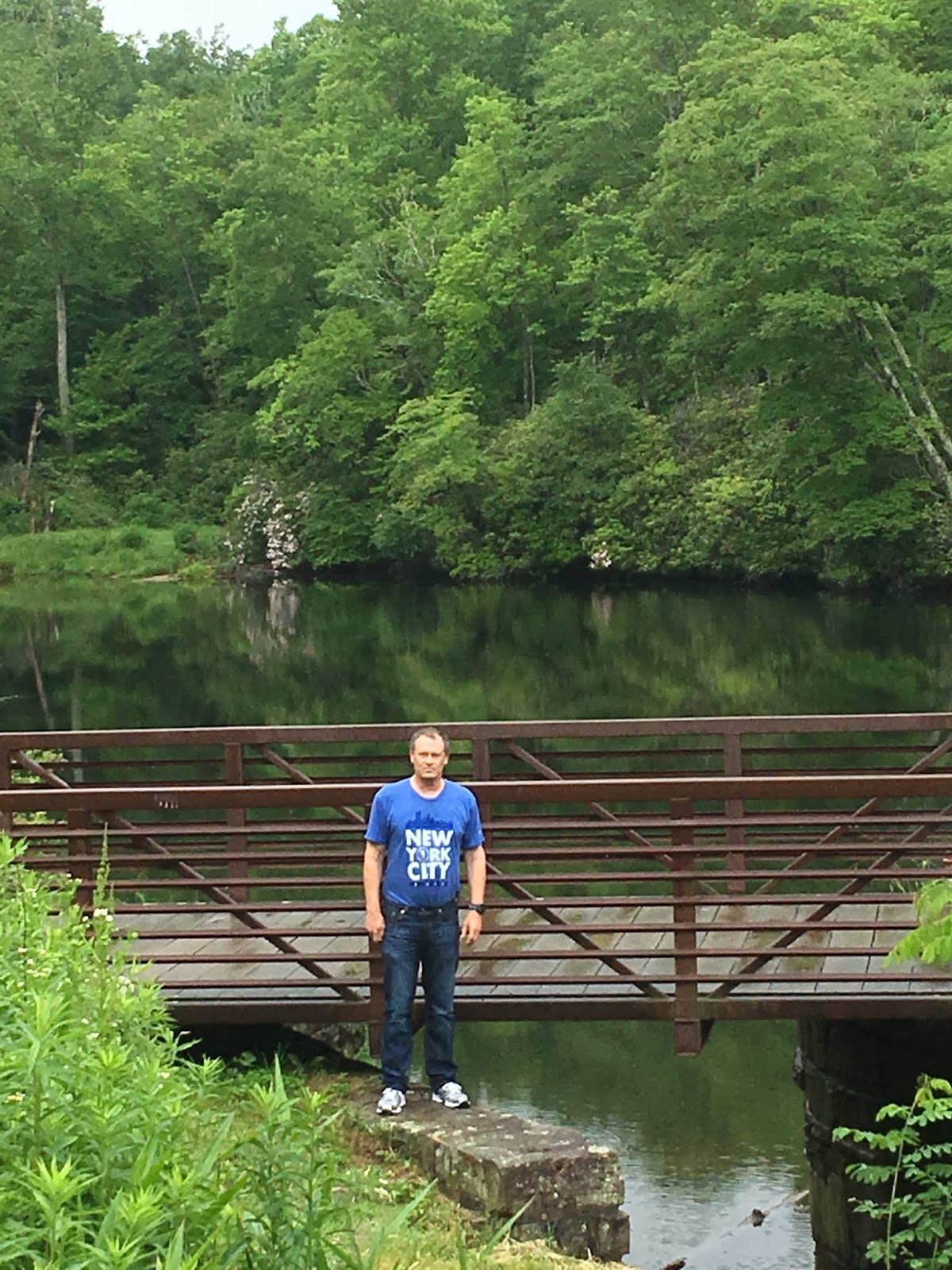
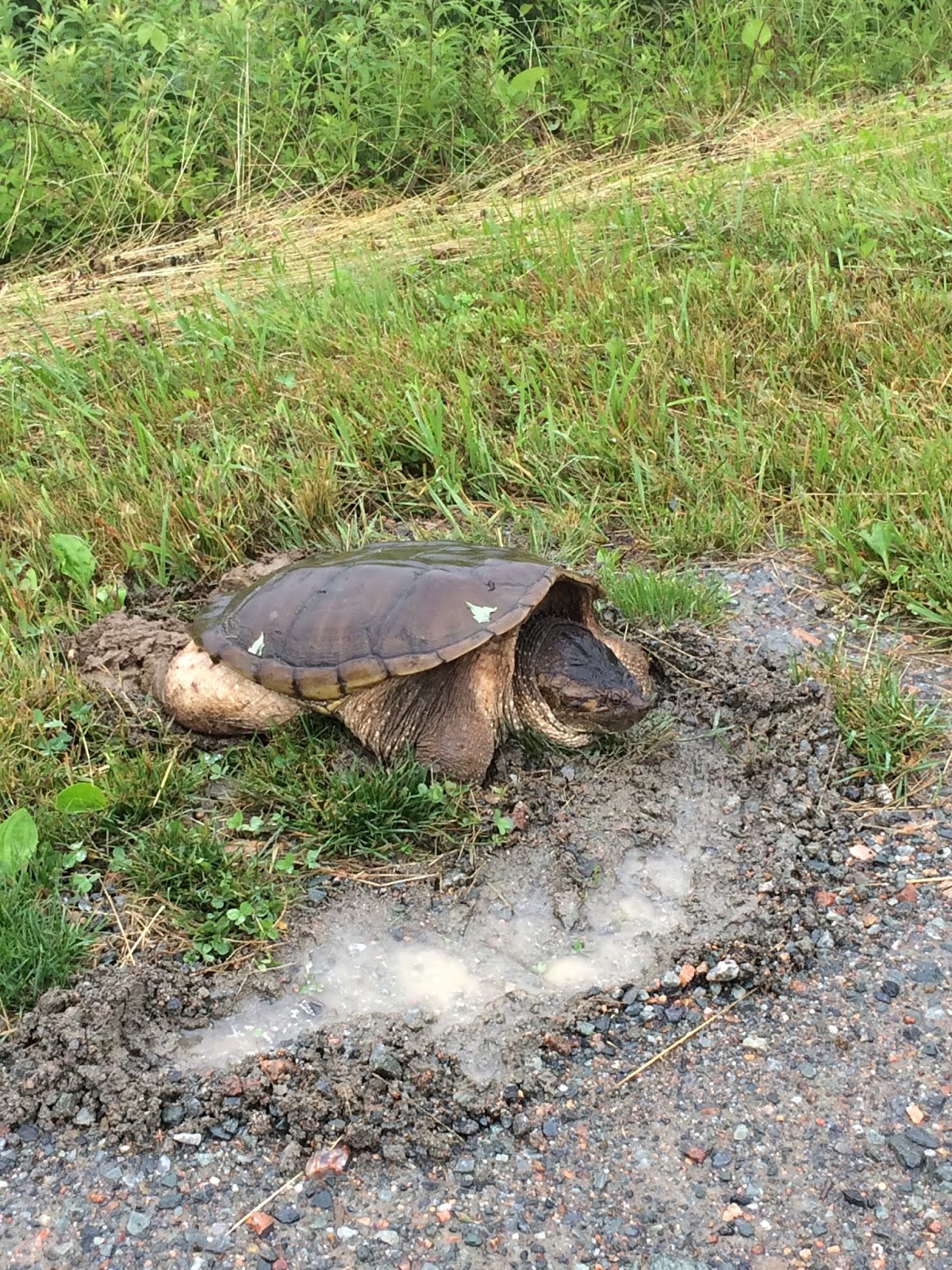
In lieu of these popular activities, we entered the famed Blue Ridge Parkway just north of Blowing Rock, stopping at such places as the Moses Cone Manor, Sims Pond, Price Lake, a few scenic overlooks, and even a roadside snapping turtle alongside the parkway.  I tried to move it to a safer position, but it was bound and determined to snap off a finger or two.  I let it be.

Sim's Pond

Sim's Pond

Foggy dreary view of Price Lake along Parkway

Snapping turtle

Moses Cone Manor
We left our hotel in Boone around 0530 for the twenty-mile drive to Fleetwood.  Under a flash flood warning for Ashe County, the unrelenting rain throughout Friday night served as a signal to prepare for a wet, soggy and mushy marathon run, but I hoped for the best.  It was relatively warm and humid which had me a little concerned.  The rain had stopped for the time being and low-lying clouds and fog shrouded the nearby hills.  At times, a light drizzle splattered the car’s windshield as we drove through the lush green countryside towards the quaint village of Fleetwood.

Inside the woodshed
We arrived at the “woodshed” just off Big Flatts Church Road as runners began to infiltrate the area.  The community’s wonderful volunteer first responders directed vehicles to specific parking areas in a large grassy field soaked with the continual rainfall.  The main concern crossing my mind was the high probability of driving through mud and muck as multiple vehicular loads soften the soil and bring water to the surface.  Without a four-wheel drive, the last thing we needed was to get stuck as we left for the airport.

My wife expressed concerns to me about the mud and our tight schedule with our departing flight out of CLT.  Overhearing this, a passing race official kindly allowed us to park near the exit gate, thus suppressing any kind of anxiety or worry about getting stuck or catching our flight.

Race organizers allow for bib and shirt pick-up race morning.  In the weeks preceding the marathon, my wife emailed the race director on my behalf requesting Bib No. 50 to correspond to my fiftieth state.  He was honored we chose New River as our final state but couldn’t guarantee the request.  As I received my bib, I happily found it to be #50.

Parking area looking towards the woodshed

North Carolina state flag

Old Glory
Let’s Do This

With a Tennessee marathon already tucked away in my back pocket, it was time to run another marathon, this time in the morning rain on a rural solitary country road alongside the meandering New River.  No multiple out-and-backs, but rather a combination of a looped out-and-back course, in some sorts.

Before the start

I let the world know this race is No. 50
As with Mockingbird, I approached New River with a positive frame of mind as the day commenced with warm humid conditions with a light fog characteristic of a steamy tropical environment.  I knew it was only a matter of time before the temporary reprieve from any quantifiable precipitation amounts would soon end.

The first half: (9:46, 9:27, 9:49, 10:35, 10:03, 10:41, 12:42, 11:51, 10:46, 11:15, 11:26, 13:59, 10:44)
Runners lined up on a muddy gravel driveway adjacent to the woodshed.  At 0730, the starting horn sounded, as 120 or so runners charged up a rather sizable incline to Big Flatts Church Road to a 1.5-mile descent to Railroad Grade Road.

As anticipated, about three miles into the course, a light rain began to fall.  Based on my limited knowledge of the high country, I found that a light rain serves as a precursor to a much heavier event.  Lo and behold, the light rain suddenly converted to a much heavier intensity, representative of a tropical rain forest.  Mother Nature seemed angry, but she wasn’t going to deter me from enjoying cool refreshing showers.  It was a day to get wet, so I just had to suck it up.  It wasn’t particularly cold, so hypothermia was the farthest thing from my mind.  As long as I kept moving, I would be fine.

The next several miles consisted of a rolling paved section of a narrow roadway without any kind of roadway striping.  I marveled at the surrounding scenery dominated by the swollen turbid waters of the tempestuous New River, the Christmas tree farms with multiple rows of Fraser fir conforming to the hilly topography and a mixture of scattered broad-leaf trees hanging over the roadway.  I saw tractors left silent near giant rolls of hay lying motionless in the fields, sitting there soaking up every drop rain.  I thought, “Won’t the rain spoil the hay?”

Along the course
At around Marathon Mile 6.5, runners veered off the main road to a private ¾-inch crushed rock roadway (Seats Road) and the first significant gradient of the day.  The five-percent half-mile incline tested my endurance.  I began walking once the road turned steep; however, I mixed in some running in areas with gentler slopes while evading rivulets of water rushing down the wheel paths as the flowing water seeked out its path of least resistance.

My shoes and socks became soaked and sloshy.  I was as wet as one could get and sincerely hoped that I would not end up with any kind of nasty blister at the end of the day.

According to the laws of physics, whatever goes up must come down.  At the summit of Seats Road, a course monitor pointed me in a direction leading to a steep descent down Panorama Drive.  I judiciously barreled down the rocky surface as I meandered my way around the provisional streams while being careful not to careen off the side of the road or slip on the muddy surface.


After the mountainous descent, the course once again turned to a paved surface, Todd Railroad Grade Road.  The next three miles of rolling terrain led runners to the community of Todd for a quick out-and-back segment before returning to Big Hill Road.  And, as the name implies, a big hill awaited, testing anyone who dared to conquer it.  

Sheet flows of water streamed over the paved roadway.  My depleting energy levels forced me to walk the steeper sections of road.  I read the curve tangents and crisscrossed the curvy road seeking out the shortest possible route while being mindful of traffic.  The rain continued and didn’t let up as I reached the summit before heading back down towards the river below and to the half marathon split, crossing in a time of 2:23, more or less.

The second half: (12:36, 14:39, 11:06, 11:26, 12:33, 11:57, 13:36, 12:27, 14:52, 13:02, 13:53, 13:50, 15:44, 6:33 projected pace [final 0.08 mi])

Soon after the half-way point of the marathon, the rain stopped as quickly as it began.  I knew it was temporary, but a nice change, nevertheless.  With the absence of rain, the air temperature and humidity levels noticeably increased.  I thought to myself, “It’s getting hot, it feels better when it rains.”

At Marathon Mile 14.5, runners make a left turn onto Castle Ford Road to the “notorious” hill everyone talks about – a one-mile long seven percent grade.  Did I have the strength to run up that monstrosity?  Was I going to run it?  The answer was an emphatic “NO,” but I did find some idiots wasting their energy attempting to run as I walked at their speed.  Save your energy people – walk.

Shortly after I began my ascension, the rain unleashed its fury once again and couldn’t come at a better time as I began to overheat.  Sheet flows of water carrying dirt and debris washed over the pavement and roadway swales overflowed with enough velocity to erode driveway approaches.

The top of the hill emerged soon after a steep switchback.  I charged down the steep gradient as my thighs and ankles began to burn under the constant braking.  My downhill form was anything but ideal and I knew I would suffer the consequences of downhill running as I did at Mt. Charleston.  The road flattened out at Marathon Mile 16 as I crossed a bridge spanning the New River intersecting Todd Railroad Grade Road once again.

Runners retraced their steps for the next seven miles passing through the fertile farmlands of the New River floodplain.  A course monitor standing in the rain at the intersection of Big Flatts Church Road at Marathon Mile 23 directed runners to proceed straight.  Flippantly, I voiced to the nice lady, “But the finish line is up that road.”

She chuckled and said, “Sorry, but you have three miles to go.  The last hill is that way,” as she pointed.

The hill?  Yes, another hill.  The final hill.  Besides, how hard could it be?

I moseyed by the Fleetwood post office and a small baptist church with the classic steeple standing proud, a symbol of understated Christianity, perfect for small community services, weddings or those searching for quiet contemplation.

Mack Woodie Drive muddy mess
The course continued up Railroad Grade Road to the parking lot of Mission Home Baptist Church.  From that point, the course turned ugly onto Mack Woodie Drive, a private gravel road with a moderate incline.  As the hundreds of runners before me traversed that one-lane drive, the continual foot traffic created a muddy mess.  I crisscrossed from one side to the other, then to the middle then back again in an attempt to avoid the mud, muck and numerous puddles.  The course quickly turned from a road race to a one-mile cross-country trail run.  It reminded me of the muddy section of the Hatfield-McCoy course, but only worse.

Mack Woodie Drive merged with Call Creek Road shortly after Marathon Mile 25 leading up to one final push up the seven to nine percent grade for the next half mile.  As with those around me, walking was the norm, but I kept pushing my pace hoping for a 5:10 finish.  The rain had reduced itself to just a light sprinkle, but for how long, I did not know.

As I crested the hill at the intersection with Big Flatts Church Road, two girls sat quietly in their folding chairs informing me (and probably everyone else) “it’s all downhill from here.”  As I gazed down the road, I knew they weren’t completely truthful.  A small hill stood between me and the finish line.  From what I learned over the years, you cannot believe people when they say those words.

I glanced at my Garmin, made a quick calculation and I realized a 5:10 finish morphed into a 5:15 finish.  I pushed up the final hill to the final left turn down that gravel driveway from whence we began.  I focused my attention to the finish line gantry and charged down the hill passing a runner who I had played leap frog with for the past ten miles.  It was “operation let-no-one-pass” as I sprinted down the muddy gravel driveway kicking up mud behind me, clocking in with a time of 5:15:18.
Pouring it on to the finish!


With a big smile on my face, I gave a triumphant fist pump.  Realizing my 50-state quest was over, it was a poignant moment.  In a way, I was happy, yet sad at the same time.  I was immediately greeted by a young volunteer who congratulated me on my fiftieth state as she draped a unique handcrafted wood medallion around my neck fashioned from old original wood paneling from a 1920s era farmhouse.

I quickly loaded up a plate with some delicious strawberries, scones, cookies and a banana from the food spread.  Since time was of the essence, I had to consume my snacks in the car as we drove to CLT.  After a brief stop at a Chick-fil-A in Wilkesboro to wash up and slip into some dry clothes, we arrived at CLT with only seconds to spare.  Following a long agonizing run through the airport to our assigned gate, we found passengers already boarding – but, in the long run, we made it safely to our humble place of abode, tired and glad to be home.

Overall, I was honored to have participated in the New River Marathon, thus completing my fifty-state journey.  It certainly wouldn’t be possible without the great organization and super wonderful volunteers who donated their time, endured the constant rain, some with mud all over their clothes and made this event one of my crowning achievements.  I consider this one marathon an excursion into marathoning excellence and the fulfillment of a lofty goal I set for myself.

RACE STATS:

Distance: Marathon (26.2 mi) – my Garmin clocked it at 26.08 mi
Date: 8 June 2019
Bib No.: 50
Weather at start: 63°F, cloudy, drizzle at the start turning to rain
Gun time: 5:15:29
Chip time: 5:15:18
Average cadence: 152 steps per minute
Average pace: 12:02 per mile
Overall rank: 104 of 116
Gender rank: 75 of 82
Division rank: 9 of 11
Elevation: 1056 ft gain / 1056 ft loss
Half split: 2:24 (10:59 pace)
Average finish time: 4:25:53
Standard deviation: 0:43:40
Age graded score: 45.46%
Age graded time: 4:34:25
Garmin splits: (9:46, 9:27, 9:49, 10:35, 10:03, 10:41, 12:42, 11:51, 10:46, 11:15, 11:26, 13:59, 10:44, 12:36, 14:39, 11:06, 11:26, 12:33, 11:57, 13:36, 12:27, 14:52, 13:02, 13:53, 13:50, 15:44, 6:33 projected pace [final 0.08 mi])

LIKES / WHAT WORKED:
  • Small and challenging course in the Blue Ridge Mountains. 
  • Asking for and receiving Bib No. 50.
  • State No. 50.
  • The rain showers.
  • Very well-organized event from bib pick-up to the multiple aid stations along the course.
  • Super friendly volunteer support.
  • A HUGE thank you to the great volunteers enduring rain-soaked conditions!
  • Easy parking race morning.
  • FINISHING!!
DISLIKES / WHAT DIDN’T WORK:
  • The rain showers.
  • The wet muddy parking and finish line areas.
  • The hills and muddy conditions.  
  • Roadway flooding.
 
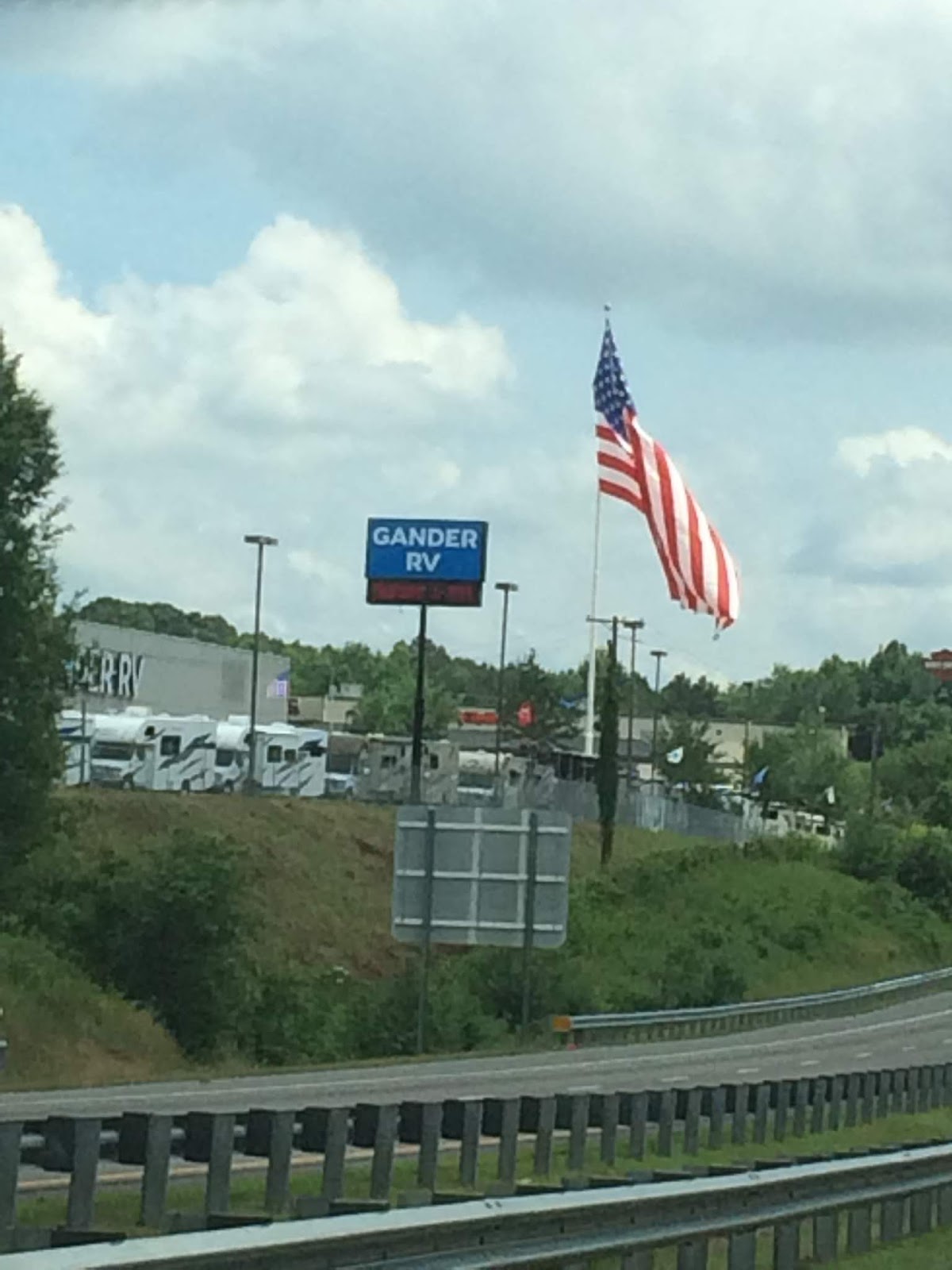
Flag in Statesville causing a constitutional concern

Final thoughts

With an appreciative nod to an old favorite, James Taylor, running down a country road is a favorite way to escape the mental overload and visual onslaught of living in a city.  By living in the San Joaquin Valley of California, it can be difficult to find a refreshing place of solitude.

With houses set back off the road and few intersections to cross, a run on a country road is as relaxing and soothing as a run can be.  Sure, running on a beach is a grand and glorious option but even then, one must consider keeping dry while finding some hard-packed sand.  A rustic setting is a respite, an almost uncluttered feel.

The New River Marathon is located in a secluded rural area tucked away in the Blue Ridge Mountains.  This marathon gave me the opportunity to enjoy a morning run on humble two-lane and one-lane roads.  Some lanes paved with asphalt, some comprised of a muddy gravelly surface.  The region’s homes appeared surrounded by open Christmas tree farms, hay farms and small fields, lined with oaks, ash, elms and various evergreens.

Cars were few and far between on this early Saturday morning. Was it because of race day or was it a typical indolent Saturday morning?  Some houses I passed still looked sleepy and quiet, with only a few dogs out for their morning constitutionals.  It was late enough in the morning that the nocturnal animals had turned in for the day, but wet enough for the mosquitoes not to have an appetite for me.

As I ran parallel to the turbulent New River, flowing full to its banks, I raced small sticks and branches floating in the water, but seemed to never pull ahead as the mighty river conveyed its water faster than I could ever run.

Unlike home, the mountain breezes move more gently down through the hollows so clean and clear.  No stagnant air and unhealthy smells assaulted me, nor the aromas of nearby dairies and feed mills.  Instead, I smelled the essence of tropical-like rain and fresh mountain air with an occasional fragrance of breakfast emanating from nearby kitchens.

Mostly, I welcome a turnaround point to bring a breeze to my face.  Although not a singular turnaround point, the twelve-mile loop around a mountain seemed not to matter much.  So slight was the air movement on this particular day, when the rain stopped momentarily, I do wish a slight breeze blew to cool my face; however, as the heavy rain showers stepped up their presence once again, they helped bring refreshment from the warm humid air.

As the long loop closed back to the original marathon route, the view was slightly different of course, seeing the other side of the trees, being on the other side of the road and the river on my right side.  It is amazing how subtle changes of view can keep the return trip of an “out-and-back” run from becoming a tedious exercise.  The change in light and shadows, the opportunity to run down the slope I just trudged up are all rewards of the return.

I am sure my memories of morning marathons in the country are colored by notions that parts of our country are still as untouched and as innocent as they were when I was a kid growing up in Northwestern California. I like to think everything is as it was when I moved away many years ago. 

When I run the busy streets near my home, I’ll remember the songs of birds, the steady rains dripping out of the rustling leaves of trees and the sound of the New River as it meandered alongside me, eventually joining up with the Kanawha and Gauley Rivers in West Virginia.  I’ll hold on these memories during my next run on a quiet country road.

Now, my fifty-state quest has come to an emotional conclusion.  To me, marathoning is a privilege and a valid reason to feel gratitude.  No matter how miserable I may feel at any particular point during or after a race, I can always fall back on the fact that being able to run a marathon is something for which I’m incredibly grateful. 

Over the years, I’ve come to realize that running is a love-hate relationship.  I do love to run and during any particular week, I may put in anywhere between 20 and 50 miles – sometimes less.  But if I told this to anyone who knew me in high school or even as I started college, I think they’d be shocked that I was able to grind out over seventy marathons and countless half marathons.  I was the student who abhorred physical education in junior and senior high school.  So, how did I go from avoiding exercise at all costs to running a marathon?  It all comes down to why I chose running.

I run for my 10-year-old self, who never got over the embarrassment of being unable to complete a one-mile run at my grammar school Olympics without having to walk part of the way.

I run for my 14-year-old self, who hated those kids who seemed like they exerted minimal effort to run two laps around my junior high school parking lot – when he could only muster a half-hearted attempt to sum up the rear. 

I run for my 21-year-old self, whose only true exercise was trouncing up the notorious hills on his college campus.

I run for my 25-year-old self, who struggled to run one mile, gave up and took up cycling as a replacement.

I run for my 33-year-old self, who experienced the joy of racing with hundreds of other runners during his first 10K.

I run for my 36-year-old self, who completed his first full marathon and removed all remaining discomfiture over being a sweaty, red-faced, barely-limping-along mess in public.

Finally, I run for my own self, who craves the amazing peace of mind that comes from running and completing a full marathon.  I know that when I need a complete mental break or a simple way to jumpstart my brain with a shot of endorphins, all I have to do is to lace up a pair of running shoes and head out the door.

Lastly, what did I learn from my journey?

You must have dreams and goals to arrive at your final destination.  One of my lifelong ambitions was to visit all fifty of the United States, and running a marathon in each state gave me the opportunity to do such a thing.  So, I made it a goal to run fifty marathons in fifty states by 2020.  Besides my home state of California, I began my quest in August 2012 with Nevada’s ET Midnight Marathon.

At that time, I thought, “Two states done – forty eight to go.  Will I ever accomplish such a lofty goal, or am I just spinning my wheels?”  It took amazing discipline, dedication and a lot of planning to conquer all fifty states in six years.  In the words of Steve Prefontaine, “You have to wonder at times what you’re doing out there.  Over the years, I’ve given myself a thousand reasons to keep running, but it always comes back to where it started.  It comes down to self-satisfaction and a sense of achievement.”

My destination.  After you run a fair number of states, folks often ask, “Where are you going to finish?” or “What will be your fiftieth state?”  They may offer suggestions – Boston, Hawaii, Alaska, or Florida.  I thought for a long time and considered many options for my fiftieth state.  Developing an algorithm to design the most efficient use of time and travel is a difficult undertaking.  But in the end, the only possible finishing destination was to a point located in the beautiful Blue Ridge Mountains in the High Country of North Carolina (Lat 36° 18’ 50” N; Long 81° 31’ 54” W).

It’s all about the journey.  The best part of the journey is meeting so many wonderful folks.  I met some super wonderful volunteers who gave their time and effort to make a marathon possible and to assist me in achieving my goal.  I met runners who shared a few moments, a few miles, a few smiles, and pieces of their lives with me as I struggled during the final ten kilometers.  I met many folks running their first marathon and realizing a bucket list item.  I have at times cautioned those runners that the sport can be addictive and to always be on the lookout for another marathon to add to their list.  I’ve met lots of fellow 50-Staters who greeted me as an old pal, provided me with encouragement and congratulated me on my progress.  To all of these folks, I thank you for your support.

When you have fun, it’s a pleasure.  Another benefit of running the fifty states is seeing one of the most beautiful countries on Earth.  I’ve run marathons in the middle of a desert; in the coal country of the Appalachians; around Narragansett Bay in Newport, Rhode Island; Niagara Falls; and sampled king cake in Louisiana’s Cajun country.  I’ve visited some monuments that may mean nothing to the ordinary person (except maybe engineers, geographers, map makers, or land surveyors); the Nebraska State Fair; the volcanoes of Hawaii; and the yellow brick road in the Land of Oz.  I’ve run alongside the natural beauty of the leaf change in New Hampshire; the desert landscape of Arizona; under the canopy of the Big Sky of Montana; dodging snowflakes in the Amish country of Lancaster County, Pennsylvania; avoiding bears and moose in the Land of the Midnight Sun; and the rugged Rocky Mountains of Colorado.  I ran through the gates of Oregon’s Hayward Field, remembering the many great athletes who have graced their track.  As I scan the faces, Steve Prefontaine’s face appears as he smiles and says, “Well done.”  My reaction is always the same – my heart starts pounding, with a surge of energy flushing through my body.  Each and every place creates memories not soon forgotten.

My Dream.  Another question people ask is, “What drives a person to train, travel and complete marathons in fifty states?”  My dream has carried me through training runs on very hot or very cold days, through runs when mornings come quickly, and through runs that seemed too long.  Some days I ask myself, “Why are you doing this?”  My answer is always the same – it’s an addiction.

Finally, in 2019, completing my dream began with me making the final turn onto a muddy gravel driveway and down the homestretch towards Marathon Mile 1,310 at this wonderful and scenic New River Marathon.  I stopped, received my finisher’s medallion and realized, my journey has come to an emotional conclusion.  However, my long-awaited dream has just come true – visiting all fifty states, but with a purpose. 

My favorite marathon?  I find that when I talk to others about running marathons in all fifty states, usually the first question is, “What was your favorite marathon?”  That’s usually a pretty tough question to answer as there are countless and innumerable things to consider. 

Each one of these marathons has its pros and cons, has breathtaking scenery, an organized race with friendly volunteers and spectators, a unique medal and good post-race fare.  Each marathon transmits its own distinctive flair.  

The important things to me are the memories of the race.  It might be running a race with a friend, renewing friendships with old runner friends, making a new friend you see again from a previous race, being proud of a runner meeting a certain time goal as I lead a pace group, or offering friendly advice to a first-timer.

Featured speakers at race expos can provide knowledge, answer questions, tell amazing tales of endurance, philanthropic, emotional and good-hearted experiences and their dedication to the sport, or simply telling funny stories of their running involvements.  After an exhausting evaluation of my fifty-state quest, I would have to say that my favorite marathon boils down to the Hatfield-McCoy Marathon with the Fargo, Flying Pig and New River Marathons being close runners-up.  The uniqueness, its detachment from major civilization, history, beautiful setting, challenging course, pre and post-race entertainment and the local support makes Hatfield-McCoy my hidden gem.  But…New River is also a hidden gem and cannot be overlooked.

As always, it’s forever onward and upward – even after the door to my fifty-state journey is now closed.