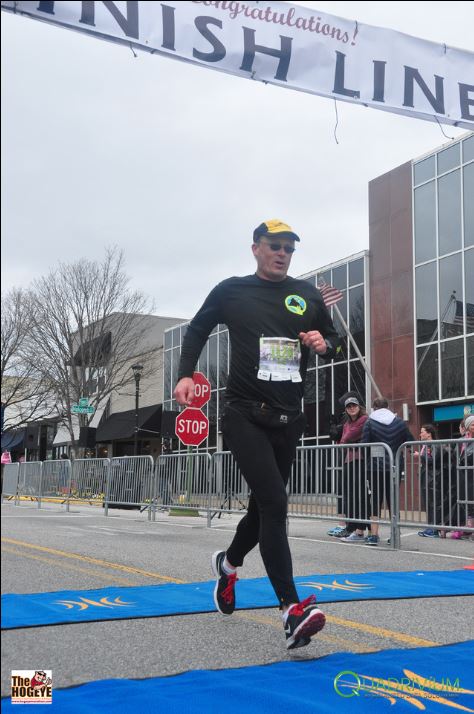
State Number 3
v2.0 – Colorado Marathon
Fort Collins,
CO
5 May 2018

As anyone knows from reading my race reviews, visiting
all fifty states of the United States has been on my life-long bucket
list. I figured that if I set a goal of
running a marathon in all fifty states, it would force me to travel while doing
something productive and healthy.
Back in August 2012, I checked off my third state with
the annual running of the Mt. Sneffels Marathon in Ridgway, CO tucked away in a
beautiful piece of southwestern Colorado, dubbed the “Switzerland of America.”
As scenic as the region is, the 8000-foot plus altitude,
coupled with inadequate preparation and training, outweighed any picturesque
pleasure I enjoyed and made running that marathon a difficult endeavor. My five-plus hour finish time unquestionably
reflected the discomfort, anguish and torment I suffered over the hilly out-and-back
13-mile course traversing the area’s monotonous and wearisome gravel county
roadways.
I completed Mt. Sneffels in a time of 5:27:36, considered a personal worst
at the time, thus putting the first unsightly and unappealing blemish on my
marathoning record. So, in an effort to
remove said stain, my wife and I decided it was time to redeem ourselves with a
Colorado do-over marathon. This time, a
faster point-to-point downhill course without the high altitude trepidations.
High altitude running can be a tough challenge, as any
runner can attest. I live and train at
an altitude of about 320 feet above mean sea level (MSL) so I’m not normally acclimatized
for high altitude running. According to
the marathon’s web site, the Colorado Marathon begins at Cache La Poudre Canyon
at an elevation of 6108 ft above MSL and concludes in Fort Collins at 4981 ft.
I’ve run some marathons comparable to the elevation of Fort
Collins area in states such as Utah, Idaho. Montana and Wyoming with elevations
ranging from four to five thousand feet without any major difficulties. Since Colorado consists of a mostly downhill
gradient, I shouldn’t consider this run to be much of a challenge.
I recently read a comical rhyme about high altitude
running. It goes like this, “Before you
hit the trail, best your urine be pale.”
In other words, hydration is the key since it’s very easy to become
dehydrated, and as a runner breathes out more, he/she loses more water through
respiration; and, with the dry mountain air, perspiration rates quickly
increase. So, in the days leading up to
Colorado, I made it a point to drink more water than I usually consume.
This little weekend “runcation” originated from our routine
stressful, chaotic and hectic LAX departure point with a short non-stop flight
to Denver (DEN). LAX parking is now
becoming the foremost problem now that our convenient Lot C is currently undergoing
a substantial facelift and modernization project. Following a ninety minute drive to Fort
Collins, we arrived at the expo hosted by the Hilton Fort Collins to pick up
our race swag.

The expo, held in one of the hotel’s conference rooms,
featured the usual players along with some local vendors hawking their products
and merchandise, as well as free sample packs of dietary hemp seeds. I’m skeptical whether I should try them as
they may contain THC. As usual, it was
in and out with a smooth packet pick-up without any malfunctions or
hiccups.
As with every marathon trip, I monitor my weather apps
throughout the week leading up to the race to prepare myself for what I can
anticipate on race day. There’s nothing
more frustrating than making plans around a weather forecast and then having
that forecast change – a cold, rainy, windy day or a hot, humid, miserable day
can make one feel like there’s no point in even paying attention to the
weather. With the possibility of several
parcels of air over the plains and along the Front Range, and the fact it’s
springtime, it’s quite possible for weather conditions in Fort Collins to
change in an instant. Just four days
before the marathon, the Fort Collins area faced winter storm warnings with 1-2
feet of snowfall in the nearby mountains.
Go figure.
 |
| No bears this time |
We arrived in Fort Collins to a mostly cloudy day with warm
mild temperatures. Late afternoon
thunderstorms loomed over the Front Range threatening to rain down on Fort
Collins. My weather apps provided an
optimistic forecast for marathon day making for near ideal for running – cool
temperatures at the start with mostly cloudy milder weather by the time I would
move out of the canyon with the possibility of rain showers later in the day. If the sun was out, I dreaded the possibility
of crashing at the end once the comfort of the canyon wall shade disappeared while
in the flat lands leading into Fort Collins.
We were only in Fort Collins for a brief period of time,
so finding something to do didn’t top our list besides relaxing our muscles in
the hot tub. Home to Colorado State, the
city’s culture appears to cater toward the young college-age population, likely
influencing the town atmosphere. We
found evidence of the college flair at our chosen pre-marathon meal
establishment, Stuft a Burger Bar, indulging in a tasty and succulent tequila
sunrise burger. It’s not your ordinary
burger, but a knife and a fork type burger!

 |
| The Tequila Sunrise |
Sleeping is next to impossible on the eve of a
marathon. I don’t know why it’s
tough. I’m not a competitive
runner. I’m not in it to win it, so why
should I be so nervous? But if I feel I
got enough rest during the week leading up to the run, any insomnia the night
before shouldn’t affect my performance. Usually,
the pre-race adrenaline rush typically helps me feel alert and ready to go.
As usual, I slept off and on before getting up at 0350. We laid out our attire and gear the night
before allowing us to quickly get ready and leave the hotel around 0410, have a
quick breakfast bite, drive into downtown Fort Collins, secure a parking spot
and line up for the mandatory bus transportation.
 |
| Morning twilight along the Poudre |
Buses loaded between the hours of 0415 and 0500 in front
of the downtown parking garage on Mountain Avenue. The forty-five minute bus ride from Fort
Collins seemed to take forever winding up the dark Poudre Canyon to the
starting line staging area at Stevens Gulch Campground around 0530. A large number of runners were already on hand
before our arrival and were either lined up for the porta-pots, sipping on
coffee or hot chocolate, or simply stretching, relaxing or meditating by the soothing
sounds of the Poudre River.
The twisty highway leading up the canyon reminded me of similar
bus ride up northern Utah’s Blacksmith Fork Canyon to the staging area for the
Top of Utah Marathon (State No. 4), only this time, I didn’t slip on a
gravelly-sloped embankment, falling on my hind quarters. That’s another story.
 |
| Heading off to the start line |
Typically, most point-to-point races that require transporting
participants to the starting lines use school buses built to accommodate young
skulls full of mush. However, race
organizers contracted with a luxury bus company, built to accommodate grown-ups
and those who are not vertically challenged.
Yes, it’s nice and much more comfortable than a school bus, but at the
same time, I got this feeling the use of luxury buses is one of the reasons the
cost of this race is so high – but, for me, it’s well worth the added cash
outlay.
I was quite surprised upon our arrival to the start line.
The temperatures were unexpectedly mild
and not as cold as I had anticipated. I
may have overdressed for the occasion, but I had to live with my decision. The refreshing Rocky Mountain air was a
delight to breathe and gave me a “Rocky Mountain High” type feeling. The sounds of the snow-fed Cache La Poudre
River spilling over the rocks and boulders provided a tranquil and peaceful
background noise amid the mix of talk and laughter from the enthusiastic
runners ready to get the show on the road.
The lines to the porta-pots were insanely long, and those
who don’t find time to purge their bilge water in the portable facilities,
typically find time along to course to empty their tank. Usually within the first few miles, it seems
to be a pee-fest within the herbaceous borders of the roadway.
Thin wispy cirrus clouds painted the early morning sky as
the sun rose over the surrounding mountains around 0600 illuminating the canyon
expanse revealing all its splendor. The
wild and scenic Poudre River canyon is a hidden treasure, with its majestic
cliffs, intriguing and fascinating rock formations and the montane forest of ponderosa
and lodgepole pines, subalpine fir, sage brush, mahogany and aspen trees. The distinctive “V-shaped” canyon walls,
indicative of unglaciated actions, preserved the large meanders of the river
deeply entrenched into the hard Precambrian rocks.

I powered up my Garmin GPS receiver about thirty minutes
before the start, so it would have time to standardize its 3-D trilateration
calculations needed to fix its position on the Earth’s global surface. I stashed my windbreaker into my gear bag and
placed it into a UPS truck later to be transported to the finish line and began
my walk to the start line. As 0630
neared, hundreds of runners made their way onto State Highway 14. From the first timer to the veteran racer
eager to capture the overall title, everyone appeared ready to start pounding
the pavement.
Following the National Anthem, it was go time, but I couldn’t decide whether to run with the 4:15 pace group or challenge myself by charging out on my own to see what I can do.
The first half: (9:06, 8:58, 9:05, 9:09, 9:02, 10:07, 9:35, 10:01, 9:32, 9:49, 10:52, 11:20, 10:39)


As I entered the North Shields Ponds Natural Area near
Marathon Mile 24, the lone 4:45 pacer overtook my progress further sullying my
morale. I dubbed this section the
“deadhead zone” symbolizing those around me walking or attempting to “jog” at
some slothful shuffle for short periods of time. The anguish and torment on their faces said
it well, “I’m ready for this to be done!”
I needed something to divert my attention from the anguish I
experienced. By smiling or thinking of
something funny gave me some unknown boost of energy. I even had visualizations of a dog chasing me,
hoping my adrenal glands would kick in some extra adrenaline. It was time to buckle down and to keep ahead
of the 5:00 pacer.

Bib No.: 45
Weather at start: 50°F, few cirrus clouds, light winds
Gun time: 4:58:50
Chip time: 4:58:28
Average cadence: 155 steps per minute
Average pace: 11:23 per mile
Overall rank: 597 of 760
Gender rank: 344 of 412
Division rank: 22 of 33
Elevation: 161 ft gain / 1033 ft loss
Half split: 2:08:43 (9:49 pace)
Average finish time: 4:20:57
Standard deviation: 0:46:23
Age graded score: 49.09%
Age graded time: 4:18:11
Garmin splits: 9:06, 8:58, 9:05, 9:09, 9:02, 10:07, 9:35, 10:01, 9:32, 9:49, 10:52, 11:20, 10:39, 10:50, 10:40, 11:57, 11:29, 11:04, 14:07, 12:56, 13:00, 14:47, 14:34, 13:19, 16:04, 13:26, 9:58 [final 0.31-mi]
Most distance runners know, the marathon begins with the
final ten kilometers. Finishing those
last 10 km is when it’s about what you have left in your core. When you use all your strength and fitness
over the first twenty miles, it really comes down to what you have left
inside. How much do you want it? You have to draw deep into your pockets and
pull out some magic. I really have to
say, “I did.” That’s probably the most
remarkable thing about a marathon.
Unfortunately, I was rather dissatisfied with the finish
line festival at Washington Park. They
had nothing to offer but orange wedges, apple slices (which were delicious, by
the way), plain bagels, bananas and Quaker chewy granola bars. Where was the pizza we were promised? Oh, for the pizza and after party, runners
had to walk five blocks to Coopersmith’s Pub & Brewery. Walking five blocks after a marathon was
certainly not in my repertoire of must do’s.
Why not have a pizza spread at the park?

Following the National Anthem, it was go time, but I couldn’t decide whether to run with the 4:15 pace group or challenge myself by charging out on my own to see what I can do.
The first half: (9:06, 8:58, 9:05, 9:09, 9:02, 10:07, 9:35, 10:01, 9:32, 9:49, 10:52, 11:20, 10:39)
 |
| On your marks |
It’s a matter of physics and inertia – Newton’s First
Law. What do I like about running
downhill races? With inertia, it feels
nice, easy, smooth and much more enjoyable than flat land running. Once in motion, I like to stay in
motion. However, with marathons, the
more one starts to walk (usually near the end), unbalanced forces from within
tend to make it tougher to continue running once again, killing any kind of
impetus I had.
The sound of an air horn beckoned the beginning of my
journey down Highway 14. At first, I
eased into an easy warm-up pace needed to relax any tight muscles before
transitioning into a faster pace and I quickly decided to take the risk and not
run with a pacer, but instead, do my own race.
Will the risk be worth the reward?
The backdrop of the canyon was absolutely spectacular and
at times depending on which way one faced, the bright sun peaking from behind
the mountains blinded the eyes of runners, making it difficult to see the road
ahead.
Based on my first impression, this marathon may arguably be
one of the most scenic road marathons I have in my running portfolio. My plan, simple, on this mostly downhill
course – either join up with a pacer, or charge out and do my own race; however,
based on experience, this is always easier said than done!
 |
| The sun in our eyes |
A side-effect and direct consequence of marathon-related
selective memory is that you forget how painful and arduous some undertakings are
and decide to try it again – e.g., banking time, downhill running!
As I began to run, the course gradient appeared nowhere
near the severity of the former quad-busting Revel Canyon City Marathon in Azusa,
California I ran in 2014, so I wasn’t overly concerned about shin splints or major
leg pain I experienced after running that grueling event, but it was certainly
in the back of my mind.
Marathon rules require that runners must keep left of the
traffic cones marking the course. At
first, traffic safety traffic cones were set along the highway’s centerline
stripe to account for the large squad of runners, and once the platoon thinned
out, the cones transitioned closer to the road’s shoulder to account for
two-way traffic.
My breathing seemed somewhat labored at first, but seemed
to taper off once I settled into a rhythm. I felt quite content with the current pace,
all the while resisting the urge to charge ahead too fast. From my experiences, I found that banking
time for the later miles doesn’t particularly bode well for me – but I’ll risk
another try. If I maintain a consistent
pace, I find my finish times improving (e.g., Louisiana, Indiana and
Arkansas). As long as I kept myself
hydrated and fueled on a regular basis, I anticipate this marathon to go
smoothly as well.
 |
| The famous tunnel |
The miles seemed to tick by as I took in the beauty of my
scenic surroundings. At approximately
Marathon Mile 2.5, I approached the often talked about narrow unlined hard rock
tunnel bored through a portion of a steep rock wall dropping off into the
river’s gorge, perhaps 100 feet in length with a 14.5-ft vertical clearance. A construction flagman stood guard at each
tunnel portal controlling approaching traffic ensuring the safety of runners. According to bridgehunter.com, the rock
tunnel was chiseled into the rocky hillside in 1929.
Outside the tunnel’s exit portal, race officials tapered
their traffic cones roughly four to six feet from the right edgeline. A little constricted, I thought, and certainly
enough to create a running hazard.
Colorado State Troopers, monitoring the participants from
their motorcycles, were so intense about keeping runners to the left of the
cones. Time and time again, the troopers
speeding along with red and blue strobe lights flashing kept waving their arms
like we were herds of cattle, mandating that runners keep to the left,
exclaiming over their PA system, “Keep to the left of the cones! Keep to the left of the cones!” OMG.
We’re all adults and know when to move over for traffic. However, once they were out of sight, runners
quickly moved back to where they were originally. I thought their obsessive movements became an
annoyance.

 |
| The beauty of the canyon |
Eleanor Roosevelt once said, “You must do the thing you
think you cannot do”. I did charge
out ahead of the 4:15 pacer, dissing my day’s plan of attack hoping I can do
what I “think I cannot do.” Over the
next few miles, I held a stable pace, occasionally walking through an aid
station for some gulps of water and/or Nuun electrolyte fluids and to give my
legs a little respite. I felt as if a
sub-4:30 finish was very doable.
Between Marathon Miles 11 and 12, I sensed a group of
runners approaching me from behind. As
one runner nearly stumbled over a traffic cone (due to being placed too close
to the shoulder), giving herself a sudden fright, the 4:15 pacer I had hoped to
run with caught up to me. It didn’t cause
me any anxiety, but I joined into the group to see how far I could survive, but
the pace was a tad too fast for my liking.
I felt as if my proverbial wheels were loosening and it was only a matter
of time before they came off and I wasn’t even half way done. I began to think that if the 4:30 pacer
caught me, I could muster the energy to tag along, but I didn’t hold out any
hope.
I sensed my energy level beginning to wane the closer I approached
the half marathon split. I had a good
pre-race breakfast, consumed some energy gels, and hydrated with water and
Nuun, so why was I beginning to falter? Likely
cause, as one descends, the air warms.
In essence, I was getting hot, and when it gets hot, my performance quickly
slides downhill.
 |
| At Marathon Mile 12.5 |
I crossed the half split (also a marathon relay exchange
point) with a mix of emotions. Even
though I crossed in a time of 2:08:43, I considered that a run-of-the-mill time
split and wasn’t overly concerned, but I had my doubts. With hopes for a 4:30–4:40 finish time, I
pressed on.
The second
half: (10:50, 10:40,
11:57, 11:29, 11:04, 14:07 [a not-so-lovely hill], 12:56, 13:00, 14:47, 14:34,
13:19, 16:04 [a nasty hill], 13:26, 9:58 projected pace [final 0.31 mi])
I managed to keep a consistent pace for the next couple
of miles until a slight uphill grade took over the course near Marathon Mile
15. My quads and calves seemed to
tighten as I ran up the hill, burning off needed energy. After the hill’s apex, it was downhill once
again leading out of the canyon confines.
Around Marathon Mile 16, runners exited the canyon, and
along with that, a drastic change of scenery, marking the beginning of a brutal
and unexciting excursion towards Fort Collins passing by the locally well-known
landmark, Ted’s Place, at the junction of CO 14 and US 287. Seeing the landmark brought back some
wonderful childhood memories of Martin & Shirley’s Market on CA 36. I digress.
Following a short little hill, it was onto the busy US
287 four-lane expressway. I was now running
in the dreaded eleven minute range at this point, and with a seemingly
increased effort compared to my earlier running labors. I really didn't know what it was – maybe I
went out too fast, maybe the heat, maybe it was my nourishment, or maybe I just
didn't have a fast time in me today.
Nevertheless, I knew it was way too early in the game to pick up my
effort – I still had over ten miles to go!
So I told my inner bargainer voice to hold back in the 11:00 range for
the time being and see if I could pick it up later.
The beautiful, shaded canyon with the scenic river was
gone. Now, it was time to focus on
mental toughness. The Poudre River has
since shifted course to a southerly direction and the only scenery are the dull
green rolling farmlands of the Front Range foothills, but there’s nothing that
can be done about that. Obliviously, it
makes sense to end the marathon in Fort Collins, but getting through the
doldrums in the meantime was a challenge, and it made me feel better knowing
that each and every runner was blessed to run through this lackluster section
of the course.
The worst thing about it? Despite the snow a week ago, it was an abnormally
HOT day and the next few miles seemed to be kind of a blur. I was getting tired and my inner thigh was beginning
to bother me.
Shortly before Marathon Mile 19, runners veered off US
287 onto CR 54G towards a not-so-lovely incline into the community of Laporte. I grabbed myself some Honey Stinger gels and a
bag of shots as I was in dire need of some nutrition. I walked up the foreboding hill and began
running on the backside. I found that opening
the Honey Stinger shots bag was next to impossible with sweaty slippery
fingers. If only the manufacturer, or
someone else, would score the seal, opening the packet would be much easier.
 |
| I felt like the characters |
At this point, I began slipping into the 13-14 minute
pace range without any effort or thought.
Granted, part of my withering pace was likely due to the “H” word –
heat. Who knows? Maybe, subconsciously, I was just giving up
since I knew a 4:30 was looking more and more remote knowing that the lone
pacer had the audacity to pass me just after Marathon Mile 20. My next option, Plan B – finish in under five
hours.
From CR 54G at the Cache la Poudre Middle School, runners
made a sharp right turn onto the area’s popular Poudre Trail shy of Marathon Mile
21. The Poudre Trail path wraps around
the backside of the school, and once again, connects with the Poudre River to
the Butterfly Natural Woods at Marathon Mile 22 before opening up to wetland recharge
ponds and wildlife ecosystems with naturally contoured river banks designed to
promote connection to the Poudre River’s floodplain. Even though the “natural area” design
stimulated my engineering mind, I considered this portion of the marathon
course to be very boring and mentally draining.
Besides the shade being gone, evading people on bicycles sharing the
road, and dealing with Mr. Sol’s beat down, I was hot and tired and wanted this
journey to soon end, but this dreaded task had to be done, so I sucked it up
and thought how grateful I am to be running the course in an effort to divert
my mind from despair.
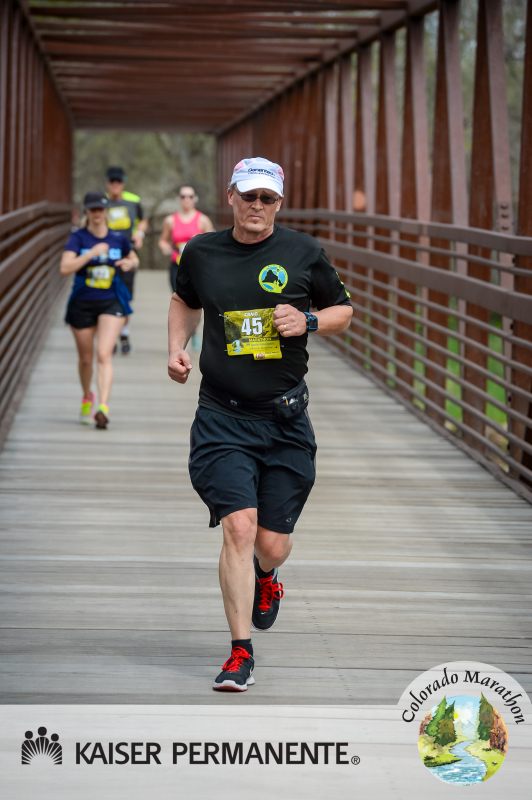 |
| Crossing the Poudre River |
Finally after four miles of unexciting
running, runners departed the Poudre Trail at Lee Martinez Park just after
Marathon Mile 25. Kids occupied
themselves on the playground equipment while adults and those more interested
in what was unfolding, lined the parking lot cheering on the seemingly endless parade
of runners. As I left the parking lot
onto Elm Street, a menacing hill leading into the city of Fort Collins slapped
me in the face. “Are you kidding?” I
thought. It was again time to walk and I
knew I was fraught with fatigue, so I just figured, “What the heck. I'm walking this.” I needed to conserve my precious energy for my
final push to finish. I tried to pick up
my pace, but I’m not sure if I really did – at least it didn’t feel like it.
At the top of the hill, it was south on
Sherwood to Maple to Meldrum when I saw the Marathon Mile 26 flag, I was ALMOST
there! The more-than-awesome spectators
kept encouraging me and saying things like, “You got this!” “Dig deep!”
“You’re awesome!” and “You’re looking good!” (Well, that’s a bit of a
stretch). I appreciated the nice words which
kept me going to the end.
I made a right turn onto Maple; thence
a quick right turn onto Howes Street leading to Washington Park. There it was, I could see the clock ahead slowly
ticking away with a solid crowd lining the barriers cheering runners to the
finish. I pushed it hard throughout the remaining real estate ahead of
me, heard my name over the PA system (yes, the man pronounced my home city
correctly!), crossed the finish line, quickly glanced at the clock and I did it
– under five hours (4:58:28). My Garmin
registered 26.31 miles, a fairly consistent differential compared with nearly
all the previous miles. Oh well, it’s
nearly impossible to run the shortest path possible.
Runners came out to run today, that is for sure.
Whether it’s those who strive to conquer a BQ, PR, break a sub-three hour
marathon or simply want to win it outright, runners meant business today. I’m no exception. I set out to run a good time and although I
did not succeeded at my stated goal, I did succeed with an alternative goal
instead.

RACE STATS:
Distance:
Marathon (26.2 mi) – my Garmin clocked it at 26.31 mi
Date: May 6,
2018Bib No.: 45
Weather at start: 50°F, few cirrus clouds, light winds
Gun time: 4:58:50
Chip time: 4:58:28
Average cadence: 155 steps per minute
Average pace: 11:23 per mile
Overall rank: 597 of 760
Gender rank: 344 of 412
Division rank: 22 of 33
Elevation: 161 ft gain / 1033 ft loss
Half split: 2:08:43 (9:49 pace)
Average finish time: 4:20:57
Standard deviation: 0:46:23
Age graded score: 49.09%
Age graded time: 4:18:11
Garmin splits: 9:06, 8:58, 9:05, 9:09, 9:02, 10:07, 9:35, 10:01, 9:32, 9:49, 10:52, 11:20, 10:39, 10:50, 10:40, 11:57, 11:29, 11:04, 14:07, 12:56, 13:00, 14:47, 14:34, 13:19, 16:04, 13:26, 9:58 [final 0.31-mi]
It's always a disappointment by giving it your all within
the first half only to find that you're not going to earn that goal time you sought. Especially when it hurts…because it did. My ankles and inner thighs were killing me by
Marathon Mile 22. I put most of the
blame on the downhill.
I remembered that feeling from Canyon City. I still tried to push through this though,
and to help motivate me, I kept reminding myself that we had to drive back to
Denver to catch a plane, so I needed to finish in under five hours. I did the best I could and pushing myself for
that long is an accomplishment, whether or not it felt that way at the time!
I recently read a quote from a former world-class
marathoner, Robert de Castella. “If you
feel bad at ten miles, you’re in trouble.
If you feel bad at twenty miles, you’re normal. If you don’t feel bad after 26.2 miles,
you’re abnormal.” Bearing in mind I felt
bad at ten, and felt worst at twenty…am I normal, or was I in trouble from the
beginning?
So, to sum things up. Overall, I really did like this marathon; however,
was it enough to justify it being much pricier than most of the road marathon's
I've done around the country? The
scenery for the first sixteen miles was spectacular, but the balance of the
course – not so. Regrettably, I have to
say there was WAY less course support than I expected, but I can understand why
spectators were so few, and finishing in downtown was probably the best part. In addition to a hum-drum finisher’s medal, each
runner received a finisher's art print attached to a water bottle, which was
kind of a cool touch.
 |
| The medal. The "C" in the center swivels around. |
Considering the lack of theater at the finish line, we
didn’t spend much time dawdling. We had
a plane to catch, and for those who haven’t been to Denver Airport, its huge
and way out there. With the amount of
soreness and stiffness to last a lifetime, I agonizingly walked the several
blocks back to the car and hopped in for a 1.5-hour ride to DEN. Sitting idle in a car for ninety minutes post-marathon
on scant sleep, sitting in a cramped aircraft for two hours and driving 3.5
hours from LAX to our humble place of abode, equates to SO MUCH fun, by the
way! It doesn’t get any better than
that.
LIKES / WHAT WORKED:
LIKES / WHAT WORKED:
- BEAUTIFUL course throughout the canyon and the peaceful sounds of the river. Together with the downhill course profile, this really was the absolute best part about this marathon.
- Very well organized event from the expo to the starting line bus shuttles.
- Easy parking close to the bus pick-up. Yes. Close to finish line? Arguable.
- Nice shirts, personalized bibs, and finisher's keepsake art print.
- Luxury buses were great and worth the extra money. Personally, riding a school bus to save $40 would not be worth sacrificing the comfort.
- Free Race Photos!!! Always an added bonus if they become available.
DISLIKES / WHAT DIDN'T WORK:
- Running on the road shoulder. The entire course was open to traffic, and State Troopers content with riding their motorcycles were kind of anal about making sure people were running on the shoulder to the left of the cones. Generally, road shoulders are supered, the edge of pavement is mostly broken with many abrupt edges, raising the probability of foot and ankle injuries. I wish the county or state DOT would close at least one lane so that didn't have to happen.
- More porta-potties at the starting line, please.
- Hot and exposed for the second half. Marathon Miles 16-25 were brutal-ful and tough.
- Limited food and entertainment at the finish line area. Needed pizza at the finish, not five blocks away.
- Need medical professionals/EMTs at the finish line to support the needs of runners who may have pushed it a little too much or need assistance with walking or whatever ails them.
- Not a ton of course support.
- Yes, the entry fee was somewhat steep.
Final thoughts:
Well, I had really hoped to finish Colorado on an
exciting, overly exuberant note with a sub-4:15 finish, or a highly improbable
PR, but it was just not in the cards for me (once again). Although I was disappointed in myself, there
are so many more important things in life than running a marathon PR or
expecting a certain time. I know it
makes a runner feel especially good, but it cannot happen all the time.
I had some good marathon runs, put in some work, and I
wanted to have something to show for it, but it was just not the day. But I was at least delighted to expunge a
“not so wonderful” time from Mt. Sneffels.
Running is supposed to be something that brings me
joy. Mostly, it does, but sometimes,
it’s a love-hate relationship. It is
something that shouldn’t cause disappointment by running a 4:58 marathon
instead of a 4:30 or faster time (which is still a perfectly acceptable time from
an Average Joe’s viewpoint).
I hope to log a decent amount of miles in the upcoming
months, but maybe not in an overly structured format. Since my marathons are pretty much spaced out
enough for the rest of the year, I will continue to use them as my long runs,
focusing my attention to tempo runs and speed work, throwing in some hills and
a semi-long run from time to time. I
believe pacing myself, either with a pacer or otherwise, is key to enhanced
marathon times.
Now that the dust has settled and I may still feel a bit
disappointed, it certainly doesn't feel quite as upsetting as did the
disastrous performance at Mt. Sneffels.
I mean it really is JUST running.
My livelihood does not depend on running, or competing for a certain
time. I still receive the same medal as
the first or last place person. Even
though I didn’t return home with the time I had hoped for, I can still look
back and be proud of myself for a job well done.
Onward and upward!