Thursday, February 22, 2018

State Number 38 - 26.2 with Donna Marathon


State Number 38 – 26.2 with Donna Marathon

Jacksonville, FL

11 February 2018


Finishing a marathon is one of the greatest feelings in the world, whether it’s your first or the hundredth, single or a double, the feeling never changes.  Finishing one is also a state of mind that proves anything can be possible if one believes in himself.  Knowing that I am running a marathon for a beneficial cause left me with a great feeling.

After my humdrum performance at Hilton Head, I had no expectations of a sub-five hour marathon.  In fact, I had seven hours to complete this one.  For me, the hot, humid and sticky atmospheric conditions unquestionably made running less than ideal and all I could do was dig down in my inner strength and think of those struggling to beat breast cancer.

The National Marathon to Finish Breast Cancer, also a part of the DONNA Mission, is to raise funds for groundbreaking breast cancer research and women living with the disease.  The foundation’s goal, in their own words:

“The DONNA Foundation is a non-profit organization in Northeast Florida producing the only marathon in the U.S. dedicated to breast cancer research, awareness and care.  Its mission is to provide financial assistance and support to individuals living with breast cancer and fund ground breaking breast cancer research.

The DONNA Foundation provides financial assistance for the critical needs of women and men living with breast cancer.  To date, The DONNA Foundation has served more than 10,000 families. The DONNA Foundation also helped to develop and maintain the Mayo Clinic Breast Cancer Translational Genomics Program.  Ongoing funding from the foundation make it possible for the laboratory team not only to conduct state of the art breast cancer research, including the widely publicized Triple Negative Breast Cancer Vaccine Trials, but also provide genomics support for studies in all cancers.”

I would bet that everyone knows someone stricken with breast cancer – I certainly do.  Whether it’s a family member, friend, colleague or just an acquaintance, this terrible disease claims too many lives.

This popular annual event draws droves of both pink and non-pink clad runners and supporters to northeastern Florida.  Now in its eleventh year, the theme of this years’ event was aptly titled “#FindYourFinish.”  Approximately 3500 runners (half, full and the numerous relay teams) participated in this annual fund raising event.

It goes without saying that relaxing after a grueling marathon is a wonderful feeling.  As we motored off Hilton Head Island southbound I-95 back towards Jacksonville, I was glad we had already picked up our Donna Marathon swag Friday morning allowing us to direct ourselves to our hotel located in Jacksonville Beach in lieu of fighting with the traffic in downtown Jacksonville.

Sitting idle in the car for nearly three hours comes with a price to pay.  The extreme stiffness I experienced proves getting out of a car can be a difficult task, but once I resumed some kind of freedom of movement, walking became a little easier.  Following a shower and a lengthy soaking in the hot tub, I felt re-energized.  However; the elusive question hung over our heads – what to have for our pre-race dinner meal.  We first tried a nearby Mexican establishment, but with valet parking and what seemed to be a long waiting list, we said, “No thanks!”  I hate handing my keys to some stranger so they can park my car – especially with a rental car. 

At the corner of Beach Boulevard and A1A stood the Burrito Gallery.  The Burrito Gallery features a wide variety of Tex-Mex cuisine dishes.  Because the nightlife on a Saturday night can be a little chaotic at times, we had to wait a few minutes to be seated, but with a variety of mounted flat screen TVs showing various sporting programs, my mind was directed away from the wait. 

To satisfy my seemingly unbounded craving of Cajun food, I ordered a Cajun mahi-mahi burrito which I drenched with the house’s green sauce.   Delicious, but I thought it needed a little extra kick (I didn’t sweat enough).

In front of our hotel
We were exhausted and turned in early.  Usually, quality sleep before a marathon can be an impossible task, but with all the travel and 26.2 miles under my belt, I surprisingly felt restored and rested the following morning. 

I felt a little nervous about Sunday’s marathon.  With morning temperatures hovering around 70°F, the atmosphere’s high dew point was apparent.  There was this unnerving hazy darkness permeating throughout the beach communities that had me concerned – I don’t do well with heat and humidity.  If the sun breaks through the clouds, I may be in for some misfortune.

From what the athlete’s guide book emphasized, marathon morning traffic on Highway A1A leading from the beach communities can become very congested.  Even though the parking lot near the start line at TPC Sawgrass in Ponte Vedra Beach was only eight miles from the hotel, we left about an  hour early to play it safe.  At that time, traffic was light and we managed to secure a spot close the runner’s village and the start line.

TPC Sawgrass is a posh resort and golf club and the site of the PGA’s Players Championship, one of the tour’s annual signature events.  I thought to myself, “Why am I running the streets of northeast Florida?  I could be running a golf cart and swinging my clubs on those exclusive golf course fairways instead.”  I can only dream, but I had a mission ahead of me and I was determined to complete it, come hell or high water.

The weather was overcast, foggy, a little on the warm side and very muggy.  Because of this unseasonable weather, I knew what kind of day awaited me – misery, to put it lightly.  But I kept in mind that the pain and discomfort over five-plus hours pales in comparison to the wretchedness cancer treatments may bring.

I strolled over to the runner’s village to peruse the region and to loosen my muscles a little.  Besides ten times the number of porta-potties Hilton Head provided, runners could munch on powdered doughnuts to bananas, or drink some water, electrolyte drinks, hot chocolate or coffee for those who need that morning caffeine fix.

Besides food and beverages, a runner could also indulge in pre-race massages, visit the Mayo Clinic’s dermatology and pain management tent for some sunscreen application, enjoy some of Jacksonville’s classic country music provided by WQIK, or listen to featured speakers (which we heard from the comfort of our car) – marathoner Donna Deegan (founder of the DONNA Foundation) and former Olympic marathoners Joan Benoit-Samuelson and Jeff Galloway. 

Jeff couldn’t stress enough that the weather was not conducive to a PR and everyone, from the novice to the experienced, should be mindful of his advice and take it slow, keep hydrated and most importantly, listen to what your body is telling you.  Joan echoed those sentiments and how it was a pleasure to be a DONNA ambassador while Donna expressed gratitude with all the supporters and runners coming from all corners of the U.S.  Her enthusiastic energy seemed to transfer to all the participants and volunteers that make this marathon a successful event.

The first thirteen.  When 0730 rolled around, it was game time.  I was a little late securing a decent place in the sea of runners crammed onto ATP Tour Blvd.  I wanted to be close the first starting wave near the 4:45 pace group, but the gridlock of runners prevented that from happening so I wound up in the third wave.

It was a sea of pink through the parade of runners as I launched my journey in the third wave nearly eight minutes after the sound of a confetti gun before I crossed the timing mat as Mardi Gras colored confetti flakes rained down over the runners.  I charged out weaving around hundreds of runners and walkers hoping to catch up to the 4:45 pace group – but to no avail.  Before the first mile on A1A concluded, I was sweating profusely.  I quickly found out it was just too hot to sustain my pace, succumbing to the desire to catch the group.  I stopped to walk after one mile to wait for the 5-hour pace group to approach, which allowed me to cool off a bit.  Besides, I was in no hurry and I knew a sub-five hour run was completely off the table.

The marathon organizers teamed up with Jeff Galloway and his crew of certified pacers.  All the race’s pacing groups employed his method of run-walk-run.  The five-hour group used the 60:30 ratio, running for one minute and walking for thirty seconds averaging 11:27 per mile. 

I once used the Galloway method while pacing 5:30 at Shiprock, NM (State No. 16), except I would run for four minutes and walk for two minutes.  I was curious if I could keep up with the 60:30 ratio, but quickly found out it actually got a little tiresome. 

The two co-pace leaders seemed to be preoccupied with counting down when it was time to run or time to walk since neither sported one of Jeff’s timer watches.  “3-2-1 walk…3-2-1 run.”  I found the pace to be just right for me considering the heat index – although the leaders were maintaining an 11:05 pace average.  Moans and groans emanated from some runners in the group and complained that their pace was a tad too fast.  The leaders seemed to ignore that fact hinting that most will drop off sooner or later.  Not cool.

At around 1.5 miles, the course made a sharp right on to Corona Road making a left onto Ponte Vedra Blvd a short distance later.  At this point, the warm humid air suddenly transformed into a welcomed cool ocean breeze. 

For the next ten miles, the course paralleled the Atlantic Ocean through the beach communities of Jacksonville Beach, Neptune Beach and Atlantic Beach.  In spots, the air turned warm and humid, but overall, the cool ocean air seemed to be the norm.  I couldn’t help but notice many homes, hotels and businesses were still in rebuilding phase after Hurricane Irma swept through the area in September 2017.

Cheering sections were plentiful throughout the quaint downtown sections of the beach communities along the Atlantic strand.  From college fraternities/sororities, churches, businesses, family support to strangers cheering strangers, the never-ending runner support was amazing and uplifting.  Individuals and groups holding posters reading “Boobies”, “We love our ta-tas”, “AtTITude”, “F**k cancer” and many other variations relating to breast cancer seemed to be the customary messages. 

One of many messages along the course
Didn't see anyone being examined
On First Street North just past Marathon Mile 8, our hotel appeared to my right.  On the opposite side, the Marathon Mile 19 banner hung from a cherry picker.  I certainly looked forward to passing by that banner on my way to the finish line.  I admit, the temptation was there to dash off to our room for a little rest – perhaps wait for the group to return before rejoining.  I cannot cheat myself, besides intermediate check points are placed at strategic locations.

I intended to keep up with the five-hour group to the half marathon timing mat.  While still maintaining a faster than the requisite pace, the group crossed the split five minutes fast (2:25).  I believe two minutes fast is acceptable – but five?  Not good.

Mile 13 to Mile 23.  From Marathon Miles 13 to 16, the course wound through the streets of beautiful tree lined residential streets of Atlantic Beach before essentially backtracking along the streets we once ran.

I let the 5-hour group go on their merry way and I began to run my own race.  The rising heat index, coupled with the fatigue of Saturday’s marathon, began to severely affect my performance and mental state. 

I looked forward to seeing the Marathon Mile 19 banner, and before I knew it, there it was, hanging proudly from the cherry picker near our hotel.  With seven miles remaining, I had to resort to some mind games to get me through.  My internal voice kept telling me it’s time to stop, but I quickly subdued it while thinking of those I know experiencing breast cancer treatments.  My pain was only a temporary inconvenience, but I had to do it for them.  The cheering crowds got me through some difficult stretches of the course.

The clouds began to break as I approached Marathon Mile 20 and the brutal sun was becoming problematic.  I resorted to the quarter mile walk – quarter mile run routine for the next three miles until reaching the feared on-ramp to J. Turner Butler Blvd leading into Jacksonville and the finish line at the Mayo Clinic.  My wife texted me that the final three miles were along a freeway section and very difficult running conditions were ahead.  I prepared myself and thought, “OMG, am I going to make it?”  I knew of the stretch of roadway, but I didn’t know it was a freeway.

Eventually, the walking stints gradually became longer and longer until I completely gave up “running” if one could call it that.  My new goal was to break six hours, but at times, I wondered if that was even possible.

I mustered up the strength and stamina to run up the curvilinear on-ramp incline from A1A to the apex of the Butler/A1A grade separation.  The heat was intense and I was in desperate need of some hydration.  My body screamed at me to begin walking.  From what Jeff alluded to earlier in the morning, I listened.

The substantial cross-slope of the freeway shoulder caused painful blisters to form on both feet.  In a very short time, walking became painful and I was rapidly turning into a mess.

The final five kilometers.  Finally, at Marathon Mile 24 near the beginning of the Intracoastal Waterway viaduct, a water station appeared from the mirage.  I grabbed several cups of water, dumping some over my head, while snatching a couple cups of ice chips in the meantime.  I savored that ice and kept it with me until I consumed it all.

The sun was intense and powerful throughout the entire freeway section of the course.  My wife was right – the final 5K would be tough and miserable.  There was zero shade over the viaduct spanning the swampy waterway marsh lands.  The concrete surface was sizzling, the sun was searing and I was glad I lathered up with sunscreen before the race.  Off in the far distance looked to be a steep incline over the Intracoastal Waterway’s main channel analogous to the Matterhorn protruding out of the Swiss Alps.  It was dispiriting, but I kept walking, enduring the blister pain, intense sun and aching muscles.  What I found astounding were all the old carcasses, tools, car parts, bumpers, hub caps, nuts, bolts, nails and assorted crap littering the freeway.

My wife texted me wondering about my progress with less than two miles remaining.  I responded that I was dying, taking it slow and should take another hour or so to finish.  She said to hang on and that I was the hero for the day.

The road grade began a gradual exponential increase (at least to the point of inflection) as I ascended the bridge near Marathon Mile 25.  Out of nowhere, the 5:30 pace group passed by.  How anyone could run up that grade at that time of day was a mystery and I was surprised how many people were in that group.  I conceived that stragglers joined in hoping to get inspiration and encouragement from the leaders to finish strong.  Not for this foot-dragging soul.  I was set in my ways doing my own race.

At the apex of the bridge, a good-humored man perched upon a pair of stilts (I referred to him as Tall Man) greeted and high-fived all who passed over the “hump”.  A convoy of Ashley Furniture trucks decked out in pink parked alongside the bridge railings gave me a little time in the shade they provided.  Drivers sat in each truck with bored, tired and uninterested expressions on their faces.  I imagine sitting there in the hot sun for hours on end watching worn-out runners could affect ones outlook on life.  Off to my right, I could see the buildings of the Mayo Clinic above the tree canopy.  I could hear faint sounds of the announcer and the cheers of the on-looking crowds.  I was close, but yet so far away.

Yahoo, the final half mile!  It was downhill, but I had no desire to run.  I walked with a hoard of course volunteers who had wrapped up a day on the course and I was envious of their fresh legs.  I followed the young volunteers as I made a right turn at the end of the off-ramp onto San Pablo Road South (Marathon Mile 26).  A police officer called out to me to use the southbound lanes only.  I said, “Sorry, but I’m very hot and not I’m not thinking straight.” 


There it was – the finish line gantry just 0.2 mile to go.  I continued to walk and told myself I will run at the Half Marathon Mile 13 banner.  As I approached that banner, I forced myself to pick up the pace.  The blisters were excruciating, but I pushed it to the end and finished strong (at least felt like it) in a time of 5:38:57.  What a relief!

Age graded score: 41.56%

Age graded time: 4:55:50

Average time: 5:01:08

Standard deviation: 1:00:10


Note the temperature
I quickly took a water bottle from a volunteer, walked over to my wife and leaned against the barrier rail happy to close out this chapter.  Once I received my large rather handsome gold finisher’s medal featuring two dolphins on the perimeter with a spinning ribbon logo in the middle, it was time to take a load off my tender and throbbing dogs.  Knowing how unpleasant it is to get up out of a chair after sitting idle for a while, it was worth the troublesomeness. 

Whew, it's hot!  So glad to be done!
Much to my surprise, runners were offered unlimited beer, but had to use their two beverage tickets for other drinks.  I was in no mood for a beer or any food item for that matter, so an ice cold Diet Coke hit the spot.

Shuttle buses shuffled runners back to the parking lot at TPC Sawgrass.  After a long slow walk to the awaiting school bus, I reveled my time seated in the locker room aroma-filled bus, but dreaded getting off and walking back to the car in a gravel-surfaced lot.  It is amusing and entertaining watching (me included) sore marathoners doing the marathon shuffle – the stiff, sore and painful walks we experience after 26.2 miles of pavement pounding action – all for a medal and the glory.  It’s time to find another marathon to run – but maybe not a double.

When all is said and done, I will always remember the beach communities of the Jacksonville area and appreciate the community spirit shown by the great spectator turnout and those all decked out in pink that helped me endure this marathon on such a hot day.  I am glad I suffered through a tough run for those I know dealing with breast cancer and for those who are surviving.

Even though my time was far from what I had expected, I will always reminisce running through the coastal community neighborhood homes and businesses displaying their support for the DONNA mission; and to all the DJs, musicians, spectators with stereos, costumes and food/beverage spreads.  How could I forget about the final 5 km?  Knowing that portion of the course is a necessary evil to reach the finish line, I later learned that the tough road to the finish symbolizes the tough road cancer treatments may bring.  I believe that, in a way, changed my outlook to that final 5 km.  It wasn’t so bad after all. 

Jacksonville Jaguar
Getting back to the hotel was a godsend.  I was spent and lacked any energy for much beyond a shower.  Hunger suddenly came upon us, and after a recommendation we try M Shack up the road in Atlantic Beach for some artisanal burgers, we found the place closed on Sundays.  For the next best thing, we limped over to their neighbor, Ragtime Tavern and Grill.  The lively rustic-industrial themed restaurant is known for their southern-Cajun fare recipes.  We were lucky to have a wonderful and nice waitress who was impressed with our marathon accomplishments and took the time to recommend a few dishes for our dining experience.  Since I missed out on one particular dish in New Orleans, it was a must I sample a plate of étouffée.  I just had to give it a try.  I must say, it was delicious with just enough kick and the Andouille sausage was perfect.

It was nice to sleep in Monday morning, relieved we didn’t have to ready ourselves for another marathon.  The weather outside was ugly – foggy, cool with a threat of rain showers.  Why couldn’t we have Monday’s weather for the marathon?

After a light lunch at M Shack, we left for Daytona Beach for some rest and relaxation and to enjoy our final day on the Eastern Seaboard.  My body felt much better, enough to spend some tranquil time relaxing on the beach and soaking in the hot tub.  The waves were small and the sea was calm, but in a few weeks, this beach will be anything be calm.  The area will suddenly become the scene to some rowdy, boisterous, raucous and drunk college students wasting away during spring break.

Munching on alligator tail
Dinner consisted of fried alligator appetizers with their spicy dipping sauce supplemented with the ahi tuna steak at Ocean Deck Restaurant not far from the Daytona Beach Main Street Pier. 

On Tuesday, we woke to foggy skies with limited visibility.  Our flight to LAX departed Orlando around 2030 hours, so we had some time to sightsee in the Daytona area.

Since I’m a lighthouse enthusiast, I couldn’t pass up the opportunity to visit and climb the Ponce Inlet Lighthouse, a working navigational light housing a second order Fresnel lens (replacing the first order lens some years ago).

A distinctive day mark

Original first order Fresnel lens

Climbing to the top
The museum and exhibits showcasing the historical keepers, their quarters and accessory buildings was very educational.  With sore legs, climbing the 200-plus steps up the circular stairway to the lantern room was a workout in itself.  I worked up a huge sweat in the humid weather, but was well worth the view, even though the fog prevented me from seeing much.

Before leaving Daytona, how could we pass up a tour of the Daytona International Speedway?  For the upcoming weekend, race fans from all over will descend into Daytona for the annual Daytona 500.  Because of that, the hustle and bustle of RVs entering the track area, the media setting up their equipment, racers unloading their gear and vendors setting up shop kept the area eventful and full of activity.

Our 90-minute tour managed to wiggle around all the activity taking place.  With photo ops at Victory Row, the media center, spectator stands and a close-up of the 2017 winning car driven by Kurt Busch, I thoroughly enjoyed myself – despite the rain and ugly weather.


Me giving media an interview
Kurt Busch car - even with the sod on the hood
View from Victory Row
At the conclusion of the tour, we drove back to Orlando for our evening flight back to LAX satisfied and happy with knocking out two more states on my 50-state quest.

 
Departing Orlando


Monday, January 22, 2018

State Number 36 - Louisiana Marathon


State Number 36 – Louisiana Marathon
Baton Rouge, LA
14 January 2018
 
Bienvenue en Louisiane!  Rendezvous Baton Rouge.  Son of a gun, I’m going to have big fun running my first marathon of the year on the bayou, and afterwards, feasting on some jambalaya, crawfish pie or maybe some filé gumbo. 
Louisiana is home to some of the distinctive sounds of American melodies, such as jazz, zydeco, skiffle, jug band and old-time music and the unmistakable tones of some ol’ busker stroking the frottoir.
On the inside of my inner soul, I hear the melody of Garth Brooks’ song Callin’ Baton Rouge.  I may not be some long-haul trucker yearning for ‘Samantha’, but rather an ordinary engineer on the lookout for some southern hospitality, good food and good people.  Also, one must not overlook the Cajun jingles of the classic Hank Williams song Jambalaya (On the Bayou).  In most instances, that song usually triggers one of those annoying cerebral redundancies.
While ultimately visiting nearly every corner of the country has always been on my bucket list, I was never on a huge pursuit to run a marathon in each state.  In fact, it wasn’t a thought or even a blip on my radar until just a few years ago, and running each state is a certain way to slowly check off that bucket list item. 
My wife and I frequently looked for the right time and place to run a marathon in Louisiana.  I knew it had to eventually happen, but with fifteen states remaining, it was no huge rush, but time was certainly winding down.  I needed a compelling reason to make Louisiana my 36th state, and after reading all the good reviews this marathon drew, I knew this was the one I wanted to be my first ever in the Pelican State.  At the end of the day, we committed ourselves.
Despite singing up 2½ months beforehand, the Louisiana Marathon was to a certain extent an impulse race for us, but a far cry from the impulsivity of Rehoboth Beach (State No. 35).  We seriously contemplated running Lafayette’s Zydeco Marathon or even the wallet strangling Rock ‘n Roll New Orleans (not a big fan of Rock ‘n Roll events), but something about Baton Rouge kept callin’ us.  Perhaps it’s the fact Baton Rouge is the state capital in the heart of Cajun country and we had no other reason to visit. 
With a perfect opportunity to indulge myself with some of Baton Rouge’s Haitian-Creole cuisine in chorus with some catchy Zydeco music, or maybe even picking up a little French Creole patois, I looked forward to participating in this esteemed and much talked about event.
Tucked away in the American South, European traditions blend with the colorful and cultural Caribbean customs.  The unique customs and influences govern the local scene and architecture; however, after savoring the local flair, leaving the Louisiana may be easier said than done.
The marathon brings together a distinctive blend of runners and local francophones who all come out to celebrate a passion for running in their energetic and effervescent community.  It’s no wonder why it’s called the “Louisiana Running Festival.” Laissez les bon temps roulez!  
I grew up in a smaller-sized city in the upper latitudes of northern California.  Traffic and parking were never an issue and dealing with big city traffic, especially in an unfamiliar locale, can rub me the wrong way. 
The Los Angeles basin has the dubious distinction of having some of the worst traffic in the country.  Unfortunately, every so often the corridors leading to my marathon events requires cutting through some of the worst traffic LA can throw at motorists.  Sitting in traffic gridlock can be mind-numbing to say the least, so I divert my boredom and aggravation towards listening to stimulating talk radio, watching my surroundings, the drivers around me and following their actions and movements.  These various little tricks have taught me ways to “remain calm” when stuck in snarled traffic.  The best way to beat the stream of traffic?  Drive to LAX in very wee hours of the morning and catch a flight before the dawn of a new day.
We departed LAX on a 2,275-mile Southwest flight during the early morning hours of 13 January arriving at Louie Armstrong International (MSY) around 1430 Saturday afternoon following a brief stopover in cold snowy Nashville (BNA).  Following a slight delay in BNA waiting for the flight deck crew to arrive and a wash-down with de-icing agents, we arrived at MSY without much time to spare for our drive to Baton Rouge.
We comfortably seated ourselves in a rental car exceptionally crafted by Nissan (coincidentally, a Rouge) and proceeded in a westerly course along I-10, the southernmost cross-country interstate freeway linking Santa Monica, CA with Jacksonville, FL.  Unfortunately, the freeway is one of the top drug and human trafficking corridors of the United States, so vigilant driving was paramount to avoid raising any suspicions a state trooper may discern.
A few miles outside the cypress dominated bayous along the northerly side of I-10 near the city of Gonzales stands a large Tanger Outlets billboard featuring a girl wrapped in white clothing wearing nothing but a smile with her pearly whites grabbing everyone’s attention.  For some unexplainable reason, that sign reminded me of the 1965 Del Reeves hit Girl on the Billboard.  “I bet it wouldn't take her very long to get gone; if someone would pull a dirty trick and take her [outfit] away.”  I wonder if the advertiser intentionally designed the billboard to convey a subliminal message alluding to that song.
Like most regions of the United States, January is climatologically the coolest month of the year and Louisiana can seem to be generally mild compared to other states.  This year, southern Louisiana experienced one of the coldest on record.   It certainly was not comfortably cool, but rather uncomfortably frigid.  My kind of running weather.  As long as the forecast did not include snow mimicking conditions we experienced at Garden Spot Marathon (State No. 22), I looked forward to a great marathon.
Back in January 2014, my wife and I had the pleasure of flying into MSY en route to our first double marathon challenge, Mississippi Blues and First Light Alabama, ugh, (State Nos. 8 and 9, respectively).  We spent the night in nearby Metairie in the intervening time to experience and absorb the hospitality, esprit de corps and magic of the Crescent City prior to traversing Lake Pontchartrain on our northward journey to Jackson, MS.
Experiencing the “magic” of southern Louisiana is a great feeling.  In my eyes, it appears to be a different kind of magic – the magic of the residents being grounded and coexisting with real life and struggles from their unfortunate confrontations with natural disasters.  From what the drive-by media wants you to perceive about the state’s natural disasters (Katrina sadly comes to mind), it’s easy for outsiders to see New Orleans becoming a netherworld making it easy to dismiss the realities and hardships these residents face.  To them, it’s a real, and better, magic.
I find southern Louisiana an exciting place due to its uniqueness and energetic atmosphere; a place with tons of history, attractions and friendly people.  It has its share of spiritual curiosities and everyone can’t avoid being immersed in its charm.  Louisiana is an epicenter of unique culture.  It’s magical, more importantly, it’s genuine.
Regrettably, I failed to take it upon myself to sample a slice of the colorful Mardi Gras delicacy, king cake, during my prior visit to the glitzy Big Easy.  I saw it in the airport, I saw it in stores and I saw it in the numerous boutique shops up and down Rue Bourbon in the heart of the French Quarter, but, somehow for some reason, I just looked at it as I walked on by, not unlike someone who had a loathing for desserts.  I love desserts, and this time, I wasn’t about to let this tour “dans le sud” deny me the opportunity to sample that famous and widely held regional confectionary treat. 
Acquiring a whole cake and taking it back home with me will guarantee I will acquire the plastic baby hidden inside and will be a self-proclaimed “king” for the evening with luck and prosperity bequeathed upon me.  Unfortunately, with that decree, I may be held responsible for hosting the next Mardi Gras party.  Perhaps I will play it safe and just purchase a cake for next year as a standby, but I seriously doubt anyone would know.
Following an eighty-minute drive out of MSY, without a whole lot of time to spare, we arrived at the expo venue held at the Baton Rouge River Center perched atop a bluff overlooking the Mississippi River waterfront, a stone’s throw from the state’s old capitol building, which bears a remarkable semblance to a medieval castle.  Much to my surprise, the expo sported a small number of vendors on the expansive arena floor probably due to the late hour of the second day.  Packet pick up was easy and convenient.  Unfortunately, race tech shirts were unavailable and runners were informed that their shirts will be mailed to them.  What a disappointment!
The River Center complex houses a large exhibition hall, performing arts center and room for large-scale sporting events, concerts and conventions.  The weather was just too blustery and cold for any outdoor activities such as the Louisiana street food festival, a visit to the USS Kidd, the Belle of Baton Rouge Casino or just walking the park grounds adjacent to the Mississippi.
We hopped in our car and checked in to our hotel located a few miles from downtown off I-10 and had a bite to eat at a Mexican establishment near the LSU campus.  The place was packed with LSU fans decked out in their traditional purple and gold enjoying their “illegal burritos” before heading off to a basketball game against SEC foe Alabama.
We were exhausted from our cross-country flight and it was just too cold to be outside, so we turned in early and relaxed in a warm room.
During my fifty-plus marathoning experiences, and I believe most runners would agree – whether its nerves, excitement, a new environment, being many miles from home or whatever –most marathon events don’t allow their runners to get much sleep the night before.  Assuming that there’s no bus transportation to the start, the typical race starts between 0600 and 0800, which leaves some of us eating their ritualistic pre-race meal between 0400 and 0600. 
Most of us need some time to wake up, wipe away the remnants of the magical dust left by the Sandman, and clear the “I-just-got-up” haze before breakfast, so we end up setting our alarm clocks between 0300 and 0500.  If you’re a night owl like me, getting to sleep before 2300 is a rarity, which sometimes means, if you’re lucky, just four hours of shuteye before tackling the 26.2-mile monster.  Acclimating to a two-hour time differential between Central and Pacific Time Zones throws in an additional element to the circadian rhythm equation.
My iPhone alarm sounded at 0430 as I woke from a semi-restful sleep surprisingly, but somewhat blissfully, refreshed.  I was ready…ready to tackle the monster.  I chowed down my pre-race glucose producing breakfast consisting of a banana, granola bar, and a Whatchamacallit candy bar.  It may not be the best breakfast prior to an endurance event, but for me, it works.
Getting into downtown Baton Rouge in the early Sunday morning hours went, surprisingly, without incident.  After researching the best possible parking areas fronting River Road near the Pentagon Barracks Museum (the original grounds of the LSU campus), we circled around the north side of the capitol building finding a premium spot not necessarily close to the start line, but rather close to the finish festival area.  We walked a short distance through the sub-freezing temperatures to the starting corrals on North 4th Street near the Louisiana State Museum in the umbra of the state capitol building’s protuberant tower shortly before the 0700 start.  We toughed the frigid air and left our jackets and other apparel in the car in order to avoid a drop bag.  Standing among all the runners seems to raise temperature a bit, so the bite of the cold wasn’t too bad.
Drone-like view of downtown
Clear cloudless skies dominated the climatic conditions with only the brightest of stars visible through the light pollution emitted by the buildings and lighting fixtures throughout the Baton Rouge’s downtown environs.  The air was cold – around 23° F, not an average January day in southern Louisiana.  I admit, it was cold, but I revel running in cold temperatures.
After the presentation of the colors and the singing of our great National Anthem, it was game time.  Let’s do this!  I reached into my pocket of goodies, pulled out and put on my game face and situated ourselves near the 3:45 pace group.  With some much improved training under my belt, (even with the weight-gaining vices and proclivities of the Christmas season) I was ready to take on the day with a good feeling complete with a positive outlook, something I had lacked during my previous two marathons of 2017.  As a farewell to runners, the race organizers couldn’t resist playing Garth Books’ Callin’ Baton Rouge.  I was pumped and ready.
I was uncertain if I was going to set in motion the same “Operation-Let-No-One-Pass-Me” I employed at Rehoboth Beach.  However, if I pick up the pace too much or too hastily, one, or both, calf muscles will cramp causing substantial pain and discomfort causing me to limp and hobble across the finish, leaving a lasting and long-term impression on spectators.  That fear crossed my mind as I huddled in with the crowd of runners.
At 0700, a loud canon sounded setting in motion the seventh running of the Louisiana Marathon.  My race strategy was simple, but not really a recommended approach.  Go out fast and bank some time to utilize for the later phases of the race.  I anticipated crossing the half-marathon split in under two hours.  With that said, I must sustain a sub 9:10 per mile pace.
The first eleven:
The marathon began in the shadows of the tallest capitol building in the United States, thence south through downtown’s North 4th Street; thence easterly across the North Boulevard overcrossing after Marathon Mile 1. 
For some reason, the “lady hump” of the overcrossing left an indelible impression in my memory banks, probably knowing that I will have to negotiate that hump once again on the rebound, sans fresh legs.  From what I knew of the race course, conquering “the overpass” can be one of the toughest parts of the course.  First half complete – would I have enough leg to finish the second half?
In the beginning, I maintained a comfortable pace at around 9:00 per mile, excepting a ten-minute second mile due to a self-mandated porta-potty stop, adequate to surpass my half goal time.  The big question, is it sustainable? 
Normally, I pace 2:00 and 2:10 half marathons with comfort and ease.  I was determined and focused on a great first half and wasn’t about to let any heal or inner thigh pain negate my progress.
By taking the section of roadway less traveled, i.e., the west-bound traffic side of North Boulevard, I cranked out the first mile in 8:56.  Miles two to three took us south down Park Boulevard toward City Park where the road changed names to Dalrymple Drive.  Besides city buildings in my peripheral vision, runners now enjoyed a dog park, tennis center, a municipal golf course and a beautiful lake setting.  The large flocks of Muscovy and other “mutt” ducks seemed to enjoy the icy waters of the lake.  My pace felt good as I cruised behind the two-hour half marathon pace group.  Similar with the Reston Marathon (State No. 23), the sub-freezing air temperatures caused the sweat on the bill of my cap to freeze and form icicles.  The mass of the “ice” kept weighing down the bill causing it to fall below my eyes.  Some may call me a sweat hog.  Welcome to my body.  
At Marathon Mile 4, I was still solidly on pace and I wondered if Murphy’s Law would get the best of me.  I entered the campus of Louisiana State University feeling great and looking forward to catch a glimpse of the famous Tiger Stadium, traditionally known as Death Valley, on our running tour of the LSU campus.
Marathon Mile 5 came as we rounded Tiger Stadium – just if we were allowed to run around the track as I did at Drake University in Des Moines (State No. 29).  Much to my chagrin, the miles seemed to fly by, and if that was any indication, I was going to have a great day.
While still chilly, but certainly refreshing, there was this bright G-Type main sequence star in the eastern sky and I wondered how long we would stay shaded from it.  Approaching the sixth mile, holding on to my planned pace, I began to feel the deathly grip of those sunny rays here and there.  Well-shaded, the course provided respite from the sun which can be soul-sucking even on a cold marathon day.  Nevertheless, I was happy to be sporting a pair of cheap sunglasses.  If nothing else, they can hide the look of death and despair in my eyes should that time come.
Marathon Mile 7 had us beginning our jaunt around University Lake and into the Zee Zee Gardens area of the Red Stick and slowly I notice my pace slipping.  To my left, magnolia trees flourished and the grassy land sloughed off into the chilly waters of the lake; and to my right, stood upscale lakefront homes with beautiful views.  Sitting in a driveway of one particular home were an Audi and a Ferrari – I’m happy they are doing well.  It wouldn’t surprise me if they also owned a Lamborghini.  I guess they park them outside on marathon day for all to see and envy.
About this point, I knew we could begin three to four miles around the narrowish twisty-turny local streets.  With magnificent views, I wouldn’t doubt the local residents enjoy running these streets on a daily basis.  I do appreciate paths like this in a race and I was happy to be in close proximity to these magnificent views.  
With the slew of half-marathoners working with the two-hour pacer just up ahead slowly laying down real estate between us, I was met with a dilemma.  Do I speed up to keep running with this group or should I slow down to conserve some energy for the later miles?  I know I was falling off my planned pace, so speeding up lost out to some energy conservation.  My inner voice cried out to avoid working too hard.  It decided it was time to back off or things may go bad later.
I conceded near the ninth mile.  My new goal was to finish better than Rehoboth Beach (State 35).  I joined up with the 4:15 marathon pacer.  The tall slender bearded man, an elementary school assistant principal, kept the group engaged with this dry humor and maintained a comfortable pace (around 9:50 – a tad too slow for a 4:15).  One particular runner, a veterinary student at LSU, delivered upbeat and jovial conversations and welcomed new runners into the group.
Leaving this gorgeous section of an overall wonderful course, it was back through City Park and up a small hill (which I don’t remember coming down, but we most assuredly had) and onto the straight city streets.  I always seem to run better on curvy paths than on long straight paths or streets.  Personal preference.  At the base of the hill, the enthusiastic LSU lacrosse team was there handing out water and electrolyte fluids. 
The striking canopies and low-hanging branches of the majestic live oaks lining the streets blocked the sunlight.  Spanish moss hung from their limbs, producing a serene and cool shade.  The oaks seem to be a staple and prized commodity of the Baton Rouge area and one can easily conclude, the trees can be a valuable asset for homeowners.  I think the large branches of the old oaks may pose hazards to life or property if they break. 
I encountered only one negative throughout the street sections, the massive root systems damage the pavement and concrete flatwork creating hazards for runners and I was always cognizant of my footing.  The last thing I needed was a sprained ankle.
The half marathoners abandoned us full marathon folks at Marathon Mile 11.  I enjoyed eavesdropping on half marathoner’s conversations, but that quickly ceased leaving me hanging on what happened.  Suddenly, it got rather desolate.  They had this aura of delight that they were returning to the barn; but, for me, I looked forward to the half marathon split.  I pushed ahead of the 4:15 group around this point.  Their pace slowed somewhat – on purpose, I don’t know, but I left them.  I accepted the fact that they would likely catch me over the next few miles to make up for lost time.
Running down the oak lined Kleinert Avenue drew me ever so close to the halfway point, and my only lament is the same lament I have had with any race that goes through any neighborhood – where are all the people? 
Here, snaking through gorgeous neighborhoods, there were a plethora of opportunities for people to come out and show some southern hospitality.  I cannot knock the race itself nor on these particular people, either.  I presume that the near-freezing temperatures kept most spectators indoors, possibly watching from the comfort of a chair from behind their front windows.  Yes, my body had ample time to heat up, but standing around in the cold may not be the most desirable thing to do and is totally understandable.
It happens in cities across the country.  I just wish they knew how nice and motivating it is to have strangers cheering for strangers.  Hats off for those who came out to brave the cold – some even enjoying themselves in front of a fire pit – and providing many spreads of their own treats to runners, such as king cake, cookies, pickle juice, mojitos, mimosas, you name it.  I digress.
Miles 11-24 happen: 
As any runner can attest, there are many psychological challenges of marathon running.  Besides the self-talk thoughts, the mental imagery and other visualization strategies I employ, the one that few people talk about is seeing runners still on the “out” stretch of an out-and-back section of the course.  For me, running on the out stretch can be demoralizing at times.  It can be tough seeing runners happily coming back as I’m grimacing and pushing myself forward seeing just how far behind I am from the lead pack, fighting against the tantalizing desire to stop.  However, eventually I’m running back with a smile on my face only to see the same grimacing faces I once exhibited and knowing just how far they have to go.
Although technically an out-and-back section beginning at Marathon Mile 11, I found this section of the course surprisingly scenic and not what I had anticipated.  I expected to see many of the lead runners of their return trip to the finish, but that was not the case.  There was only one particular area on Claycut Road where I witnessed the lead runners smiling at me knowing just how far I needed to go.  Turned out to be seven miles.
The funny thing is that when you “decide” to slow down, sometimes you don't realize by how much you are slowing.  You enjoy the ease of tension and relaxation and all of a sudden: CRAP!  That mile was twenty seconds slower than my last mile!  OMG, I wanted to slow down, not stop.  I crossed the half marathon split in a time of 2:04:21 (9:30 pace).  Not overly impressive or planned, but I was content.  My aim was still set on a sub 4:30.
Shortly after the turnaround near Marathon Mile 14, I have to admit that I saw one of the more original marathon signs I’ve seen.  The “Smile if you peed a little”, “Worst parade ever”, “F@#k yea!” or “Never trust a fart” signs are nice, but a little played out and overdone.  I believe any cheering is good cheering, but a variety is also good.
When I saw a sign that read, “You have ‘Les Miles’ to run than before!” featuring a picture of LSU football coach, Les Miles, I was impressed.  Innovation, but may not apply to all marathons.
I managed to maintain a comfortable distance ahead of the 4:15 pacer for the next four miles until I heard some footsteps emanating from a group and the leaders’ unmistakable voice.  I made a quick backwards glance, and there they were – just like a road bike race as the peloton swallows up the lead cyclist.  I expected it.  I joined in the group for as long as I could, but I could immediately tell the leader stepped up the pace making up time from his slower miles.  I didn’t see him again.
I was tiring and just couldn’t hold on, maintaining a 9:55 to 10:05 pace.  Even the slice of king cake I consumed wasn’t enough to give me an added energy boost.
I crossed the 19-mile timing mat on Rosale Drive clocking in with a time of 3:05:07 (9:45 pace), still eyeing a sub 4:30 finish time.  I thought to myself what a weird point to place a timing mat.  My guess is that it was there to catch runners tempted to cut the course off LaSalle Avenue.
Beginning with Marathon Mile 20, the next four miles consisted of a straight section of Claycut Road/Kleinert Avenue.  I would occasionally see runners with the same grimacing face I once exhibited.  This time, I had the façade of a smile.  Because of my cheap sunglasses, no one could see the despair in my eyes.
The Last Two:
Normally, my inner voice tells me to pick up the pace in the final ten kilometers, but this time I ignored that voice and conserved some energy combining short walking stints with some running.  I was walking less than Delaware and a sub 4:30 was definitely in the realm of possibilities.
When I turned the corner onto Park Boulevard at Marathon Mile 24, left over fencing, barricades and delineators separated the half marathon and full marathon routes.  I situated myself on the right side all set to head back to the barn.  I could hear the clanging of the cow bells signaling supper time.  It’s go time and I felt as if I had a second wind.  I heard an animated spectator with a booming voice yelling at runners, “It’s time to dig deep. You need to dig deep all the way to the finish!”
I dug deep into my bag of tricks, but it just wasn’t enough.  Remember the overpass?  It was time to face the music sans fresh legs.  The ascent up looked daunting and stared me in the face.  It screamed, “Just try to conquer me!”  I took what little energy I had left and tried to focus on form.  I picked up my achy and tired feet and threw them down with what felt like grace and speed, but probably looked like a newborn calf trying to gain a foothold with the ground.  I’m not in it for style points – I’m in it for time.  My running pace seemed to mirror my walking pace – so I walked to the vertical curve’s apex.  I constantly performed a myriad of math computations in my head estimating my finish time.  No matter how I calculated, barring a catastrophe, I projected a sub 4:30 finish.
Thanks to a set of hypothetical elementary particles mediating the forces of gravitation in the framework of quantum theory, I picked up the pace on the descending grade of the lady hump passing block after block – Eighth Street, Sixth Street and suddenly Fourth Street.
As I rounded the corner at Fourth, seeing the finish line gantry in the distance, I picked up my pace with a smile on my face – only to experience that dreaded calf cramping on both legs.  That smothered the fire and my smile quickly eroded like ocean waves washing away a sand castle on a beach.  I could only manage a pace right at the cusp of the cramping point.  It was slow and steady and the last 0.2 mile seemed like an eternity.    

I fantasized that I was the leader and that I had just passed my last competitors, throwing my hands in the air triumphantly when the announcer called me by name as I sailed through the barn doors crossing the timing mat with a time of 4:29:39 with my Garmin computing 26.38 miles.  Fortunately, no time penalties are added to one’s overall finish for a lack of style. 
Age graded score: 52.24%
Age graded time: 3:55:21
Average time: 4:31:03
Standard deviation: 0:54:57
I received my sought-after, coveted and awesome finisher’s medal, grabbed a bottle of water and a vanilla shake containing 46 grams of protein and made my way to the car to change into a dry shirt.  By the way, that cold muscle-building shake tasted really good!
After a little warm-up in the car, I looked forward to the finisher’s festival and post-race party on the green oval near the Capitol Park Event Center everyone raves about.  Each participant wore a wristband and awarded six menu items of their choosing – beer, food or any combination of the two. 
I got my fill on bowls of gumbo, jambalaya, rice, beans and an alligator sausage po’ boy seasoned with a Cajun mustard, while relaxing my aching dogs in the warm sunshine and absorbing some good blues music emanating from the bandstand.  However, the craft beer being served wasn’t what I particularly care for, so I stuck with water.
Gumbo

Finished at last
After lagniappe:
After the great marathon post-race festival, we found our way back to the hotel to clean up and to take a much deserved nap before venturing out to find some good food.  We settled on a burger at nearby Burgersmith.  While feasting on a bison burger complete with all the condiments, practically everyone (employees included) at the bar and seating area was glued to all the wall-mounted TV sets hoping their Saints could knock off the Vikings in the NFC playoffs.
When the Vikings scored a touchdown in the final seconds to win, the place went silent, one could hear a pin drop.  Not long after, grumbling and disappointment seemed to be the mood.
The next day, Monday, I was planning to visit the state capitol and the neighboring grounds, but was met with disappointed that the capitol building was closed.  Whether it was due to construction, building rehab taking place or MLK Day, we were unable to visit the capitol – or any other building for that matter.  Maybe another time.
Along the river waterfront sits the USS Kidd, a decommissioned WWII battleship who saw combat in the Pacific theater.  Passing up a tour of the ship, not a chance.  The self-guided tour was fantastic and I was amazed to find how the sailors endured such tough lives aboard that ship!
A delicious lunch across the river at Cou-Yon’s BBQ waited for us.  Grandpa Jones, what’s for supper?  How ‘bout a hefty sized sausage po’boy seasoned with Cajun spices followed by a generous helping of hot bread pudding smothered in a tasty lip-smacking rum sauce topped with vanilla ice cream.  Yuuum…yum!  With a large lunch in our gullets to sustain us for the rest of the day, we made our way back through the bayou to New Orleans. 
An excursion into New Orleans’ French Quarter was not as inspiring as I imagined to say the least.  I was surprised of the light crowds and empty streets, considering Mardi Gras being only a month away.  Stores stocked with Mardi Gras paraphernalia proliferated the area.  There were the usual jazz bands either marching up and down Rue Bourbon or simply jamming in the myriad of taverns, eccentric street artists and annoying kids banging on five-gallon plastic buckets.  I surmise they were begging for attention, but the banging was enough to rattle my nerves.
The highlight of the French Quarter was the consumption of the New Orleans’ traditional confectionary pleasures, fresh hot beignets.  I’ve never had one, but those French doughnuts, tasting similar to an unglazed old-fashioned or buttermilk bar or sopapilla, smothered in confectioners’ sugar were delicious.  They weren’t from the overrated Café DuMonde, but from Café Beignet at Musical Legends Park.
Yummy treat after a hard day's work
On this particular New Orleans visit, I purchased of a king cake to take home (it sailed through TSA security) and to share with my co-workers.  
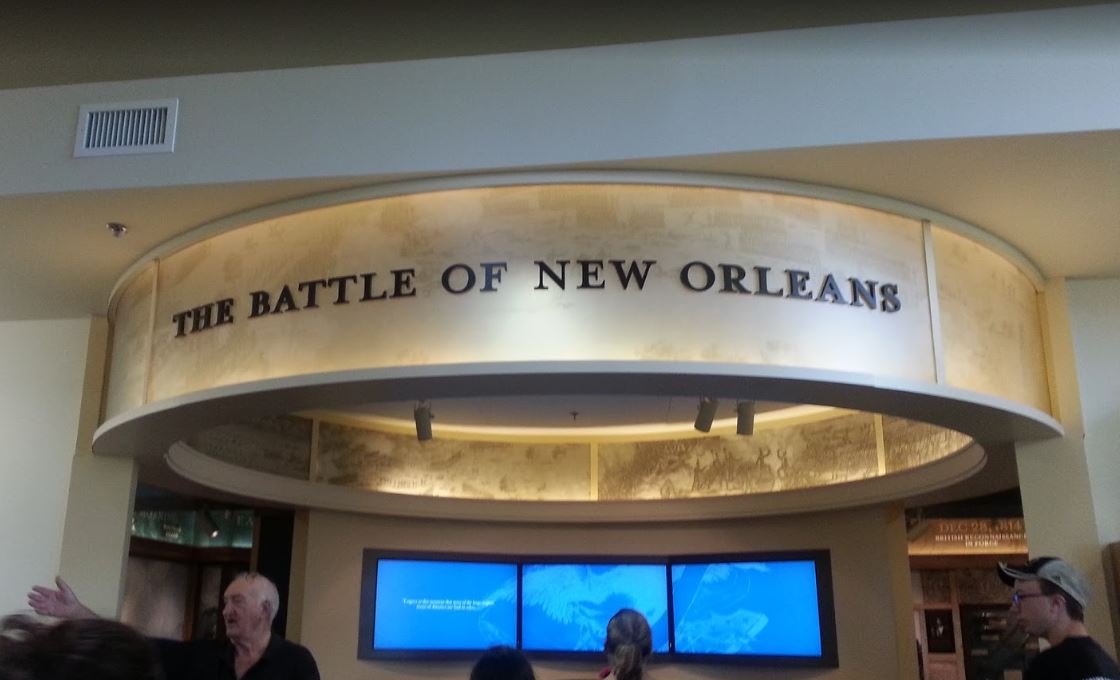
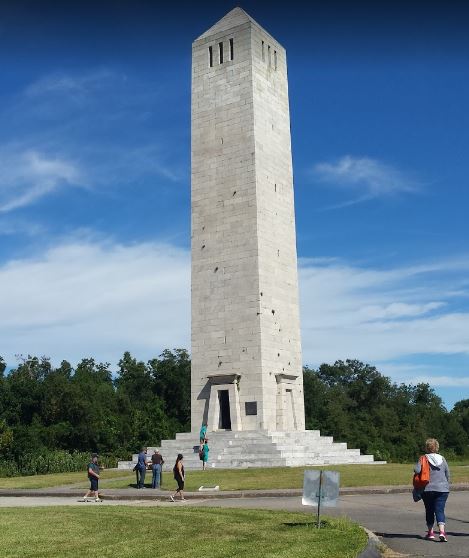
I consider myself a life-long student of learning and with every marathon trip, I try to find places of historical significance.  I respect and appreciate the history of our country, the good and also the not so good events.  The south saw many battles throughout the course of our history and one of them is the Chalmette Battlefield and the site of the Battle of New Orleans a stone’s throw from the Hurricane Katrina ravaged Lower Ninth Ward.
Even the cold blustery day with the possibility of freezing precipitation could not dampen my mood throughout my battlefield visit.  From the park ranger’s presentation to the informative visitor center’s interactive displays, I learned a great deal on what actually happened during the Battle of 1812. 


It’s easy to spend a few hours exploring the battlefield, climbing the vertical staircase of the memorial obelisk, remembering those buried at the National Cemetery or walking through the site’s plantation home, but time was of the essence.  Time to return to the airport, but first, lunch.
Following a pizza lunch at one of Metairie’s hole-in-the wall eateries, Mark Twain’s Pizza Landing, it was off to the airport for our evening flight home.
With a great deal of confidence, I can tell you from my experience as a runner that this event was unquestionably near top-notch.  It may be only less than ten years old, but I believe that the Louisiana Marathon has already established itself as one of the must-do races in the nation.  The course is scenic and solid and the weather is usually fairly predictable which makes for good racing.
The marathon organization partners with a non-profit called Ainsley's Angels.  Their wheelchair pushers and athletes in chairs throughout the race were a welcome reminder of how lucky and grateful we all are to be out there pounding the pavement – and we must not forget that.
I learned one thing on this southern swing, that Louisianan’s seize any opportunity to have a good time and love what’s called lagniappe – or a little something extra.  The Louisiana Marathon definitely lives up to its reputation as a “running festival with lagniappe.”  Their great food, music, southern hospitality, the expo, unique finish festival, and all the generous people who made this marathon a remarkable event.  I have to give a shout out to all the organizers, volunteers, spectators and strangers extending their warmth to each participant – something not seen in most of my marathon travels.  “Let the good times roll!” and roll they surely did!  Au revoir.
The coveted and esteemed Geaux Run LA medal