Friday, July 13, 2018

State Number 43 - Mad Marathon


State Number 43 – Mad Marathon

Waitsfield, VT

7 July 2018


As I open my forty-third chapter on my fifty-state quest, I feel a sense of victory and accomplishment.  Enduring the widely hyped hilly marathon gives rise to a feeling like no other marathon I’ve run.

Race organizers of the Mad Marathon tag their annual event as “The World’s Most Beautiful Marathon” and Runner’s World has placed this marathon on their ten bucket list items for all marathoners (on the same stage as Paris, Rome and the Great Wall of China). 

Compared to most states, there aren’t a whole lot of marathons in Vermont.  While the Mad Marathon has been on my radar for some time, there’s always time to second-guess myself whether a marathon I commit to is the right one to run.

A side-effect and direct consequence of serial marathoning is that you forget how painful and arduous some courses are and then decide to try one again.  Particularly, nasty hill-dominated courses.  But, for some reason (I guess it may be runner’s amnesia), I decided to do it again – run another hilly course.  On the bright side, the tougher marathons are, the better stories one can tell.  You got to do them to be a better runner.

I’ve heard and read great reviews about Mad not only because of central Vermont’s year-round splendor, views of the Green Mountains, challenging rolling farmland terrain, the remarkable covered bridges, old barns, silos and green fields of cattle and other sorts of livestock, but it’s one of those rare marathons that takes place during the peak of summer. 

Over the course of late spring and early summer, I considered my marathon training meager at best. As I coasted off my post-Hatfield & McCoy struggle, I looked forward to the challenge of the famed hills the Mad River Valley can throw at me.

My mission to New England began on 6 July when my wife and I boarded an LAX JetBlue flight bound for yet another long cross-country flight to Boston (BOS).  With the number of times we’ve flown into BOS, we may consider ourselves as part-time Bostonians. 

We arrived Friday afternoon around 1430 EDT, each excited about conquering and checking-off another state and adding a shiny new addition to my motivational cartography plat.  However, with a little trepidation about tackling a notoriously hilly course – there was no backing away now.


Boston greeted us with some ugly warm muggy weather.  However, the weekend weather forecasts all predicted the stale air would give way to lower dew points, dry clean air and clear blue skies.

We secured our rental car and drove into East Boston for an enjoyable lunch at Rino’s Place.  My wife ordered a succulent lobster/shrimp cannelloni while I indulged in a plate of lobster raviolis in a creamy plum tomato sauce.   With stuffed gullets, we escaped the hectic metropolis of Boston and drove up the heavily congested Interstate 93, stopping in Concord, NH for the night before continuing on to Vermont’s Mad River Valley thirty minutes from the state’s capital city, Montpelier. 


Welcoming Québécois visitors to Vermont's capital city
Central Vermont is predominately a haven for winter sports and activities that includes a variety of outdoor adventures such as skiing and snowmobiling.  Numerous ski resorts lie within an hour’s drive from Montpelier.

Even though it may have been a little too early to check in to our hotel as we arrived in Waterbury, we found enough time to tour the Ben & Jerry’s ice cream factory on our way to our afternoon activity, zip lining.  In my view, I found the tour to be a huge disappointment and not worth the time.  Sometimes, certain things are better left unsaid, and that’s all I will say about that.

I have a fondness for zip lining, whether it’s through the canopy of trees, flying over ravines or soaring above canyons.  Arbortrek Adventures in Smuggler’s Notch, just north of the Stowe Mountain Ski Park, affords visitors year-round aerial adventures, even in sub-freezing temperatures (I can’t imagine). 

After missing a highway sign and driving up a dead end gravel road, we eventually found our way to Arbortrek for our zip line adventure.

The three-hour tour takes adrenaline junkies through stands of eastern hemlock (Tsuga canadensis), white birch (Betula papyrifera), red and sugar maples (Acer rubrum/saccharum) and a smattering of ash trees (Fraxinus sp.) on eight zip lines covering nearly a mile of terrain, crossing two sky bridges and rappelling from two platforms.  Although geared for the leisure adventure seeker, the zip lines also appeal to the experienced as well.  Breathtaking views of the Green Mountains abound from tree platforms perched high on the mostly mature hemlock trees.  With the increased likelihood of falling off the platforms (as a couple of kids did), safety is paramount with copious redundancies built into the harnessing gear to prevent any serious mishaps.

Staff personnel fit each participant with a red protective helmet snuggly fastened to the chin, a heavy harness and lanyards and a pair of heavy-duty leather gloves.  Our eight-person group ranged from first timers to those with some previous experience.  Some appeared a little apprehensive at first, but after participating in the compulsory ground school introductory lessons and the shorter span cable lines at the start, the nerves settled and the excitement came out.

Guides informed our group that it is not uncommon to reach speeds in excess of 35-40 mph using the correct aerodynamic postures.  Yes, it’s fast, but it pales in comparison to the sensation of zipping across a canyon in excess of 60 mph on West Virginia’s Adventures on the Gorge’s 4,800-ft Adrena-line.


Stowe gondolas
During our tour, the guides attempted to educate the group with some siliviculture and taxonomy lessons about the region’s native forests.  He stressed that harvesting maple syrup is a big ticket item in Vermont.

Personally, the whole experience was such a buzz I wanted to repeat the adventure a second time.  I know that wasn’t going to happen, but all good things must eventually come to an end.  Following our fun, it was time to head back to Waitsfield to retrieve our race swag.  But before, we checked in to our hotel in Waterbury, not quite as stylish as the “Stratford Inn” characterized in the 1980s sitcom Newhart, but rather a plain ordinary run-of-the-mill hotel chain balanced on the edge of a hillside slope.  The hotel complex seemed newly built with an indoor swimming pool and spa with a relaxing and beautifully landscaped outdoor patio area surrounded by both conifer and broadleaf trees overlooking Waterbury and the countryside.

We worked up quite an appetite following our forest adventure.  After some suggestions by a local resident in our zip line group, we opted for some serious pizza at the Blue Stone in downtown Waterbury.

Fifteen miles south of Waterbury, lies the community of Waitsfield.  This small municipality lacks signalized intersections.  There are no chain stores, no Walmarts, or even fast food eateries in this small winter resort enclave of around 2000 that retains elements of its past while merging them with the modern economy.  Rolling farmlands and pastures abound with herds of cattle, horses, goats and sheep accentuating the region’s characteristic barns, vintage covered bridges and silos, all of which shape the New England landscape.  Flowering plants and tractors tilling the ground or harvesting hay, bring out the unique fragrances and aromas of areas agribusiness activities.

It is customary to hold the marathon expo on a grassy area adjacent to the Mad River behind the historic Waitsfield Inn, a hop, skip and a jump from the marathon’s finish line area at Mad River Green, one of the happening places in town.  The expo was essentially packet pick-up and a late registration table, with one rack selling running apparel and paraphernalia.  We picked up our race swag walked over to the finish line area for some photo ops before heading back to our hotel in Waterbury to relax in the heated spa and ready ourselves for a strenuous Sunday run.

After a month of digesting the heat and hills of Hatfield & McCoy, it’s fair to say that I learned a lot about tough marathons.  It taught me what I need to do, how to pace myself and, most importantly, finish with a smile.

With forty three chapters in the book complete, I’ve been able to say that I’ve finished all of them no matter how ugly the weather, circumstances, etc.  This weekend, the deck of cards dealt a different hand from Hatfield & McCoy.  Instead of hot humid weather, cooler, drier and pleasant temperatures prevailed with a few wispy clouds juxtaposed against a deep blue sky.  The hills were still there, but at least the heat and humidity stayed in Kentucky.

Crazy profile!
Where I live in California’s great central valley, there aren’t many hills to be found, except for the Sierra-Nevada foothills.  In order to get any sort of incline, I have to either drive for twenty minutes to barren and unshaded foothill terrain or run up and down the same freeway overpass fifty times in a row.  In lieu of finding uneven terrain, some runners have suggested tackling parking garage ramps.  Given the dangers present where drivers aren’t actively on the lookout for pedestrians, I’ve kindly turned down that proposal.  However; there’s always the reliable treadmill that adjusts for serious grades, but I just cannot stay on a treadmill for more than thirty minutes, so my options for hill training are generally limited.

With that said, I made it to the starting line with confidence and positive thoughts about the course that lie ahead.  The sun shone brightly in the azure sky with temperatures in the low 50s, with sunlight illumninating the Mad River valley’s deep green hues.  A refreshing northwesterly breeze paraded down Waitsfield’s main highway as an aura of anticipation swept over the crowd of runners. 

The marathon start time is 0700, which I would definitely change if I was the race director. Sunrise begins the day around 0515 near the 45th parallel, and at 0700, the earth’s solar furnace rises high enough causing air temperatures to climb.  

Starting 1.5 hours earlier sure would have been nice so runners could avoid any heat related complications. But, it did mean that I got to sleep until 0600.  It seems that I automatically wake up an hour or so before start time giving me enough time to eat a bagel, banana or some oatmeal and having time for my stomach to digest it.

Approximately 600 runners toed the start line on Main Street just north of the Mad River Green’s northern entrance enjoying the singing of the National Anthem.  With baited breath, race director Doris Ingalls sounded the air horn, sending a throng of bouncing runners on their way. 

The first half:  (8:47, 13:00, 9:23, 8:44, 10:35, 10:37, 9:42, 10:52, 14:03, 11:39, 14:22, 11:20, 12:10)

At times, I have a bad habit of being swept up in the stampede of runners by going out too fast, and this time was no exception.  I genuinely wanted to force myself to begin my run with a more relaxed pace.  I kept telling myself, “go slow.”  After my dreadful H&M struggle, I wanted to enjoy this marathon and not burn out midway through the second half.  Even though I don’t anticipate knocking off a PR, I do know that a PR on a course such as this one is a difficult endeavor.  With that said, I shall just take delight in the aesthetics of the region’s natural beauty.

Gateway to the hills
At the beginning, runners were treated to a rare, flat to downward trending stretch of road – more than enough to tease us for a few minutes.  I went out ignoring my inner voice screaming at me to relax my pace.  Following our brief mad dash along Waitsfield’s tiny Main Street (State Route 100), we turned right onto Bridge Street at Marathon Mile 1 towards the Big Eddy covered bridge spanning the Mad River, acting as a portal to the race’s unrelentless climbs.  Wow, that was an 8:47 mile.  I guess I just tossed my plan’s conservative approach over the bridge and right into the tranquil currents of the Mad River.

Soon after the first mile, an intimidating steep hill appeared before our eyes compelling everyone to reduce their paces.  I thought to myself, ”Are you kidding?  Buckle up, this is going to be fun!”
 
Two miles into the race, as we reached the pinacle of a tough uphill climb, heavy labored breathing was the featured sound of the moment.  Was all that labored breathing due to a lack of oxygen, going out too fast, or was it because of the absence of hill training?  My slow walking pace kept my lungs from requiring more than the usual breath of air.  As the gradual incline continued and as long as I kept my slow pace, I was content.

Pine Brook
Universal edicts dictate what goes up will soon come down.  I let myself lean forward on the downward slope, keeping a slow and steady pace, resisting the temptation pick up the pace too much as to burn out my quads.

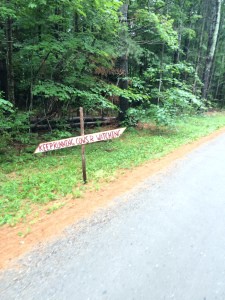
The cows are watching
Along the way, I passed a few hand-made sign posts with scribed messages.  One said “Keep Running Cows R Watching” and another said “Ski If You Can’t Run.”  As a long-time skier, how nice it would be if I could step into a pair of Nordic skis and telemark my way to the finish.  
 
With the race’s big hill now behind us, the next for miles were mostly flat as we ran over local roads surfaced with aggregate base material severing large stretches of grassy farmlands.  With the half marathon runners making their turnaround near Marathon Mile 4.6, cows watched from behind the fences, while sheep and horses grazed happily and uninterested as runners paraded by.
Once through with the flat reprieve at the first of three out-and-back segments at Marathon Mile 5, it was the beginning of a steady (but not so challenging) climb upwards towards the second turnaround just past Marathon Mile 6.  This time, there would be no rewarding downhill on the other side.

Steadily onward I ran even with my sock beginning to chafe a hot spot area on my left foot.  I immediately stopped to readjust my sock, but the damage was already done.  I had no choice but to tough it out. 

I watched the miles sluggishly tick off, silently wishing the runners well to my right, who were on the uphill portion of the second out-and-back   Suddenly, I spotted the one and only Bart Yasso happily conversing with a small group of runners as they made their way up the incline.  I thought about slowing and waiting for Bart’s group to catch up so I could join in on the conversations.  But I decided to push forward perhaps catching up with him at the finish.

The road continued on, passing back through the Pine Brook bridge along a rare flat stretch of roadway at the base of a dreadful climb back up a hill I so enjoyed running down just forty-five minutes earlier.  I voiced to another runner alongside me, “I guess it’s time to pay the piper.  It’s time for me to begin walking.”  Without much hesitation, she agreed.

I thought I had reached the summit, but instead, the course make a left turn to the final out-and-back section, continuing its skyward path, totaling a length of about three miles of near continuous uphill.  Having walked almost every uphill section of Hatfield & McCoy, I found myself having to walk nearly every hill of this one, too.  I kept advancing with a shortened stride to the much anticipated turnaround cone a short distance past Marathon Mile 10.

After the turnaround, the terrain maintained consistent rolling topography for the next two miles or so along Common Road.  I was able to maintain a slow consistent jog up the short hills if they weren’t too steep, all the while enjoying the scenic landscape as if it was God’s country. 

Half marathon runners broke from the ranks as Common Road joined with East Warren Road.  I admit I was a little envious of their journey back to the covered bridge at the finish line knowing how many miles that lie ahead.

I crossed the half marathon split in a time of 2:17:35.  It was soon time to play some psychological games with my mind to get me through the second half of the course.  Perhaps the scenery will be enough to override the need for such games.

The second half:  (11:37, 12:35, 13:36, 13:16, 13:38, 12:08, 13:37, 12:50, 13:15, 14:58, 12:29, 10:42, 11:46, 11:38 projected pace [final 0.29 mi])

The Dip
It wasn’t long after half marathon split when runners approach what is affectionately known as “The Dip.”  It takes the shape and appearance of a roller coaster drop, except there weren’t any stomach churning g-forces or puking at the bottom of the undulating sag curve, but I caught myself thinking.  A runner is able to garnish plenty of speed descending a negative slope, but that celerity doesn’t translate into any kind of sustained momentum to propel oneself up the opposite side.  It’s all you, chugging up that long steep incline.  Somehow, in a bizzare fashion, I enjoyed the painful climb up the other side.

After runners dug themselves out of the despairs of The Dip, the road began a long two-mile steady uphill trend to the intersection of East Warren Road and Roxbury Mountain Road at Marathon Mile 15.5 and the beginning of a three mile rectangular-shaped loop.  I grabbed some watermelon, water and Gatorade and continued on my trek as the aroma of wildflowers mixed in with the fresh clean mountain air.
I came into this race knowing the marathon’s theme – hills and covered bridges.  At Marathon Mile 16.5 as we rounded the corner onto Senor Road, we were near the highest elevation of the course, surely a pleasing thought.  Although, there were some minor hills left on the course to negotiate, it was all downhill from that point.
At Marathon Mile 19.5, runners pass by the same Roxbury Mountain Road intersection.  I again grabbed a large slice of watermelon and chased it down with another GU to get me through the final ten kilometers.  With a few runners and walkers on the opposite side of the road, I felt relieved I was over four miles ahead and wasn’t the one bringing up the rear.

Somehow the relentless sun and heat wasn’t affecting my running that much, but I took out my cooling towel, soaked it in some ice water at an aid station and placed it around my neck.  Besides the cooling effect, it also protects the back of my neck from the intense sun.

The one thing I love more than the challenge of the marathon distance itself is sharing the miles with others.  I kept a consistent, but conservative, pace making an effort to save some precious energy for the harsh final push to the finish line. 

I managed to sneak up to a couple of runners from New Mexico who were on a little walk break masticating on some slices of watermelon.  After some idle repartee, I learned one was running her forty-ninth state (Colorado being No. 50) while the other was in the initial stages of her journey.

I offered some advice on my 42 experiences and that some states may require a do-over – for me, Alabama.  They immediately disagreed saying, “They all count no matter the time.”  True; however, they sympathized with me as I explained First Light Alabama and that redemption is in the cards.  One told me she was familiar with what happened at First Light and had a friend who agonized with food poisoning there as well, nearly landing himself in the hospital.  The enlightening conversation made the miles so much more enjoyable than the previous twenty and served to temporarily dissociate my mind from the tiresome hills, heat and fatigue.

The problem with running downhill so far into a race is that it still requires a lot of effort, despite the welcomed gravity assist.  The perpetual chafing from the sock/skin interface of my left foot, as well as the bottoms of my feet, ankles and quads, had taken a beating during the last twenty miles, and when running downhill segments, the pavement seems to get harder and harder.  When faced with another brutal hill around Marathon Mile 23 (The Dip once again), a slow agonizing walk ensued.  As a result of my legs growing fatigued by the minute, it appeared that this uphill segment was much more difficult than the other side. 

Instead, I continued forward on the downhill trending final leg passing familiar landmarks.  At Marathon Mile 24, a typical aid station had been upgraded to a beer station, where a nice bespectacled woman served up deliciously refreshing pale ale from a cooler.  Fatigued and wobbly on my feet, I pulled over to the side nearly losing my balance if not for the fence rail, and took a cup from her hand.  I told her I needed the icy refreshment as a little bump to get me to the finish.  Even if my watch weren’t telling me I was just a couple of miles from the finish, beer stations normally portend the final stretch.  Just two more miles under the flitting, green terrain separated me from finishing my 43rd state and 61st marathon.

The steep downhill grade leading into Marathon Mile 25 exacerbated its toll on my legs.  My quads ached and the painful chafed skin on my foot was no longer ignorable.  I felt the onset of shin splints and my legs felt as if they were dragging a ball and chain.  Negative thoughts quickly enveloped my thinking.  I needed to do something, so I implemented a self-imposed rule requiring two positive statements per one negative thought.  I used this with myself and it seemed to work – if anything, it got me out of the habit of letting negative thoughts rule the day.
I reached the race’s final covered bridge (Big Eddy), the same portal we ran through just past the first mile marker, except this one brings runners back into the realm of reality.  A friendly spectator stationed near the entrance urged me to keep going (easier said than done).  There was just one more mile and one more minor hill to climb.  I told myself “the faster I run, the faster I’m done.”  Sounds easy, but the punishing slope wasn’t going to let that happen.

At the intersection with Main Street stood a friendly sheriff deputy informing me to stay left of the orange cones while giving me with some generous words of encouragement.  I thanked her for her time to assist with the marathon and she wished me well.

After a demanding run, or should I say walk, along Highway 100 (the one that was such a teaser just a few hours beforehand), now awake with a flurry of spectators and vehicular traffic, I turned into a green grassy clearing through a parking lot.  A chute of orange traffic cones and metal barrier fencing morphed into parallel lines of flags representing various countries like an Olympic sport, guiding tired and exhausted runners to a replica covered bridge spanning the finish line.  

The boistrous announcer broadcasted to the world of my presence as I hobbled down the grass-laden chute as if I was the lead runner.  He even pronounced the name of my hometown correctly.  I was aghast, he actually placed the correct emphasis on the correct syllable.  I stopped the clock at a mere 5:17:56, much better than my misfortune in Kentucky, but not what I had expected to run.  Without exception, race director Dori Ingalls was there, greeting me with a hug, just like she did for everyone finishing before me (which was almost the entire field).  At first, I was hesitant to receiving a hug due to the shear perspiration and crusty salt covering every square inch of my skin.  But it’s her tradition and custom.  Thank you, Dori.  Finishing a challenging run wouldn't be the same.

RACE STATS:

Distance: Marathon (26.2 mi) – my Garmin clocked it at 26.29 mi

Date: July 7, 2018

Bib No.: 223

Weather at start: 52°F with wall-to-wall sunshine

Gun time: 5:18:01

Chip time: 5:17:56

Average cadence: 148 steps per minute

Average pace: 12:06 per mile

Overall rank: 188 of 247

Gender rank: 136 of 172

Division rank: 14 of 17

Elevation: 2,106 ft gain / 2,103 ft loss

Half split: 2:17:35 (10:30 pace)

Average finish time: 4:43:26

Standard deviation: 0:54:34

Age graded score: 45.49%

Age graded time: 4:34:35

Garmin splits: 8:47, 13:00, 9:23, 8:44, 10:35, 10:37, 9:42, 10:52, 14:03, 11:39, 14:22, 11:20, 12:10, 11:37, 12:35, 13:36, 13:16, 13:38, 12:08, 13:37, 12:50, 13:15, 14:58, 12:29, 10:42, 11:46, 11:38 projected pace [final 0.29 mi]

I received my finisher medal, grabbed some food at the food tent and walked across the street to the Waitsfield Inn to indulge in some adult libations.

With the race director Dori -- Madness Managed!
 
I’m not a fan of craft beer.  The bitterness of the Heady Topper IPA served in the beer tent was enough for me to dump it in the trash can after a couple of sips.  From what I heard, the “famously rare” beer is a must-try for any beer enthusiast.  Not quite.  Just give me a plain old domestic beer such as Bud or Coors Light.

Following a delightful break schmoozing with fellow runners from Texas (also 50-staters), we, at least I, painfully walked back towards the car wondering where to appease our enormous appetites, something rare for me after a marathon.

The Mad Taco grabbed our attention and we thought a little taste of Mexico would satisfy our hankerings for a delicious meal.  Of all the menu items plastered on the wall, choosing the right one turned out to be a challenge.  Tacos, enchiladas, burritos, tortas, tamales, fajitas, you name it.  Ultimately, I settled on two pork chorizo tacos loaded with beans, cilantro, meat, pico de gallo and mole sauce.

Sadly, our marathon day ended and we drove back Waterbury for some spa/pool time, clean up and have a delicious pizza dinner at The Blue Stone before turning in for the night.  Unfortunately, it was closed so we decided on the next best thing, The Reservoir for a scrumptious burger.

On Monday, with some time to utilize before our drive back to Boston, we had enough energy to take a short hike to Moss Glen Falls, a few miles north of Stowe, and a drive-by of the state capitol in Montpelier.
2011 flood high water mark
 
 
The firehouse burger at The Reservoir - Yum!


State capitol in Montpelier
 
After fighting some Boston area traffic, we arrived at BOS in time for our Delta flight, and after a slight mechanical delay (surprise surprise), back to LAX and to our humble place of abode.

LIKES / WHAT WORKED:

  • Great challenging course in the Mad River Valley. 
  • Wonderful place to escape the hustle and bustle of the real world.
  • Very well organized event from packet pick-up to the multiple aid stations along the course.
  • Super friendly volunteer support.
  • Obviously, this event is a labor of love for the race director and her staff of volunteers. 
  • Hats off to the great spectators displaying their support!
  • Mostly shady course.
  • Easy parking race morning.
  • FINISHING!!

DISLIKES / WHAT DIDN’T WORK:

  • The non-stop “mountains” and hills, but there’s nothing one can do about that.
  • The heat.  I know, it’s an element that cannot be controlled.
  • The food variety at the finish line could be improved.   
  • The late start time.

Final thoughts:

If anyone is looking for an amazing race experience, run the Mad Marathon – or the half.  I really cannot say enough great things about this marathon.  Is it hilly? YES!  It is beautiful? Absolutely!  It’s the laid back and relaxed feeling of this smaller marathon tucked away in central Vermont that I enjoyed so much, and everyone was so friendly and helpful.  The old covered bridges, gems of the engineering past and iconic symbols of Vermont, provide a unique and distinctive touch to this event.

A huge thank you to the race director Doris and all her staff and volunteers for making all the runners feel so welcome.

If you have never visited the Mad River Valley, I highly recommend it.  While there, visit the Mad Taco for some succulent tacos, burritos, locally produced ciders or craft beers, but beware, some of the hot sauces can set your mouth ablaze.

Now, I can kick back, relax and digest the hills and beauty of the Green Mountain State before heading back to Boston as I embark on my next marathon adventure.  Thanks, everyone.

As always, it’s onward and upward!


Monday, June 18, 2018

State Number 42 - Hatfield-McCoy Marathon


State Number 42 – Hatfield-McCoy Marathon v2.0

South Williamson, KY

9 June 2018

“No feudin’, just runnin’” Yup, Version 2.0 complete and still one of my favorites!  No gunfights, no hangings, no pigs – just running.

The Hatfield-McCoy feud was a violent, long-running battle between two clans who lived in what is now coal mining country along the Tug River on the West Virginia/Kentucky state line during the late nineteenth century.  While few may know all the details, in the USA the term “Hatfield's & McCoy's” is a familiar metaphor between feuding neighbors, families, or even the successful lives of “Waylon, Willie and the boys” in Luckenbach, TX.  It ended long ago and today it’s the theme of an annual festival in the Williamson/Matewan area, of which this marathon plays an integral part.  For the second time, I feel honored to play a small role in this yearly commemoration.

I’m going to attempt to spare you from excessive dramatic expressions of how much I enjoy this marathon, but based on the title of this review, it might not work.  

I can say with most marathons, it’s usually a “one and done” event – glad to get in and glad to get out.  But I cannot say that with Hatfield-McCoy.  There’s something about it – the scenery, the friendliness, the challenge, the volunteers, the history – that draws me to repeat this marathon.  If it just wasn’t so difficult to get there.

"Almost Heaven, West Virginia, Blue Ridge Mountains..."
As the race begins out of the Food City parking lot in South Williamson, right away the beauty of the course immediately grabs the attention of everyone who begin the first couple of miles along U.S. Highway 119.  The huge tree-covered mountain, the vertical cliffs, and rocks towering above the highway are pretty remarkable.

I had two main objectives for this race.  First, I wanted to run up the entire length of Blackberry Mountain without breaking my stride, a hill 1.25 miles long with a rather steep, but steady, incline, and from what I hear and experienced, a lot of people walk it.  On my previous attempt, I made it to the top without walking, but barely.  The notorious hill is longer than what it seems.  

Second, I wanted to finish this tough and demanding race faster than my 2014 time – 4:59:30.  I desired to challenge my time goal while simultaneously having fun during the race, taking some photos I failed to do the first time around, and just enjoying the setting.  The way I see it, the earlier I finish, the more likely there will be food and drink left at the finish line.  Priorities are priorities.

Let’s back up for a moment.  This review should not be construed as a déjà vu moment.  I’m not attempting to rewrite, amend, clarify, modify or change anything about my original marathon review of H&M. 

According to the rules and guidelines of the 50-States Marathon Club (in their own words):

“If a race starts in one state and ends in another, it may be counted once for either the state where it started or where it ended.  If the same event is run on a subsequent year, the race may be counted for the other state.”

As mentioned, I ran this race in June 2014 (State No. 10, simultaneously becoming an official member of the 50-States Club), but I was caught up in a dilemma, deciding which state to count, West Virginia or Kentucky?  The decision to count West Virginia hinged on the fact that marathons in that state are not very plentiful – compared to Kentucky.  Moreover, traveling and trekking in and around “God’s Country” can be a little time consuming and problematic.  Thirty-two states and four years later, I can finally count this marathon towards the commonwealth of Kentucky.  Who knew I would ever come back to run this marathon a second time.

So, why am I doing this marathon again?  Perhaps the best answer, it WAS to be combined with Indoor Insanity Marathon (Winston-Salem, NC), paving the way for an exhausting double marathon weekend.  But when the indoor facility’s air conditioning system became defective, the race organizers decided to ultimately cancel the event.  What a disappointment!  Besides, I had no doubts or misgivings about running H&M a second time.

After an agonizing six-hour delay due in part to a faulty engine part (I guess the pilots noticed an illuminated “check engine” light during their pre-flight check) and shuttling back and forth from gate to gate, terminal to terminal, we finally departed LAX on a replacement plane for the long direct flight to Raleigh-Durham International Airport (RDU), arriving shortly after 2315 EDT. 

If our carry-on bag hadn’t been gate checked, we would’ve packed up and driven back home, forfeiting our trip.  The infuriating and frustrating Delta Airlines experience was enough to piss-off the good humor man, to put it lightly.  Enough said on that experience.


On a normal day, the drive from RDU to Pikeville, KY (our H&M lodging locale) takes approximately six hours.  In the meantime, we settled in for the night in Winston-Salem before embarking on our road trip through Appalachia to Pikeville. 

The beautiful four-hour drive to Pikeville took us through Mt. Airy, NC, Wytheville, VA and through the heavily forested scenic backroads of Appalachia into the coal region of Pike County in eastern Kentucky.  What immediately grabbed my attention are the massive highway and railroad excavations revealing precipitous cliffs exposing ancient horizontal layers of interbedded limestones, sandstones and shales. What fascinating engineering and geology.

We arrived at our destination hotel in Pikeville in time for a cool and refreshing swim in their sparkling pool.  The weather was sunny, quite warm and muggy with a tropical clammy feel.  The warm weather had me concerned and uneasy about marathon day – I don’t do well with heat, humidity and hills.

We arrived at the Belfry gymnasium around 1630 for packet pick-up and to partake in their complimentary pre-race pasta dinner held in the Belfry High School cafeteria for all marathon and half marathon participants.  I had a choice between marinara or meat sauce.  Remembering what had happened at the pasta dinner at First Light Mobile (State No. 9), it wasn’t a hard decision to make – I opted for the plain marinara sauce.  Superstitious?  Maybe, but I didn’t want to chance it. 

The pre-race dinners are always fun.  It’s easy to strike up a conversation with anyone about what else – running.  Those in the running community always have an interesting story to tell. 

Following our dining experience, runners enjoyed the attention-grabbing and informative H&M skit featuring “Devil Anse” Hatfield and Ran’l McCoy.  It’s an annual tradition for these actors, recounting the tale of the notorious feud.  In a cafeteria setting, the acoustics were less than ideal and there was too much annoying feedback with the microphone system.  However, I do appreciate the enlightening experience and education.  Four years ago, we watched the skit in the comfort and acoustically friendly setting of the school’s auditorium.

This great event features a full marathon and two half marathons.  One half is the “Blackberry” half and the other is the “River Road” half.  The Blackberry begins with the full and ends in Matewan while the other begins in Matewan and ends in Williamson.  Runners may do the full, one of the halves or both of the halves, earning a special double medal.

The marathon ends in the small enclave of Williamson, WV, so runners are encouraged to park in Williamson and ride the event’s shuttle bus from Williamson to the start line in the Food City parking lot in Belfry, KY, a quick two-mile ride.  Food City is also the title sponsor of the marathon.

The kind folks at Food City are awesome and welcoming people.  Not only does Food City provide spreads of water, bagels, bananas, cantaloupe, watermelon, strawberries and grapes for the runners, they also allow runners inside the store to socialize in air conditioned comfort, use the restrooms or just to get out of the elements before the start of the race.

June weather in this part of the state is typically hot and humid, like a wet blanket with just a touch of a mist.  Coupled with the course’s unrelenting hills, runners can quickly fatigue, dehydrate or simply run out of energy.  But fear not, there are aid stations every mile to placate anyone’s thirst or nutritional needs. 

My concerns for the day grew by the minute as I wandered the parking lot, but I found that talking with fellow runners temporarily eased my mind from the anxiety.  At first, my goal was to break five hours; then, just to finish in under six hours.  With the temperatures expected to hover around ninety degrees, I reassessed my goals and decided just finishing will make me happy.

About ten minutes before seven o’clock, the race director summoned runners to begin lining up at the start line for some pre-race announcements and the singing of our National Anthem.  Devil Anse and Ran’l stood ready at the start line each clutching their double barrel 12-guage shotguns waiting for race director Alexis to signal the shotgun start (literally).

It was time, Devil Anse and ol’ Ran’l raised their guns pointing into the foggy steamy sky each simultaneously firing off a round, and the race was underway.

The first half:  (9:03, 9:01, 9:44, 10:13, 10:16, 10:18, 12:37 [stopped to pet the dwarf horses], 11:37, 9:14, 11:10, 10:07, 12:56, 12:53)

Race start
Under the foggy skies draping the Tug Valley, we headed out of the parking lot down U.S. 119 which I thought my pace was a bit too fast for the first couple of miles due to the slight downhill trend and towards the quiet hamlet of Toler to Highway 319 through Hardy towards the famous and dreaded Blackberry Mountain grade.  Runners pass everything from immaculate little cottages to old ramshackled mining camp homes with plenty of barking dogs and crowing roosters in the background.  Friendly residents sat on their porches sipping on their morning coffee cheering on the parade of runners.

One of the awesome things about the H&M Marathon is that the race organizers craft “Welcome Back” signs for all the returning runners and place them at various locations along the course route, which I think is a real cool and clever way to honor and recognize returning runners.  Knowing this ahead of time, I become attentive once on the course keeping a sharp eye in order to locate my “welcome back” sign.  Would I see mine?  

The first aid station was located at Marathon Mile 2 and was well-stocked and well-run by super friendly volunteers.  I was already drenched in sweat and looked forward to drinking several cups of water and Gatorade.

The next four miles consisted of varied rolling terrain, but nothing too difficult, but I relaxed my pace and huddled in with the ten-minute pace group (4:22 finish time).  I knew that time goal would be unattainable, but I wanted to hang on as much as possible to conserve some energy for the upcoming hill climb.

Profile of Blackberry Mountain
At Marathon Mile 6, runners hit the foot of Blackberry Mountain.  Suddenly, the road started heading upwards climbing about 750 feet in a mile and reaching the summit just after Marathon Mile 7 and the site of aid station No. 5.  My goal for this climb was to run at pace as long as I could tolerate and then walk, if needed.  I found that the ten-minute pace group charged ahead, leaving me in their wake so I was on my own.  Maybe if I had just slowed down a little bit over the previous miles, I could have made it up the entire hill running.  But as it was, I burned myself out about three-quarters of the way up and had to walk to the summit.  Besides, the temperatures seemed to be quickly rising making any kind of serious effort pointless.  By this point, I was beyond drenched in sweat, it was almost comical.  My shirt and shorts were literally clinging to my body with sweat dripping off the bill of my cap like a leaky faucet.  I could see myself as the world’s most efficient sweater, but seriously, body, you need to take it down a notch.


Road up Blackberry grade
On my way.
As happy as I was to not be running up the mountain anymore, the run down the steep gradient on the back side was actually harder for me and I’ve accepted the fact that I'm not a great descender.  I know the mechanics of descending a hill and letting gravity do its job, but that's a hard thing to do when you're literally running down a steep grade.  Anytime I got some decent speed, I felt like I was going to blow out my ankles, a knee or go careening down the steep mountainside due to loss of balance. Fortunately, neither happened, but I felt that the descent hammered my quads a little too much.


By Marathon Mile 8, and the base of Blackberry Hill, we were back to some gently rolling hills skirting Blackberry Creek.  I was handed the first of many ice-water soaked towels from the hillbilly aid station adjacent to the Hog Trial site near the community post office.  I squeezed out excess water over my head and placed the cold towel under my cap hoping the evaporating water would remove some of the excessive body heat, but with the humidity levels, evaporative rates tend to slow.

Blossom on the left
Runners made a left turn onto Highway 1056 en route to Matewan and the end of the first half of the marathon.  Along the way, runners pass by the “world’s smallest horses.”  I have no idea if they are actually the world’s smallest, but I made it a point to stop and pet the horses anyway.  But as I approached they were strangely skittish and would keep moving to the opposite side of their fenced pen.  The horses’ owner held one at bay (named Blossom) so I had the opportunity to pet her. 

I continued on down Highway 1056 passing by several markers commemorating the feud or some other major incidence.  As the heat kept rising, it gave me a reason to stop and read the historical plaques.  Damaging my health over a marathon is not in my set of playing cards, so a brief respite every so often was something I needed to do.

The next three or so miles consisted of gently rolling sections of two-lane roadway with irritating cambers in some areas, then through a narrow one-lane roadway and across the Michael Justice Memorial Bridge spanning the Tug River into Hatfield territory, Matewan, WV and the site of the Matewan Massacre brought on by a dispute between the coal miners and union organizers in the 1920s.

The course led runners on Matewan’s Main Street hooking around to Hatfield Street, thence onto McCoy Alley leading to the half marathon split (also the end of the Blackberry half and start of the River Road half).  As runners approach the split, one has the option of passing through the finish line and ending it with an official half marathon to your credit or continue on to the end in Williamson. With the blazing sun, heat and the stifling humidity, it wouldn’t surprise me one bit if some marathoners chose to end it in Matewan. 

I crossed the half split in a time of 2:19:29, hoping for a sub-five marathon, but as time passed, my hopes for such a time continued to dim and fade away.  

The second half:  (14:04, 15:18, 16:39, 13:05, 14:23, 16:43, 17:35, 17:17, 17:14, 17:08, 16:17, 17:21, 15:07, 13:36 projected pace [final 0.38 mi])

Marathoners continued on through the streets of Matewan, through the floodwall and back over the river into Kentucky’s McCoy territory and down a one-lane asphalt road (River Road).  The journey along River Road was a very quiet five miles with practically zero traffic with a few houses or dilapidated trailers visible from the road.  Runners were thin and spread out now that the half marathoners were fortunate enough to conclude their race.  

Lots of folks took the time to sit out in front of their homes or along the roadway watching and cheering all that pass by.  Shade was plentiful along this part of the course and the cool air radiating from the Tug River provided somewhat pleasant running conditions.  Knowing what was ahead of me, I relished my time in the shade and it delivered me with the energy needed to keep plugging along, albeit a slow pace.  

The continuous rolling hills caused my legs and ankles to begin feeling fatigued.  I took a couple of acetaminophen tablets to take the edge off my current pain levels and to give me a little boost.  Over the course of the day, I consumed enough fluids and electrolytes to prevent the discomfort of cramping.  

The swinging bridge

Bridge decking
Marathon Mile 17 was one of the hardest parts of the course, as the pavement ended and the road metamorphosed into a hilly, rocky, muddy jeep trail.  A couple of men sat alongside their ATVs offering rides to the golf course for $100.  I didn’t notice any takers.  How many runners carry money anyway?

As a “veteran” of this marathon, I knew what was in store along this section of roadway.  After about a mile of this gravelly and muddy section, the road ended spitting out runners through a hole in a fence entering the Tug Valley Country Club golf course at Marathon Mile 18.  Runners then paralleled one of the par four fairways along a rough but paved golf cart path leading up to the legendary swinging bridge over the Tug back into West Virginia, a signature part of the course.  Not surprisingly, the course seemed void of golfers – likely because of the weather.  The moisture levels of the fairways caused the dew point and humidity levels to rise considerably.  Along with the exposed sun, the intense heat index felt was enough to pierce my soul.

Personally, I believe the wood-plank decking of the swinging bridge makes for serious tripping hazards, especially up and down the two steep approaches.  Once off the bridge, I stopped at the aid station to munch on some delicious fruits and goodies and to restock my gas tank with ice water and Gatorade.  The staffers were so nice and friendly and were impressed I traveled all the way from California.  I wanted to stay and talk with them, but I needed to move along.

With a sense of revitalization and renewed energy from my nutrition stop, I hit the cart path once again, passing down a steep hill, under a pair of railroad trestles and back up a similarly steep hill that wrapped around a course maintenance building onto a local roadway.

Near Marathon Mile 19, runners approached another bridge leading back into Kentucky one last time.  I again stopped at the aid station for some water and fruit.  As I crossed the bridge, I seriously wanted to throw myself over the bridge railings into the cool waters of the Tug to end the misery!  I felt exhausted and the thought of seven more miles squashed my morale.

By now, at the Marathon Mile 20 mark, the sun was out in full force, it was really hot, and the shade vanished as quickly as it came.  I’ve been steadily losing time and I soon realized that a sub-five marathon was likely not in the books.  

I'd call them design demarcations of geometrical characteristics between two or more entities, not flaws.
The next four miles consisted of a rolling, cambered two-lane highway with two-way traffic.  Law enforcement personnel forced runners to hug the right side of the road for safety.  Roadway shoulders were non-existent, so I had to skirt the right edge line along steep embankments fortified with guard railing.

In the meantime, I dreaded for what lied ahead – the “McCoy Hill” at Marathon Mile 23.  This hill is touted as the last major incline of the course and seems to come at the worst possible time.  It goes without saying, I slowly walked up the hill while baking in the sun at the same time.  For me, it was a miserable experience and when I reached the summit, it was rejoice time.  I could “relax” and “enjoy” the final 5 km.

The two men runners cannot wait to see.
At long last I reached Marathon Mile 25 into some resemblance of civilization.  Over the previous twenty five miles, I was unable to locate my “Welcome Back” sign.  The eternal mile has to be one of the ugliest that I've run – a stretch along the busy Highway 119 in the blazing sun past fast-food restaurants (I so wanted to stop at the DQ for a frozen concoction) and over a stark concrete bridge into West Virginia once again, through the floodwall gates and to the finish line on Second Avenue in downtown Williamson.  I forced myself to begin “running” the final 0.2 mile, and, there waiting for me was Ran’l McCoy with his shotgun slung over his forearm reaching out to give me a much earned high-five as I crossed the finish line (I guess Devil Anse got too hot and left the scene).  Those men are at the finish line each and every year and they are always a pleasure to see.

I finished with a time of 5:52:30.  Much slower that what I had hoped for, but at least I beat my six-hour time goal I had made for myself soon after the half split.  I finished the second half with an unbelievable time of 3:33:01 – but I’m OK with it.

RACE STATS:


Distance: Marathon (26.2 mi) – my Garmin clocked it at 26.38 mi

Date: June 9, 2018

Bib No.: 4

Weather at start: 61°F, cloudy, muggy, no breeze

Gun time: 5:52:33

Chip time: 5:52:30

Average cadence: 137 steps per minute

Average pace: 13:22 per mile

Overall rank: 148 of 228

Gender rank: 85 of 113

Division rank: 15 of 20

Elevation: 1,201 ft gain / 1,165 ft loss

Half split: 2:19:29 (10:39 pace)

Average finish time: 5:34:39

Standard deviation: 1:22:44

Age graded score: 40.72%

Age graded time: 5:11:29

Garmin splits (unbelievable): 9:03, 9:01, 9:44, 10:13, 10:16, 10:18, 12:37, 11:37, 9:14, 11:10, 10:07, 12:56, 12:53, 14:04, 15:18, 16:39, 13:05, 14:23, 16:43, 17:35, 17:17, 17:14, 17:08, 16:17, 17:21, 15:07, 13:36 projected pace [final 0.38 mi]

I was immediately handed a towel soaked in ice water which I immediately wrung out over my pounding head and face to cool my internal furnace while I sat down for a few minutes to gather my thoughts before receiving my finisher medal.  A medic asked me if I needed assistance, but I told him I just need a minute to take a load off while a few other runners needed to be carted off to awaiting ambulances for medical treatment.  It was definitely super-hot, with a nearby bank marquee displaying a temperature of 96°F.

Note the temperature! 98 degrees!!
The finish line of H&M is one of my favorite of all marathons, although I’m not entirely sure why.  Runners finish in downtown Williamson (to be fair, there isn’t an “uptown” or anything else, but it’s their main street, so you get my point), and there are charming little shops all along the way.  The small quaint town has an old-fashioned allure reminiscent of the old days.

I was pleased to meet my so-called time goal, and even more excited that I had plenty of time to relax, grab my Mason jar finisher’s award and chowing down on a delicious BBQ pulled pork sandwich, sweet juicy watermelon and drinks.  Just too bad the Mason jar wasn’t filled with some locally produced moonshine – I could have used a drink.

The H&M Marathon is a fantastic race, but can be very difficult and challenging.  Runners really are made to feel welcome by the locals as well as the organizers and volunteers.  It has just about everything you could need (unless you thrive on big expos, massive crowds and big entry fees).  The only drawback is that it takes some effort to get there, but well worth it.  You even get a great history lesson thrown in at no extra charge! Booking a room early is usually a must, as lodging in the Williamson/Belfry area is limited and the nearest hotels are thirty minutes away.  If you like to sleep on cots, runners are even permitted to camp out at the Belfry fire station for a nominal charge.

We flew into RDU for one main reason – to complete a double marathon weekend with North Carolina.  But, that was not to be, so we had to supplement one activity for another.  Our supplemental activity?  How about some whitewater rafting on the New River!  Sure, it may be not as strenuous as a marathon, but it’s a much cooler strenuous activity in another way.

My wife and I stumbled upon “Adventures on the Gorge” during our marathon visit in 2014.  We decided to partake in the gravity zip line adventure which was an awe-inspiring and exhilarating experience.  But, as we drove down the narrow canyon roads of the New River Gorge to swim in the New River, we witnessed several rafts full of thrill seeking individuals wrapping up their whitewater adventure.  We second guessed ourselves and wondered if we should have done that instead of zip lining.

Fast forward to 2018.  Now with a second chance, we were armed with the perfect opportunity to indulge ourselves with a whitewater rafting trip.

Note the words "Hanks Last Stop" on sign
Donned in our river attire, we showed up at the adventure campus with some whitewater experience under our belts.  Since the morphology of each river is different, I had no clue what to expect on the New River, the turbulence, hydraulic jumps and the wave trains from the supercritical flow regimes.

View of the gorge.  New River Bridge in background.

Fayetteville.  Had to stop here again for some pizza pies.
After an introduction, safety demonstration and description of our excursion by one of the expedition guides, we were in for a great six-hour adventure tackling an assortment of Class II to Class V rapids.  With a river flow of several thousand cubic feet per second, I felt a little apprehensive about climbing into an inflatable raft traversing Class V whitewater, but with an experienced guide at the helm, I was in it for the long haul and looked forward to getting wet.  With seven of us in a raft, we were in store for a great time.

Vickie, the bus driver, dropped us off near the hamlet of Thurmond, an old mining and railroad town, on the banks of the New River, about sixteen river miles upstream from the take-out base area.  The road to Thurmond passes by the Skyline Drive-in just outside of Oak Hill, WV,  the place where Hank Williams was found deceased in his car on New Year’s Day 1953.

After our six-hour whitewater adventure complete with a delicious lunch, including an unplanned rain and thunderstorm thrown in for good measure, it was off to a rather cool destination in rural North Carolina, Mt. Airy.


Andy's house


With Andy and Opie.


Mt. Airy?  What’s so cool about that place?  I believe most know, whether they admit it or not, happens to be the birthplace and home to the late Andy Griffith, and the setting and inspiration for Mayberry in the classic 60s TV sitcom, The Andy Griffith Show.  Yes, you may call me a square, and I’m not embarrassed to admit, that sitcom is one my favorite classic syndicated television programs.

It takes me back to a simpler time in life, a time during my childhood days of living in a small town.

Our final day included walking around “Mayberry” seeing Floyd’s Barbershop (I even planned for a haircut, but “Floyd” was out on vacation), Opie’s Candy Store, Snappy Lunch and the Andy Griffith Museum.  I even hopped into the motorcycle sidecar Barney acquired for the department. 

It’s not hard to create a scene in my mind watching Barney yelling, wielding the “Big Iron” attached to his hip, absent one bullet, of course, at the town drunk, Otis, as he is once again arrested for public intoxication.

We left Mayberry in the early afternoon for a two-hour drive to Raleigh to catch our Delta flight back to LAX.  This time, no delays at RDU; however, our early arrival into LAX was met with a thirty-minute delay sitting on a taxiway, sweating in that stuffy aircraft air waiting for a gate to open.  Just our luck.  I learned one thing, arriving early doesn’t pay off.

LIKES / WHAT WORKED:

  • Great course throughout Eastern Kentucky coal country and surrounding communities. 
  • The two men depicting Devil Anse and Ran’l and enduring the sun and heat near the finish line high-fiving runners as they cross the timing mats.
  • Very well organized event from the expo (even though it is small) to the multiple aid stations along the course.
  • Super friendly volunteer support and residents, some using their hoses to spray runners with cold water.
  • Medical support along the course and at the finish line. 
  • Thank you to the medical professionals concerned about my well-being at the finish line.
  • Hats off to the great spectators displaying their support!
  • Mostly shady course for the first sixteen miles or so.
  • Easy parking in Williamson.
  • Nice event shirt and a finisher’s keepsake Mason jar to store moonshine.
  • The finish line food, BBQ sandwiches, drinks, watermelon, bananas, cantaloupe and water.
  • The race organizers not cancelling the marathon due to heat indexes and black flag warnings.
  • FINISHING!!

DISLIKES / WHAT DIDN’T WORK:

  • No, I did not see my “Welcome Back” sign 😩, but my wife found hers 😊.   
  • The heat and the humidity.  I know, those are some elements that cannot be controlled.
  • Hot and exposed for most of the second half of the course.
  • Street pavement conditions – abrupt edges and muddy gravel sections of River Road over the second half.

Final thoughts:

I love visiting God’s Country and the Williamson area.  I can argue that this race is still one of the best races ever and I’ve run some spectacular marathons.  Of all the marathons under my belt, there is literally no competition in my mind.  I’m glad I came back again this year because it firmly cemented my feelings that this is undeniably one my favorite marathons by far.  There are a lot of good races out there, but in my personal view, this is probably the most fun you’ll have running 26.2 miles – putting aside those extreme meteorological conditions.  

It is evident there’s history between the two families, and that alone is enough to lure history fans interested in seeing the places the feud made famous.  Running this marathon is a great way to do just that since the course leads runners into regions where some of the feuding incidences happened.  For history fans like myself, this is an unrivaled quality because you’re getting a personal look at the setting where some of the most famous Kentucky/West Virginia events transpired.  I think of this marathon as a quick-paced history tour.

The H&M Marathon is a small low-key “hidden treasure” and is a spot-on description the race director Alexis and his dedicated team of volunteers do in the heart of Hatfield-McCoy feud country – except that no feuding takes place, just running.  I am blown away by generosity of all the people who came out to cheer or volunteer to hand out course-side treats like watermelon, grapes, oranges, bananas, candy, sponges and rags dipped in ice water, ice water/chips, pickles and even fried chicken.

I don’t know what it is about the course, but you’re just surrounded by mountains, and everything is so green, and at the start, there’s typically this kind of early morning fog that appears like it’s shrouding the mountains in a clandestine manner. 

Usually, June weather in the Tug Valley is hot and humid.  With the area’s unrelenting hills, there are water stops every mile either to cool or nourish your inner self.  Even though my finish time certainly reflected the heat related struggles I had throughout the second half of the marathon, somehow I savored each and every mile.  There is no time limit to complete the marathon and the course remains open until the final runner high-fives “Devil Anse” Hatfield or Ran’l McCoy.

Yes, getting to Williamson does take some effort, but once you arrive, you’ll be in for a treat – a diamond in the rough, so to speak.  The race organizers and all the volunteers are incredible.  The course is both beautiful and interesting, and you get a lot of really unique special touches that you just don’t get at the bigger marathon events.  Whether you’re a Maniac, Fanatic or a Fifty-Stater or just want to do something different, run this race.  It's worth the trip and see how far you can run with a stolen pig.

I think hillbillies are actually pretty smart, because they live in a setting way more scenic than I do. Just saying. 

One must remember, be in by dark and if you see a pig, look the other way.

Onward and upward!