Thursday, April 11, 2019

State Number 48 - Cheap Marathon


State Number 48 – Cheap Marathon

Salisbury, MA

7 April 2019

I begin with a quote from the race organizers, “If you have high expectations [for this marathon], please lower them.”  Great, this will be a first.

New England has so many great marathons to choose from.  Aside from the famous Boston Marathon held every third Monday of April, I chose one of the less expensive alternatives, over one hundred dollars cheaper – the Cheap Marathon, as the name implies.

The cost for marathons seems to be trending higher due to the ever-increasing race budgets.  With added swag needed to attract runners, race directors have no choice but to require higher and higher entry fees.  Perhaps I should follow the cheap route with a cut-rate economy sized blog write-up.

With the Cheap Marathon, organizers decided to strip down many of the expenses and focus on the essentials needed to produce a solid race.  The entry fee – $26.21 (an affordable one dollar per mile).  Swag, forget about it.  Post-race food and festivities, forget about it.  Just don’t come into this marathon with high expectations for added frills – you won’t find them at this marathon on the banks of Massachusetts’ north shore less than an hour north of Boston.

Back for its only second running, Cheap has added a half marathon (at half the cost) as a way to entice a larger field of runners.

Looped courses are quite common, the Mainly Marathon series being a perfect example.  The Cheap course comprises 4.37-mile “loops” zig-zagging through an RV park in which marathoners must complete six of those loops and the responsibility of counting each loop lies with the runner.  I don’t mind so much repeating a half marathon loop twice, but I hope that multiple loops do not work to my disadvantage and plague my psyche.  I may have to resort to some mental games and mantras to get me through, just as the pros do, for example:


Meb Keflezighi: "Boston Strong."
Desi Linden: "Calm, calm, calm.  Relax, relax, relax."
Shalane Flanagan. "Run without any regrets."
Bill Rodgers: "Relentless."
Deena Kastor: "Go faster. Push harder. Today, define yourself."


Ever since the Napa Valley Marathon weekend, I’ve suffered through on-and-off bouts of coughing and sinus issues that’s vetoed my desire to run any serious training miles.  I was worried and I won't lie and tell you that I didn't have a “what the f*** am I doing” moment on the journey to Massachusetts, because, I did.  My fitness level was nowhere near what it was a month ago.  Though it was obviously too late to turn back. 

Instead of hassling with the ordeal and torment of LAX, we flew into Boston (BOS) from our local airport via Chicago-O’Hare (ORD) on another dreaded red-eye flight.  On the bright side, it’s such a great feeling to have a stress-free forty-minute drive to the airport.  We arrived in Boston to a cold cloudy Saturday morning around 1100 EDT (more or less) giving us plenty of time to negotiate the streets of East Boston and have some lunch before hitting the highways into the old-world maritime community of Newburyport to pick up our bibs.

Packet pick-up

Jackrabbit (a local running store) in downtown Newburyport hosted the bib pick-up from 1200 to 1600.  Of course, there is no event expo; but, since Jackrabbit is a running store, one can think of the store serving as an interim expo.  As advertised, the small four-hour window was a runner’s only chance to pick up their bib numbers.  Later, I learned that was not the case.

Let’s Do This

Runners ready
The marathon begins at the south end of the Salisbury State Reservation overlooking the point at which the Merrimack River feeds the Atlantic Ocean.  This popular summertime destination on the mouth of the Merrimack is an idyllic retreat for RVers and for those who like to rough it by camping in their tents.

I arrived at the reservation around 0630 ready to run, even feeling the way I did – ill prepared.  But, I would have to see how the day progressed to assess my stamina and fitness level.  Contrary to what the marathon’s web site indicates, I found runners crowding around a portable table picking up their bibs and shirts/hats, if they pre-paid for them.  So much for the Saturday only pick up.

It was a beautiful morning as the sun rose over the Atlantic Ocean, with a bright blue sky and a brisk 37 degrees with a slight southerly breeze, making for a perfect running day.  While it was a tad on the cold side, I wasn’t stressed as I usually am – similar to how I felt at Napa Valley.  I’d be lying if thoughts about my hamstring and my lack of training wasn’t at the forefront of my thinking.

Approximately 400 half and full marathon runners toed the starting line.  After some brief messages from the race director, it was go-time.  In the for-what-it’s-worth department, this is my second marathon event without the national anthem.

The first half: (9:53, 9:51, 10:02, 9:51, 10:01, 9:56, 10:07, 9:55, 9:52, 10:12, 10:24, 10:43, 10:19)

Course map
Red light, yellow light, green light GO!  As the race director signaled, we were off and running.  It wasn’t much above freezing, but the sun was shining with an aura of a mellow vibe warming the starting area.  So, while I was cold, I wasn’t super stressed, and that was a nice change. 

Only three pacers (4:20, 4:35 and 5:20) implanted themselves into the runner’s queue to assist anyone who desired to meet a certain time goal.  I began my run with the 4:35 pacer, but it seemed a little too slow and relaxed.  But, as it always seems to happen, I charge out ahead and ignore the advice to start out slow.  I kept the 4:20 pacer in sight and without burning up too much energy, I slowly caught up with the group within the first mile.  I figured, with a 9:55 pace, I am quite comfortable since I routinely pace 2:10 half marathons. 

The first thing I noticed were the absence of mile markers set up on the course.  Were they too expensive to acquire?  Were materials too expensive to purchase to make their own?  Whatever the case may be, when it comes to no frills, this is it. 

The first mile and a half consisted of a straight shot along swampy marsh lands followed by a hairpin turn at the entrance to the reservation at the junction of Highway 1A, only to come back in the other direction. 

As runners veered off the entrance road and into the camping area shortly before Marathon Mile 3, a thought entered my mind.  “OMG.  That was a boring two-plus miles and I have to do that five more times!  This may end up being a long day.”

Marathon Miles 3 and 4 zig-zagged through the reservation’s multiple unoccupied RV campground sites before finishing the full loop at 4.36 miles.  The course was well-marked preventing runners from making a wrong turn – yet, they couldn’t supply simple makeshift mile markers?  After one lap, I realized the intensity of the challenge confronting me.   The course was flat, yes.  But that hairpin turn at the reservation entrance was cruel, with a very slight uphill gradient facing a headwind, and knowing I had to do that each time was a bit unnerving.   Regardless, I settled into what I thought was comfortable race pace, somewhere between 9:50 and 10:00, and I told myself to just zone out, enjoy and focus on completing my final New England state. 

I felt good.  Surprisingly good.  There were no hamstring, ankle or calf pains, which I thought was awesome.  My legs felt strong, but psychologically, the thought of running multiple loops created a constant pain within my inner self.  While I had some sense of what to expect in the days leading up to the marathon, I was now wondering if I would not only finish but maybe even equal my time at Big Beach, AL. 

The pace group completed the first loop on pace with a time of 43 minutes and change.  I felt strong as we began our second loop and thought the first lap wasn’t so bad after all.  Listening to various conversations within the pace group made the out-and-back boring section a lot more palatable.  We completed the second loop in a time of 44 minutes, putting us slightly over pace.  Runners rarely run the shortest possible route causing courses to run long, and without mile markers to judge time, correct pacing using only a Garmin watch becomes problematic.

It was right around the Marathon Mile 11 point as clouds began to fill the sky, providing relief from the sun’s intensity.  I made the mistake by stopping at an aid table to drink some water and choke down some energy gel as the group continued to proceed, leaving me to either drop out or fight back.  In lieu of fighting back, I decided to keep them in sight, by running my own race.

I felt my legs quickly becoming more and more tired as I fought to complete the third lap.  I crossed the timing mat completing the half marathon with a respectable time of 2:12 while overlooking those runners around me as they finished their half marathon run.  My focus was straight ahead to the next aid station.
Course map


The second half: (11:31, 11:49, 12:21, 12:55, 13:14, 11:40, 12:23, 11:46, 12:47, 13:07, 13:20, 13:30, 13:38, 11:13 projected pace [final 0.19 mi])

Fortunately, the wind worked in my favor as I proceeded down the lonely boring section of road leading to the turn-around point.  With the temperature beginning to rise, the sun poking through sections of broken clouds, even with the wind at my back, I felt my energy levels draining.  Whether it was psychological or physical, I was getting hot, and for those who know me, I don’t do well in the heat.

At Marathon Mile 14, I swallowed a couple of my acetaminophen/caffeine pills to smooth out the rough edges and to boost my energy level for two miles of easier running.  It may be only temporary, but it’s worth it.

I felt my pace slowly dwindling as I made the dreaded turn, confronting a headwind challenging my every step.  I had no choice but to reassess my goal time to five hours.  Sure, I was disappointed, but with injuries and illnesses hampering my training, it left me with no other option.  With two hours and forty-eight minutes to finish the remaining three laps, I felt confident.  But, I had to continue to keep grinding.

I managed to keep a steady pace after Marathon Mile 16.  As the finish line drew closer with every step, I felt confident of beating my five-hour time goal.

I closed out the fifth lap in a time of 3:58, just as a young runner dashes past me raising her arms above her head celebrating her accomplishment.  Demoralizing? Undeniably.  I had one more lap to finish – in less than an hour.

A steady consistent pace ruled the final 4.36 miles, walking every so often giving my tired legs a chance to energize themselves.  I was hot, worn out and ready to end this run and I even talked with myself, “There’s that pothole, I won’t see you again, and that drainage grate and rotten fence post, so long.”  As I approached the final quarter mile, I gave everything I had, amped up my pace until my calf began to camp.  I quickly adjusted my gait to minimize the discomfort, crossing the finish line with a time of 4:57:07, thus meeting my goal.

A few seconds after crossing that final map, a young girl approaches me and hands me a bottle of water with my symbolic finisher’s “token” as I best describe it, attached to it. 

I thought, “This is it?  A crappy ribbon similar to what I earned in grammar school that reads, ‘I ran, I conquered and I didn’t go broke at the Cheap Marathon.  I ran a full marathon and all I got was this lousy ribbon!’”  I reckon it’s cheap, but at least it could be a cheap medallion or something resembling a medal.  It just doesn’t fit well into my medal collection, but it’s light weight and easy to hang among my extravagant medal collection.  They said race participants need to lower their expectations.  Well played. 


Almost there...

Whew! Six done, zero left

Really?


RACE STATS:


Distance: Marathon (26.2 mi) – my Garmin clocked it at 26.19 mi

Date: 7 April 2019

Bib No.: 145

Weather at start: 37°F, sunny and clear

Gun time: 4:57:32

Chip time: 4:57:07

Average cadence: 156 steps per minute

Average pace: 11:20 per mile

Overall rank: 171 of 194

Gender rank: 83 of 89

Division rank: 10 of 10

Elevation: 102 ft gain / 102 ft loss

Half split: 2:12 (10:04 pace)

Average finish time: 4:11:19

Standard deviation: 0:38:55

Age graded score: 48.28%

Age graded time: 4:14:41

Garmin splits: (9:53, 9:51, 10:02, 9:51, 10:01, 9:56, 10:07, 9:55, 9:52, 10:12, 10:24, 10:43, 10:19, 11:31, 11:49, 12:21, 12:55, 13:14, 11:40, 12:23, 11:46, 12:47, 13:07, 13:20, 13:30, 13:38, 11:13 projected pace [final 0.19 mi])

LIKES / WHAT WORKED:

  • Small and pancake-flat course on Massachusetts North Shore. 
  • Very well organized event from bib pick-up to the multiple aid stations along the course.
  • Super friendly volunteer support.
  • Hats off to the great spectators displaying their support!
  • Easy parking race morning.
  • FINISHING!!

DISLIKES / WHAT DIDN’T WORK:

  • The multiple loops of the 4.36-mile course.
  • I understand the cost-cutting, but a finishers ribbon?  
  • No food at the finish – but everyone was warned.  At least there was water.
  • Seeing others finish when you still have one lap to go.

Post-race merriments at the finish line?  Forget about it.  With that said, my wife and I quickly vacated the area.  In the meantime, we asked three people sitting in the parking lot as they took the load off their achy dogs enjoying their beer the whereabouts of the post-race party.  They said, “The beer’s right here” as they pointed to several cans in front of them.  Funny, as they kindly gave us two cans of craft beer.  Such nice friendly people!

Salisbury Sports Pub in nearby Salisbury Beach hosted the post-race party.  The pub was packed with people eating and having a good time with classic rock n roll blasting through the speakers, but I don’t believe there were many runners left among the patrons. 

I don’t like dark or hoppy beers with that bitter craft beer taste, but rather a light beer that’s mild and easy to drink.  Among the selection, I chose a Shiner light blonde as my free 16-ounce sample.  As with all craft beers, I was skeptical about this brand, but to my surprise, I found it delicious with a light crisp taste, similar to a Coors Light.
In the parking lot


Grande burrito
Following a refreshing shower, we satiated our appetites with some Mexican cuisine at Casa Tequila across the New Hampshire state line.  The giant chile verde burrito certainly challenged the capacity of my crop.

With the rainy weather and water-logged roads, combined with Boston’s predictable morning rush traffic, we left our hotel in Amesbury around 0530, giving us ample time to arrive at BOS for our flight home via LAX.

Final thoughts

There you have it – a cheap economy-sized race review paralleling the marathon’s theme.

As far as races go, The Cheap Marathon was about the most low-maintenance event I had ever attended.  And that was the point.  It was cheap, easy to deal with, no shirts (unless you bought one), no awards, basically, no frills at all.  They did, however, provide us with water and UCAN, thank you very much.  The downside of this event may be the repetitiveness of six laps; but the upside being that there were people along the way the entire time.  I honestly never thought I’d do a race like this, particularly a marathon, but there is a first time for everything, right?  Just because something may be cheap does not necessarily mean it lacks quality.

From my perspective, the more serious runners comprised a large portion of the runner field.  For those preparing for or qualifying for Boston, it’s a solid course.  With cool weather and flat terrain, it’s no wonder runners wouldn’t flock to such an event.

Not long after I finished the marathon, I began to digest my experience and give it some thought. I was proud of myself for being able to rebound back from a hilly Connecticut course by putting myself back out there, albeit a pancake flat course, and I was truly happy with my performance. 

On the other hand, I was also dissatisfied and somewhat unfulfilled.  I’ve made many attempts to break the 4:30 barrier, but seems like such a rare occasion.  Deep down, I know I have it in me. But for the last several attempts, there’s always some outside factor, something out of my control that I couldn’t necessarily prepare for (heat, sickness, injuries, wind) that has kept me from reaching my goal.   I’m not providing excuses, but I just couldn’t get it done.  There are always going to be variables out of my control and there is not a damn thing I can do about it. 

At times, I just don't know where to go from here.  I’ve worked at it for a long time and I can’t seem to get the time I want.  I just keep fighting, and at times, it seems to feel like a losing battle.  

Perhaps I need to let go of the time goal obsession and just run for the joy of running – I just want to be able to run tomorrow and the next day.  It doesn’t mean it’ll never happen.  But, time goals shouldn’t be my primary focus anymore.  I am getting older and I must face reality – the body slows down with age.

I don’t want to lose the joy of running and to forget why I do it in the first place.  Rather than celebrate what I’ve done over the years, I’m just getting more and more down on myself. 

In 2018, I completed a demanding twelve marathon schedule averaging 5:07:56; with each race ranging somewhere between 4:29:39 and 5:52:30.  Forgive me if I sound like I’m boasting, but the point is despite this inordinate achievement, I’ve never once given myself credit because I’ve been focused on the fact that I didn’t hit my goal time – except once.  Which, when I think about it, is really kind of stupid.  My fifty-plus-year-old body has been nothing short of a miracle for me as I plodded my way through some niggles, heat, humidity, snow, rain, wind, hills, cold temperatures and double weekends. 

What really matters here is that I truly love to run full and half marathons, not only to do well, but because I enjoy the process and the fifty-state experience as a whole.  I’ve lost sight of that this past year and I’m realizing that I need to hit the reset button or I’m going to start resenting running as a whole, and that would suck. 

Am I going to maintain my training?  Of course.  Do I want to improve?  Absolutely.  Do I believe I’ve plateaued?  I really don’t.  But, my focus clearly needs to shift if I’m going to stick with it.  So, that is what I’m working on at the moment, which may take a little time to decipher.  It’s not necessarily a totally new story, I suppose.  It’s just a new chapter in my book of life, one that centers around my love for running, not around meeting a particular time goal.

Onward and upward.


Friday, March 29, 2019

State Number 47 - Savin Rock Marathon


State Number 47 – Savin Rock Marathon

West Haven, CT

23 March 2019

“Got nothing against a big town…And I can breathe in a small town.”   For those who remember John Mellencamp’s 1985 hit song Small Town, I’ve come to a realization, I do not like big cities.

In my playbook, the lyrics from that classic song ring true.  I was born and raised in a small town and I now live in a moderately-sized city with the look and feel of a small town.  Some may say, “there’s little opportunity,” but I love my ten-minute commute to work (in my own car) and the freedom to drive without any traffic congestion, constant construction, broken infrastructure and constant pedestrian movements.

To be frank, I was a little apprehensive about driving the crowded freeways, bridges, tunnels and city streets of New York City; but, sometimes it’s a condition precedent to visit the places that interest me.

In the early days of my journey to the Fifty States Club, I understood I’d have to tackle all those “tiny” states in New England.  At the time, I was unsure about the logistics – would I need to fly into each state and struggle to find a cheap stay?  Would I have to double-up on states to spread out travel costs?  And, is there even enough room in Rhode Island for a full marathon?

With non-stop air service from the West Coast to New England’s large airports such as Boston and New York, ground transportation to the various marathons throughout New England is relatively cheap and easy.  But, the thing I loathe the most about the Northeast are the toll highways.

Basically, Connecticut hosts six yearly road marathons and one trail marathon.  My wife and I elected to choose Savin Rock Marathon as our race of choice for Connecticut back in October 2018, as it fell conveniently into our plans to complete our fifty states in June 2019.  With only a 70-mile drive from New York City or a 145-mile drive from Boston, the drive from the New York area appeared to be the sound option (tolls and all).

My wife and I caught a United 787 Dreamliner red-eye flight from LAX into Newark, New Jersey (EWR).  For those who desire to dish out enough dough, the Dreamliner offers distinctive and unprecedented comfort.  But, for us economy passengers, sleeping in a cramped seat or watching movies on a small screen embedded in the seat in front of us was our only option for comfort. 

We arrived in Newark around 0530 EDT as a cold blustery rainy morning dampened my spirits.  We were undoubtedly tired and exhausted from the long red-eye flight.  I was unsure how the weekend would pan out, but early indications cultivated early optimism that this was my kind of running weather.

After hopping aboard EWR’s Air-train to the rental car facility, we took possession of our rental car.  Following a quick catnap in an empty restaurant parking lot not far from the airport, we got out of Dodge and proceeded to negotiate the surface streets of Staten Island, Brooklyn and Queens to the National Tennis Center, home to the U.S. Open tennis tournament.  I can safely surmise that the frantic drive to the NTC was nothing more than frenzied and chaotic.  Of course, it didn’t help that our experience occurred during morning peak-hour traffic conditions and that we were tired. 

Over the years, I’ve watched the U.S. Open on television cheering on such greats as Pete Sampras, Jimmy Connors, Martina Navratilova, Chris Evert, among others, grace center court.  With an opportunity at my disposal, I had the occasion to grace center court as well, but with a different set of circumstances in mind.

It was a Friday in our favor.  Facility tours are not conducted every day, but rather as demand and interested individuals dictate.  The ninety-minute guided tour through the light rain and puddle laden walkways and courts brought us into the facility’s:

  • Media interview room
  • Media workroom
  • Player locker rooms and Open winners’ designated lockers
  • Player lounge
  • Arthur Ashe Stadium center court
  • Featured courts
  • Champions walk of fame


I was shocked to learn that center court rents to the public for $3500 per hour.  Yikes!

Following the facility tour, we satiated our appetite with some slices of New York style crispy coal-oven pizza at Sac’s Place in the heart of Brooklyn.  Sure, it was good pizza, but definitely not worth the traffic hassle or driving through the congested pot-hole laden city streets to eat there.

It didn’t take much to elevate our stress levels and to realize we had enough of New York to last us a lifetime.  We delightedly retreated to the renowned I-95 corridor to our hotel in a much smaller town, Milford, CT, a few miles short of West Haven.

The Expo/Packet Pick-up

The Savin Rock Conference Center hosted packet pick-up.  The conference center sits adjacent to Savin Rock overlooking Long Island Sound with views of Long Island on the horizon. With my wife being tired from a long day traveling, I drove ten miles into West Haven to the conference center to gather our race bibs and event shirts.

I expected to see an expo, but to my amazement, there was no expo or anything resembling one, but only a large room of volunteers milling about behind a few portable tables with boxes of race bibs and shirts stacked on top of them.  I was in and out in less than five minutes.  What can one expect from a small caliber, small town race?  I walked around the building listening to the calm waters of the sound, along the “boardwalk” and scoped out the parking areas before heading back to Milford. 

The Savin Rock Marathon and Half is organized and sponsored by a local multi-sport athletic club, the Shoreline Sharks.  Held annually in West Haven, the course starts and concludes at Savin Rock Park, the site of a former seaside resort and amusement park, adjacent to Point Bradley.  For beach enthusiasts, it seems to be a great place!  Granted, it's not quite the time of year to hang out at the beach unless you’re donning winter weather jackets, hats and gloves, but being there is the next best thing – even if bundled up with multiple layers. 

The course itself consists of roughly four miles of flat, five miles of tortuous hills, and the final four miles of flat once again.  The course was originally laid out as a half marathon course, but in 2011, organizers decided to add the marathon – with marathon runners completing two laps of the course.

I’m not a huge fan of repeating 13.1-mile loops, let alone smaller multiple loops, but over the years, I’ve become more accustomed to loops or out-and-back segments by altering my approach and attitude.  I plan to treat the first lap as a preview of the course to get a feel for the terrain and what to expect, while hopefully treating the second loop as a more competitive run.  At least that’s what I planned.

Before embarking on my Connecticut journey, I visited www.findmymarathon.com to print a personalized pace band corresponding to a 4:30 finish.  This isn’t an ordinary pace band with a consistent pace throughout, but a pace band accounting for Savin Rock’s topography and landscape.  Some miles are slow (uphill) while others are faster (downhill).

I plan to complete the first loop in 2:13 while running the second in a slightly slower 2:17. Resisting the temptation to go out fast to bank time is easier said than done.

Like multiple out-and-backs, multiple loops can break the race into manageable sections; but, familiarity with a loop can help psychologically, strategically and tactically (even though I don’t employ tactical situations with my races).  However, knowing you have to do the loop again can lead to mentally and physically draining effects (yes, that’s definitely happened).  With looped courses, the net elevation gain/loss is zero.  What goes up must come down.
Shoreline Sharks dancing away


Let’s Do This

The race begins at 0800, leaving us some time to sleep in and have some breakfast items at the hotel.  On our way out the door, I seized a banana, bagel and some cranberry scones from the hotel’s pantry.  I hoped that the pizza I had the previous night combined with my paltry breakfast would be enough to sustain my energy levels.

We arrived at the parking lot nearly a half hour before the start, giving us time to enjoy the shelter of our warm car as long as possible before heading off to the conference center and out into the frigid Connecticut air.  Runners of all abilities quickly assembled along the unassuming “boardwalk” that overlooked the sound behind the conference center, eager to get the show on the road.  The tide was low; the wind was blowing; flags flapped in the stiff wind; runners shivered around me; and the seagulls found difficulty keeping steady flight – all gesturing it was go-time.

The race director, Clint, made some quick announcements as he stood at the foot of Savin Rock.  He stated that runners were to remain on the right side of all roads and expected traffic to be minimal.  Clint also revealed those who were signed up for the marathon but didn't feel like completing the second loop could finish with a half marathon, but had to inform the timekeepers of downgrading to the half.  I do admit, I kept that in the back of my mind, but I was there to cross-off the state of Connecticut and I was not to about to relegate my fifty-statehood because of a trace of cold weather.  Clint also warned runners that there were only two locations for port-a-johns along the route – at the conference center and at the 6.55-mile split point.

As I waited for the race director to signal the start of the race, I forced warm air into my gloved hands, jumped up and down and slapped my hamstrings to keep them from shaking.  A sky shrouded in clouds surrounded the rising sun with the lingering effects of Nor’easter winds keeping the temperature just above freezing.  I actually wore a jacket to keep warm while I waited for the start.  There weren’t enough bodies around to warm the air in the start line.  For me, it was perfect running weather.  I positioned myself a few rows back from the serious runners up in front of the line, excited to knock off another state.

After a short verbal countdown, the blast of an airhorn sounded the start of the race and 500 runners (350 half and 150 full) bolted across the starting line timing mat.

The first half: ((9:14, 9:30, 9:46, 9:21, 10:53, 11:19, 10:25, 11:13, 12:13, 10:03, 10:19, 10:23, 10:34)

Being pulled nearly right along with the runners at the front, I took off paralleling the shoreline, past some waterfront condominiums onto the aptly named Beach Street with the desire to push it.  I held back.  I stayed comfortable for the first mile and tried to imagine how I’d feel at this pace for most of the race.  I passed the Marathon Mile 14 sign, but I didn’t let that affect my focus.  I felt a slight push, but overall relaxed.  Good!  Marathon Mile 1 complete in 9:14.  Too fast.

There I am on left side, white hat
Then, it was around Morse Park onto 2nd Street as runners went from a delightful tail wind to wind in their faces.  All of a sudden, it felt a lot cooler and a little more difficult to run.  With the headwind and a very slight but perceptible uphill gradient, I felt my pace slack off a bit.

As 2nd Street intersected with Main Street, runners had to “fend” for themselves as they crossed the street, dodging vehicles and frustrating motorists.  Where were the police officers?  Who was responsible to direct traffic?  Being an engineer who has experience with special event permits, I couldn’t believe it.

I fought through the cold headwind as I made my way through West Haven's downtown area, following Main Street and past the historic West Haven Green at Savin Avenue and the nearly 150-year old First Congregational Church of West Haven, that defines the town's skyline. 

Runners turned left onto Savin Avenue and reached the five-kilometer point.  The lone police officer controlling traffic failed to properly control traffic and runners and another free-for-all ensued confusing runners as they crisscrossed all over the place.  Again, I was dismayed.

Suddenly, I had a short burst of energy and managed to run unperturbed, though slightly labored, for about fifteen minutes as we continued down Savin Avenue doubling back onto Captain Thomas Boulevard as volunteers directed runners onto the sidewalk.  The conference center from whence we began our race, was to the left. 

Shortly before Marathon Mile 4, runners turned right onto Kelsey Boulevard, facing the first big challenge of the morning and the first big hill of many to come in the race.  That's when my physical fortitude failed me, I began walking.   

Oh, those damn hills.
At the crest of the hill, the course proceeded into Painter Park for a short out-and-back.  I grabbed my first chocolate GU pack of the day and choked it down with a few swigs of water.  On a side note, cold temperatures and GU packs do not mix well.  With the very viscous substance, swallowing the glucose laden material is only accomplished by washing it down with water, sometimes triggering the gag reflex.  As I exited the park, I fist pumped a person dressed in a shark costume.

After a short and steep downhill, I picked up my pace to around an eight-minute mile, making up for my walk stint.  We turned left into a residential street deviating back to Marathon Mile 5, to a busy Main Street, backed up with cars waiting for breaks in the continuous flow of runners (the police officer did his job, thank you).  Runners proceeded west along the rolling hills of Main Street while dodging puddles alongside the street from the melting snow and the previous day’s rain events.

The rolling hills posed a problem for me.  I just didn’t possess the stamina to run them.  My legs felt heavy and the thought of expending my energy levels during the first loop did not appeal to me.  Thoughts of the Atlantic City Marathon and pushing through the “five stages of grief” suddenly flashed before my eyes.

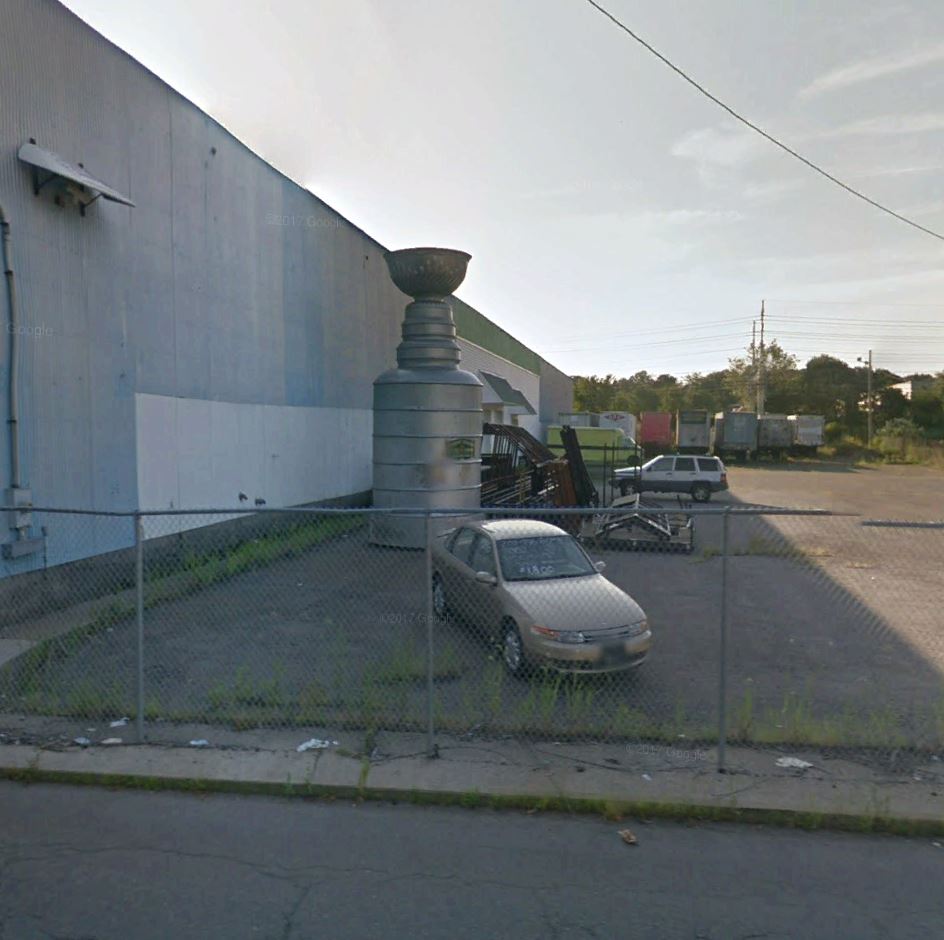
Stanley Cup. Photo courtesy of Google Earth
Runners made their way to Island Lane and into an industrial part of West Haven passing a large replica of the Stanley Cup next to a heating oil warehouse building.  I pressed on knowing my 4:30 finish time quickly vanishing into thin air.  My mile splits grew slower and slower and I resigned to the fact that a five-hour finish time seemed to rule the day.  I crossed the 6.55-mile split timing mat in a time of 1:07:24 (10:17 pace).  A volunteer exclaimed, “For you halfers, you’re half done.  For you marathoners, you’re only a quarter way done.”  Nice to know.

Google Earth birds eye view

Lighthouse house
The roads leveled out to begin a nice downhill trend into Marathon Mile 7 and onto Benham Hill Road and the start of another excruciating hill.  But, the best part of the course was the coolest house of the day – the lighthouse house.

I didn’t have my phone with me to snap a photo; however, I did manage to snap a picture as I left packet pick-up the day before.

The house has a lighthouse spire topped with a lantern room on the backside of the house and even half a boat built as a deck with a swimming pool.  If anyone was watching me, they saw me walk that entire hill with my head pointed straight at that house, thinking ‘That house is so cool!”  What a way to keep me distracted while chugging up a nagging hill, ha-ha.

The hill’s backside consisted of a steep downhill into Marathon Mile 8.  I gave what I had as I cruised almost out of control and turning wide onto a broken pavement potholed street.  It was time to watch my footing as I did not want to injure an ankle or knee.

As I made a right turn onto Jones Hill Road, the next test for runners came into plain view – another dreaded hill leading into Marathon Mile 9.  While on another walking stint, I consumed another GU pack and some Honey Stinger chews – hard and chewy from the cold temperatures.  I’m surprised my dental work stayed in place.

Upon cresting the hill, I picked up the pace on the steady downhill and into a roundabout on Ocean Avenue shortly after Marathon Mile 11.  Again, the police allowed traffic to obstruct runners from crossing the road.  For me, a large 18-wheel tractor-trailer slowly negotiated the roundabout monopolizing the inside overtracking area.  I glanced back at the officer with a displeased look as other runners shared my sentiments.

The next two miles consisted of flat sections of Ocean Avenue with magnificent views of Long Island Sound.  With a welcomed wind at my back, I cruised back to Bradley Point Park and into the finish line area.  The only caveat, I had to do the loop once again.

I crossed under the red inflatable finish line banner stopping the clock at 2:17:09 (10:28 pace) as an exuberant announcer excited the cheering spectators, “Let’s hear it for another marathoner as he begins his second loop.”

All I could think about was the fact I was four minutes slower than what I had planned, but with those hills posing a serious test of my fitness level, I did the best I could.

The second half: (11:32, 11:20, 12:53, 11:15, 14:30, 12:05, 12:13, 12:49, 12:59, 13:48, 12:14, 12:38, 13:58, 11:47 projected pace [final 0.44 mi])

Same profile as the first half.
With the texture and feel of the first 13.1-mile loop now behind me, I knew what to expect the second time around.  I set a goal to finish in under five hours – or a 2:42 lap (12:22 pace).  Easy, right?  I was happy to have one lap done.  I felt okay, but not great – and that concerned me.

Shortly after crossing the timing mat, I pulled over for a shot of GU I had stashed inside my glove as a way to keep the gelatinous substance warm and easier to swallow, chased down with two swigs of water.  With the wind at my back for the next mile or two, it was time to employ my personal race psychology to get through the final loop.

As I circled around Morse Park, I suddenly felt my legs growing heavier.  I kept telling myself, “it’s the headwind and a slight uphill grade.”  As I approached the intersection of 2nd Avenue and Main Street, I immediately noticed police controlling the intersection.  Perhaps someone complained.

As predictable, the number of runners drastically diminished for the final loop and I appeared to be running alone.  I quickly gave up hope striking up conversations with other runners.  My main concern was to avoid getting off course.  I’ve never been to West Haven in my life, so I made it a point to remember certain landmarks the first time through.

I slowly crept up the hill leading into Painter Park tired, with the feeling as if things were beginning to crumble in front of my eyes.  It was at the aid station in Painter Park when I administered two acetaminophen/caffeine tablets to briefly energize my legs.  I realized the brief charge would last but a couple of miles, but I needed it. 

I pulled off the course at the edge of the park, behind a large mature northern red oak tree (Quercus rubra) to relieve some bladder compression I endured over the past twelve miles.  With new sense of euphoria, I focused my attention on my charge down the relatively steep descent leading to Marathon Mile 18, passing two runners on the way.

By not being mindful of my surroundings or the presence of their simple pavement markings, I sensed I took a wrong turn.  I looked back and ahead, but no runners.  I thought, “am I off course?”  I didn’t remember the intersection from the first time, but I saw a police car with a traffic cone nearby.  As I approached the car to ask for assistance, a cop exited his unit and stopped traffic for me.  I told him as I passed, “Thank you.  Looks as if I took a wrong turn.”  He chuckled, but I didn’t find it amusing.  Later, as I analyzed the course map, I did fail to run the correct line.  Again, I was dissatisfied with the lack of course markings or that no one was around to direct runners.

Anyway, I got back on track leading to longer and longer walking stints.  The hills were too much to keep running.  I passed by the Stanley Cup replica once again and crossed the 19.65-mile intermediate split with a time of 3:40:57 (11:14 pace).

I looked forward and set my sights to once again seeing the cool lighthouse house.  The walk up the hill was agonizingly slow, but allowed me to take in the view of the house, wondering if the lantern room houses a Fresnel lens.  I doubt it, but one can wonder.

I focused my attention on the next mental landmark – the downhill gradient leading into the roundabout on Ocean Avenue just shy of Marathon Mile 24.  I kept glancing at my Garmin, mentally calculating a finish ETA.  Five hours seemed like a realistic possibility, but in a marathon, anything can happen.

With a little more than two miles remaining, I was once again on a flat section of the course with a tailwind to push me along.  I attempted to increase my pace for the final homestretch, but my calf began to cramp, forcing me to reduce my pace and alter my gait.  Without question, I was disappointed.  As I crossed the Marathon Mile 24, I needed to finish the last 2.2 miles in twenty minutes.  That was not going to happen given my fatigue levels and cramping, so I revaluated my performance and settled on a time goal of 5:05.

As I turned off Ocean Avenue onto the pathway leading into Point Bradley Park, I could see and smell the finish line.  The end was near.  A shot of adrenaline surged through my body seemingly numbing any pain and discomfort I experienced.  I stepped up my pace up the final incline and sailed in across the finish line with a time of 5:04:35.

RACE STATS:


Distance: Marathon (26.2 mi) – my Garmin clocked it at 26.44 mi

Date: 23 March 2019

Bib No.: 10

Weather at start: 37°F, cloudy and windy (25ºF wind chill).  Winds 15 mph with strong gusts.

Gun time: 5:04:43

Chip time: 5:04:35

Average cadence: 152 steps per minute

Average pace: 11:31 per mile

Overall rank: 123 of 156

Gender rank: 88 of 115

Age group rank: 12 of 14

Elevation: 1247 ft gain / 1247 ft loss (start and finish at same point)

Half split: 2:17:09 (10:28 pace)

Average finish time: 4:26:40

Standard deviation: 0:48:59

Age graded score: 47.48%

Age graded time: 4:23:04

Garmin splits: (9:14, 9:30, 9:46, 9:21, 10:53, 11:19, 10:25, 11:13, 12:13, 10:03, 10:19, 10:23, 10:34, 11:32, 11:20, 12:53, 11:15, 14:30, 12:05, 12:13, 12:49, 12:59, 13:48, 12:14, 12:38, 13:58, 11:47 projected pace [final 0.44 mi])

Course map
LIKES / WHAT WORKED:

  • Small and challenging two-loop scenic course. 
  • Flat – hilly – flat – hilly – and flat course.
  • Very well-organized event from quick packet pick-up to the multiple aid stations along the course serving GU gels, Gatorade and water.
  • Super friendly volunteer support.
  • Hats off to the great spectators displaying their support despite the cold windy weather!
  • Easy parking race morning – but I wish there were more parking attendants directing vehicles.
  • FINISHING!!

DISLIKES / WHAT DIDN’T WORK:

  • The cold and non-stop Nor’easter winds, but there’s nothing one can do about that.
  • No national anthem at the start.
  • The food variety at the finish line needs improvement.  Only non-alcoholic beer, water, plain bagels and bananas available at the finish.
  • Traffic control at intersections!  Some locations saw a free-for-all with runners competing with traffic and irritated motorists.
  • During the second loop, with runners few and far between, make sure you recognize certain landmarks.  Most intersections lacked volunteers to direct runners.


Given my sporadic and inconsistent training since Big Beach, AL and Napa Valley, I was satisfied.  Overall, I did all I could do.  I enjoyed the scenery, the neighborhoods and the shoreline views.

After I received my finisher’s medal, I proceeded into the conference center for some locally brewed NA beer (non-alcoholic), and a banana.  I was really disappointed with the food selection, though.  Besides plain bagels and bananas, I hoped for pizza slices or some other food selections.  Needless to say, it wasn’t worth hanging around so my wife and I stopped for a burger at the West End Bistro on our way back to the hotel.

Earlier, I mentioned that I had enough of New York to last a lifetime.  However, Sunday was a day to relive the New York experience, but this time Manhattan – on foot.

Parking at the TRYP hotel in Newark

Hotel lobby - very ultraviolet-like

Newark basilica
We left Milford shortly after 0800 en route to our hotel in Newark, located a couple blocks from Newark Penn Station.  We parked our car in the hotel lot and hopped aboard the NJ Transit train for a twenty-minute ride to Penn Station New York for the primary reason to enjoy the Broadway musical, Waitress.

We walked around Manhattan visiting such places as Times Square, Bryant Park, Fox News studio, the Rock and the Brooks-Atkinson Theater to pick up our show tickets at the box office will-call window. 

I found Waitress to be about a journey of the main character (Jenna) as she vows to escape her small town and her abusive husband.  An unexpected pregnancy weighs on her conscience to leave town and to participate in a baking contest in a distant city and begin a new life. 

As a waitress in a roadside diner, Jenna is a baker of pies reflecting her emotional states.  In the end, she finds the missing ingredient in her recipe for happiness – courage. Patrons can actually buy pies in small mason jars for $12 – ouch.  Perhaps courage is an ingredient.

The musical is filled with all sorts of moments: some hilarious, some powerful, some touching as well as many feel-good moments.  I thought that the characters were very relatable to real-life scenarios with their performances quite convincing.

Personally, I was amazed!  I went into the musical not knowing anything about the characters, plot or storyline nor I didn’t read anything about the show.  I wanted to be surprised. 

The story turned out to be much deeper than I had anticipated.  It’s not your typical love story in the sense of boy meets girl, they fall in love and live happily ever after.  Rather, I found it to be about self-reflection and soul-searching.

Spending the day in Manhattan turned out much better that our excursion through Brooklyn and Queens.  The weather was great, all the pizza slices were good and the Broadway play was fantastic.  At the end of a long afternoon, we walked back to Penn Station and caught the 1852 train back to Newark.

Times Square


The "Connie" being moved to JFK for a cocktail bar
Fox News studio

Bryant Park
Final thoughts:

Overall, the Savin Rock Marathon was a great experience!  The course is awesome.  I love having a few miles to settle into a groove, then attacking the hills as they test everyone by weeding out the weaker runners from the strong.  The final miles are back to flat to let you rip it out, if you can.  But, for marathoners, a second loop is required, so conserving energy in the first loop is a key component for successful completion.

I would say that the Shoreline Sharks put on a great race from most aspects, but not all.  Yes, the atmosphere was fun and low key, and they say runner safety was of the utmost importance!  But, I couldn’t say there were police at every major intersection or volunteers controlling the minor intersections.  Is that safety?  Traffic cone delineators lined most of the course, but runners had to be cognizant of traffic at all times and course markings need some improvement. 

The aid stations were well stocked with GU, water and Gatorade.  As always, the volunteers and spectators who came out are awesome!  If the opportunity presented itself, would I run this course again in the future?  I could envision myself running this race again – for the challenge and the scenery.  But, I would not fly into the New York area.

I have faced time and time again the difficult truth that strength and confidence in long distance running, much like the course’s elevation chart, exist in a wave form.  There are weeks and even months where nagging pains and tiny setbacks make marathon training feel like a chore.  But there are also spans of time when everything feels easy, effortless and that the body’s limits can easily bend to your will.  At the end, despite my overall performance, I felt strong, powerful, and incredibly optimistic about the rest of the year’s challenges.  The last few months have had their aches and pains, but as I finished my 26.4-mile weekend averaging an 11:37 pace with zero feet of elevation change, I felt incredible.  Waitress put the cherry on top.

With every mile, I kept crossing off times that I could achieve (4:00, 4:20, 4:30) were out of the running, which normally would be a disheartening thing.  However, since creating the goal to finish the distance in all fifty states, I’ve realigned my expectations and mantra – finish the race, finish the state.  I used to challenge myself to run my races to a BQ or a PR, but I’ve come to realize, almost forcibly, that not all race experiences are equal.  Sometimes everything lines up and you absolutely slay the course.  Other times, like Savin Rock or Hatfield-McCoy, you’re not as lucky.

Now I just have to make sure, as my mom advises, to not overdo it during the months of April, May and June as I close out my fifty-state journey.  Because running five marathons in three months is certainly not that.

Thanks for stopping by and reading my post.
So long my friends.
😊

Onward and upward