Thursday, October 25, 2018

State Number 45 - Baltimore Marathon


State Number 45 – Baltimore Marathon

Baltimore, MD

20 October 2018

States 45 and 46 are borne out of escalation and in the interest of frugality – quickly knocking out two states with one East Coast swing.  Securing our second double marathon weekend of the year requires our active participation in the Baltimore and Atlantic City Marathons. 


Running two marathons in two days is, by many accounts, a little nuts.  To the average person, running just one marathon is excessive and even for serial marathoners, they’re simply difficult.  So to do two consecutively requires a little more training, an affinity for fatigue, and the stamina to continue pushing yourself when every muscle is ushering you towards collapse.  However, even with all of these discouraging factors, there are many people who double-up anyway.  In fact, many nutcases go beyond two.  There is even the infamous Quadzilla in Seattle, which hosts four marathons over the four-day Thanksgiving holiday weekend.  The Mainly Marathons series even ups them by routinely hosting up to seven consecutive marathons in seven different states around the country in seven days.  Or, better yet, running the seven continents in seven days.  What’s next?  One on earth and another on the moon?


So it’s not at all uncommon.  But what I have noticed is that, for the most part, whenever fearless runners double-up, they tend to run each race at a very conservative pace.  For me, really slowly.  I’m not out to disparage anyone’s accomplishments because it still takes a lot of dedication, endurance and mental willpower to cover 26.2 miles twice in one weekend.  But for me, the marathon has always been there to push me to my limits, forcing me to cross every finish line with nothing left at times, each drop of sweat and spit, forever grafting itself on the experience.


But I’m also not stupid.  There’s no way I can bust out a marathon as fast as possible two days in a row.  For those who can, I salute you.


I therefore decided the best way to challenge myself over the weekend without dying is to run both marathons in under five hours.  But after combatting a gastrointestinal issue over the previous several weeks, my training and energy levels plummeted, leaving me with no option but to finish, and if it’s under six hours, I’ll be happy. 


When each run has a purpose, it makes training much easier.  So you could say there may be a hypocritical conflict of interest signing up for a double marathon event in the first place.  By squeezing in a full marathon before another full marathon, I am basically creating junk miles that would tire me out for the next day’s run, going completely against this ethos.


And then it hit me, these aren’t junk miles at all.  I actually need to start the Atlantic City Marathon on tired legs.  After this 52.4-mile weekend, I will have no other marathons to worry about until after the new year as I knock out my remaining four states, besides the mileage will better prepare me to tackle the responsibilities of pacing a couple of half marathons near my hometown in November.  By then, the possibility of the debilitating effects of this double marathon will have faded into oblivion.  The best thing I could do for my legs at this moment was to run long while tired. 
 

But that doesn’t mean that it is suddenly time to run with zeal akin to an agile gazelle.  Had I decided to tackle this race at the threshold of my abilities, I would put myself at risk of dehydration and injury, neither of which would help me get through the next day.  So instead, I mapped out a plan.  I would keep a relaxed pace for the first half, and then possibly crank up the speed to a tempo until well into the second half of the race when I usually begin to feel fatigued.  This may not only make the race fun, but it makes the prospects of finishing much more worthwhile – something that had been lacking since my great run in Arkansas.


In February, I successfully completed the Hilton Head Island and 26.2 With Donna Marathon twin-bill.  While the first finish wasn’t all that bad, the finish line at the Mayo Clinic in Jacksonville was all but celebratory.  Due to the Northeast Florida heat, my legs simply decided to stop running during the arduous, laborious and grueling final five kilometers.  I finished the race, but barely, and I did give myself a moment to feel pride because I endured the tough running conditions the entire way.  Even through the pain, I had felt I had a meaningful experience.  I attempted to kick through those last three miles, but just couldn’t do it with any sort of fluid motions.  I gave it my all making the race itself count for something other than a conscious attempt at tiring out my legs and body.

Running South Carolina and Florida taught me a lot about adversity and running through tough times, but a chance to run with new faces in new places made the experience a little more enjoyable.  As I look ahead to this double marathon weekend challenge, I hope the finish line in Atlantic City is a much more festive affair.


It’s strange to have to re-learn such fundamental lessons.  Challenging myself is why I got into this sport so you would think that it would be at the forefront of my runner’s psyche.  I thought my Fifty States mission would keep me excited about running, but it seems like I let myself forget that the true purpose of the sport is, quite simply, to run and quickly course air through my lungs and blood.

Fresh off a mediocre marathon experience in Illinois, hopes that Baltimore and Atlantic City will meet or exceed Belleville’s production; however, remain in serious limbo.


My wife and I departed LAX on an Alaska Airlines non-stop red-eye flight to Baltimore (BWI).  I’m not a champion upright sleeper and overnight flights are never meant for me.  Quite simply, the red-eye is synonymous with misery – especially when traversing three time zones.  Trading a bed for an airline seat is a serious comfort downgrade, and arriving at my destination well-rested and functional is the farthest thing from the truth.


We arrived at BWI around 0530 hours hungry and sleepy-eyed.  We took a short catnap in the terminal, obtained our rental car and were fortunate enough that the good folks at our downtown Baltimore hotel allowed us check in before 0800 – permitting us to slumber on the ultra-comfortable bed for some forty winks before the race expo opened at noon.


The Expo/Packet Pick Up
The Convention Center in downtown Baltimore hosts the marathon expo, conveniently located about three blocks from our hotel.  I have to admit, I was surprised!  For a larger marathon event, this expo was sadly small for a race that attracts some 20,000 runners among all the festival’s events (5K, half marathon, full marathon and relay).  Possibly the best part of the expo is the race merchandise, and the Baltimore Running Festival has some cool event merchandise designs.  I found it rather uncommon to be in and out of a large marathon event’s expo.


Under Armour is the title sponsor of the marathon, and Baltimore IS the home of Under Armour, so it goes without reason that most merchandise is labeled with the Under Armour brand.  It seems that you cannot go anywhere in Baltimore without seeing at least one piece of Under Armour on every person you encounter or every apparel store.  Baltimoreans must love their Under Armour.


As my wife and I entered expo floor, I immediately looked for an opportunity to grab a photo op with Blue (the mascot) before picking up our race swag.  Unfortunately, Blue was nowhere to be found, so an up-close of a stuffed replica was the next best thing.


This years’ marathon event long-sleeved shirt design is red in color with the title “Baltimore Running Festival” featuring the heraldic colors symbolizing the coat-of-arms design of the Calvert-Crossland families of Sir George Calvert.  Only the half and full marathoners receive long sleeve shirts, relay and 5K runners receive short sleeve shirts.


Sure, you may go to a restaurant in Alaska, California or Massachusetts and order a bowl of Maryland-style crab soup, but if you're a native from the Chesapeake Bay area, locals say those soups don't bring out the flavors of Baltimore, Annapolis and the towns surrounding the Bay.


As a visitor to the Charm City, I had to try for myself whether this soup is all the rave.  With a craving for the distinct delicious flavors of real crab soup, my wife and I ordered a bowl of the culinary creation to accompany our pre-race meal at the Water Street Tavern.


My wife and I envisioned the soup would bear a resemblance to clam chowder, but rather, it’s a tomato-based soup filled with vegetables, lima beans, potatoes, seasoning and chunks of crab meat.  Undeniably delicious.


Let’s Do This


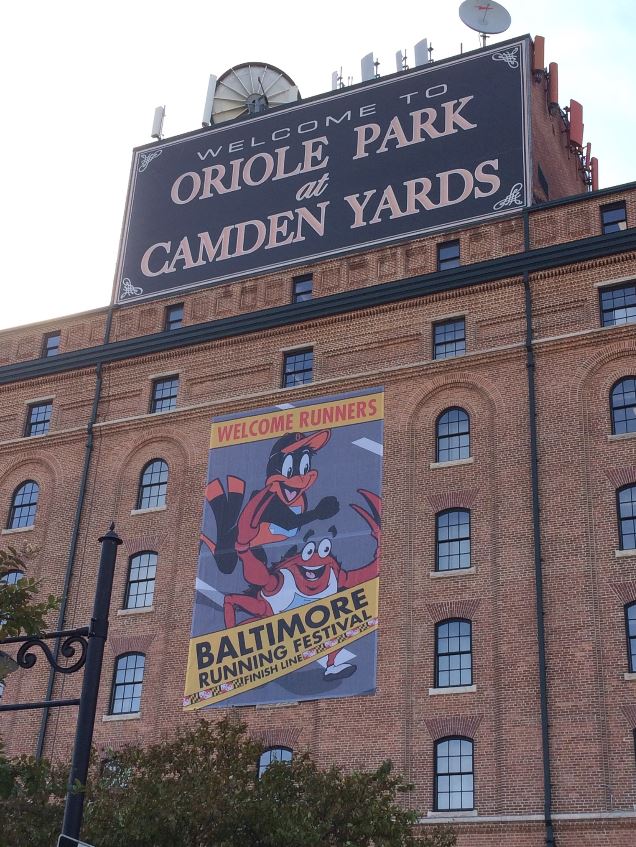
The marathon commences on the north side of Camden Yards, home to the Baltimore Orioles, which I found to be a really cool place.  I had never seen the ball park up close and personal, and it looked very different than I had expected for a ball park. 

Threatening grey clouds dominated the early morning sky with temperatures hovering around 55°F.  Meteorologists predicated a slight chance of a stray shower or two for the Running Festival.  The elevated dew point created a relatively humid morning, sounding my alarm bells.  But hey, I’ll take it over a cold miserable rainy day anytime.

The marathon begins promptly at 0800, while the half marathoners begin their journey near the Inner Harbor at 0945.


We checked our bags and headed to the start line, crowding in with 2400 runners with a little time to stretch my nervous muscles.  We were not pre-assigned any specific corral placement, as there weren’t any, but race officials set up abundant pacers and pace signs so runners may place themselves accordingly.  We slotted ourselves in between the 10:00 and 10:30 per mile group.  I still hadn’t decided if I was going to run with a pacer or just go at it alone and do what I can.  All I know, I have another marathon the next day, so I needed to carefully pace myself for that reason.


Following the pre-race introductions and announcements, runners directed their attentions to the stars and stripes and listened to the National Anthem.  I was taken by surprise when the local runners collectively emphasized “O!” while raising their right fist into the air while singing the seventh line “Oh, say, does that Star Spangled Banner yet wave.”  Apparently, it’s the signature cheer Baltimoreans use during the anthem before a baseball game and is a huge part of Orioles magic.  One must remember, the Star Spangled Banner was written in Baltimore, by the way.


I guess the Orioles tradition is analogous to Boston Red Sox fans rocking Fenway by shouting out “So good, so good” in harmony as Neil Diamond’s Sweet Caroline rings through the stadium’s sound system during the middle of the eighth inning of every home game.  Diamond’s classic and catchy song is a traditional part of Red Sox Nation lore, and by swirling in Sweet Caroline with the Fenway faithful, good times never seemed so good.  If you’ve never experienced the tradition, do so.  It’s an unforgettable experience especially after my wife and I endured the forces that shaped Boston Strong.  But I digress.


At 0800, race starters set off the wheelchair athletes and after a few ticks of the clock later, the horn declared the official start of the marathon.  We cleared the start line under an arch of red, white and blue balloons streaming with confetti and headed northward up Paca Street.


The first half:  (9:50, 9:47, 9:59, 10:16, 9:58, 9:47, 9:43, 9:44, 9:22, 10:14, 10:56, 11:00, 11:21)


The first three miles of the marathon generally fashions itself uphill towards Druid Hill Park and into the Baltimore Zoological area.  It doesn’t take a genius to know, that when a few thousand runners troop down city streets, there’s the tendency the first couple of miles becomes a little crowded leaving only marginal spaces to comfortably move about.  The crowds and slow movement forced me to hold back my propensity to charge out with an unsustainable pace and settle into a rhythm with equally paced runners.


Runners course through the historical neighborhoods of Madison Park and Penn North before entering the Druid Hill Park area.  As the ‘Hill’ in Druid Hill Park implies, it’s an obvious clue to what the first few miles demands from runners.


I managed to keep a comfortable, but steady, 9:50 – 10:00 pace up the hill into the Maryland Zoo and any hint of my typical heel or hip flexor pain was, for the most part, held at bay.


As runners cross the park’s threshold, race volunteers kindly direct runners through the gates of the Maryland Zoo.  Some of the zoo keeping staff greet runners with various animals and birds, such as a raven (hey, it’s Baltimore), a lionhead rabbit (what?), a striped skunk (whoopee), a green heron (I think) and, of course, the famous penguins decked out in their tuxedos waiting for the perfect photo-op.  Unfortunately, no photo-op for me, but I did sneak in to pet one, paying little attention to the keeper’s warning that they can inflict a nasty bite.


Once through the zoo and park, it was across the I-83 freeway into the renowned Johns Hopkins University campus and the first relay exchange point at Marathon Mile 5.7, crossing the mat in a time of 0:58:44.  I always look forward to relay exchange points along a course.  There is always great crowd support with abundant energy to lift the spirits of worn-out runners.  On the down side, runners with fresh legs charge past those without.


The next three miles saw runners trotting down St. Paul Street into the heart of the downtown area and into Baltimore’s Inner Harbor and the starting point of the half marathon.


Half marathon runners hadn’t begun their race as I began the out-and-back portion of the course.  However, the 5K race was still in progress, so crowd support was at an all-time high.


At Marathon Mile 9, runners enter Baltimore’s Inner Harbor area for a two-mile out-and-back section, making a 180-degree turnaround at the foot of the Under Armour headquarters.  Runners then turn back retracing their steps through the second relay exchange point at Marathon Mile 12.1 to the half marathon split at the westerly section of the Inner Harbor near the USS Constellation in a time of 2:16, more or less. 


The second half:  (12:13, 11:41, 13:38, 12:43, 13:00, 13:14, 13:35, 14:04, 13:38, 14:26, 13:41, 12:55, 13:46, 11:17 projected pace [final 0.54 mi])


The beginning of the second half of the marathon led runners back around the harbor through an old cobblestone plaza, home to the KatyÅ„ Memorial, honoring the victims of the 1940 KatyÅ„ massacre of Polish nationals carried out by Soviet forces during WWII. 


The cobblestones pose a significant running hazard for those not paying attention to their footing.  One can easily twist or break an ankle or trip and take a nasty fall.  I traversed the plaza with a slow, but cautious gait.


As I entered Fell’s Point near Marathon Mile 14, I sensed a maritime past and the aura of an old seafaring town.  From what I witnessed, a large concentration of pubs, taverns and other drinking establishments and restaurants lined Aliceanna Street.  

USS Constellation


Some of my feathered friends swimming in the Inner Harbor


Runners left the harbor area just after Marathon Mile 15 at Linwood Avenue in the direction of Patterson Park and the beginning of a steady uphill trend.  I had this sentiment of a rather desolate stretch of the race for the next few miles.  At this point, the half marathon course merged with the full course bringing about a noticeable increase in runners and walkers bringing up the rear of their race.  Many folks sat on their front stoops cheering runners, handing out water, gummy bears, candy and various snacks.


As runners passed through Patterson Park, the slow steady incline began to affect my focus and energy levels.  To skirt my mental and psychological weariness and to put myself into a different frame of mind, I forced myself to pass the multitudes of half marathon walkers giving me a sense of making some headway against other runners.


Valve house
Shortly past Marathon Mile 18, runners enter Clifton Park, complete with ball fields, a high school, playgrounds and an 18-hole municipal golf course.  Also, one cannot miss the Clifton Park Valve House, an 1880s massive octagonal stone structure with large once ornate Romanesque archways and Gothic windows, surrounded by Type K railing and portable chain-link fencing, has unfortunately has fallen into a state of disrepair. 


The final relay exchange point came after the valve house.  I found myself maintaining a comfortable consistent pace as I made my way onto Harford Road towards Lake Montebello.

Lake Montebello


Whether their intentions were good or not, I heard many spectators telling runners, “It’s all downhill from here.” 


Was I hallucinating?  Based on my increased running effort and by my topographic observations, I questioned their motives – it looked uphill to me.  Given the proclivity of the course, I had this strong sense as if I was running uphill all day long.


I reached the “summit” past Marathon Mile 19 with a slight downhill leading into Lake Montebello.  With one of the few flat parts of the course, runners completed a one-mile circuit around the lake in a counter clockwise fashion, only to emerge with another brief uphill out-and-back section.


Exiting the Lake Montebello area at Marathon Mile 21, it was uphill once again.  Runners proceeded westerly along E. 33rd Street into the Dunkin Donuts “Munchkin Mile” where volunteers handed out large cups full of “munchkins,” essentially a glazed doughnut hole with a glorified name. 


If you know me, I usually use common sense when it comes to eating and long-distance running, and if common sense prevails, I usually don’t try any new foods on race day or during a race.  I usually stick with that rule…well, maybe for six chocolate glazed munchkins, I made an exception.  I chalk it up as a dessert after having just consuming a GU energy blocks chased down with cups of water.


As I passed the aid station, munchkins littered the roadway as if someone participated in a dough-ball fight.  What a waste.  I guess some runners before me couldn’t stomach the doughy substance in their gullets, but I expected the sugary confection would provide an enjoyable energy boost.


After closing out the last uphill segment through various neighborhoods at Marathon Mile 23, finally runners enjoyed a much anticipated long straight downhill gradient to the finish.  While not paying attention to my surroundings, I proceeded to stumble over a small fiberglass traffic delineator, pulling my calf muscle and nearly tumbling to the pavement – scary thought, but I managed to regain my balance.


While trickling through these neighborhoods, inspiring Baltimoreans were out in force, encouraging runners and walkers with their impromptu aid stations along the course offering free beer to runners.  How could I pass up an opportunity for some needed carbs and an ice cold drink? 


I stopped to sample a Natty Boh at one of those unofficial aid stations.  A beer never tasted as good as it did then!  Fueled with a small amount of carbs, I attempted to pick my pace up once again, enjoying the feeling of heading toward the final miles of a long race.  The crowds got a noticeably bigger as I neared the final mile.  Law enforcement officers cheered runners, giving high fives or simply a fist bump, lifting my spirits as I made my final push to the finish line. 


Even though runners encounter a couple nasty short inclines after Marathon Mile 25 thrown in just to keep you honest, the final stretch was downhill.  Runners made a left turn onto Pratt Street to the enjoyment of the final 0.2 mile of cheering crowds heading into the finish. 


Multitudes of runners seemed to whiz past me during the final homestretch.  As I looked up at them, I saw the “RELAY” sign pinned to their shirts.  Nothing kills the ‘ol ego faster than some fresh-legged runner sprinting past you in the final mile of a marathon.


I crossed under the finish line gantry with a not-so-inspiring time of 5:10:34.  Considering my conservative approach to my race pace and the fact my GI issues over the past weeks kept me from feeling one hundred percent, I had to feel content. 


Shortly after I finished, I hunched over to take a load off my back.  A medic quickly approached to query me about my health status.  I assured her I was ok, but was quickly told to move off to the side so other runners wouldn’t crash into me.  Given my place in the overall standings, that was unlikely to happen.


As I entered the finisher’s chute, I gladly accepted my unique customized finisher medal in the shape of a crab, with the shell opening up to a scene of the Baltimore skyline.  I grabbed some bags of Utz chips, cowtails, water and a couple other post-race goodies and waltzed over to the harbor area meet up with my wife.


Typically right after a marathon, I do not have any kind of satiable appetite.  So, a cup of crab soup given to the first 15,000 runners didn’t appeal to me (with my luck, probably would’ve been out) – neither did the thought of having my free Dogfish Head craft beer.  I instead pointed my feet towards Pratt Street and walked back to our hotel to shower, check out and depart for Atlantic City to do this crazy activity one more time.


RACE STATS:


Distance: Marathon (26.2 mi) – my Garmin clocked it at 26.54 mi

Date: 20 October 2018

Bib No.: 2355

Weather at start: 55°F with cloudy skies, slightly humid

Gun time: 5:11:06

Chip time: 5:10:34

Average cadence: 152 steps per minute

Average pace: 11:51 per mile

Overall rank: 1426 of 2326

Gender rank: 921 of 1400

Division rank: 72 of 107

Elevation: 1132 ft gain / 1125 ft loss

Half split: 2:16 (10:23 pace)

Average finish time: 4:40:11

Standard deviation: 0:53:03

Age graded score: 45.77%

Age graded time: 4:28:39

Garmin splits: 9:50, 9:47, 9:59, 10:16, 9:58, 9:47, 9:43, 9:44, 9:22, 10:14, 10:56, 11:00, 11:21, 12:13, 11:41, 13:38, 12:43, 13:00, 13:14, 13:35, 14:04, 13:38, 14:26, 13:41, 12:55, 13:46, 11:17 projected pace [final 0.54 mi]


LIKES / WHAT WORKED:

  • Great communication from race organizers.
  • Cleverly crafted crab finisher’s medal that opens to reveal a skyline scene of Baltimore.
  • Well organized event.
  • Fantastic race shirts.
  • Medium-sized marathon field of about 2500.
  • Amazing support by Baltimore police! They love high fiving and cheering on runners.
  • Free race photos!
  • FINISHING!!

DISLIKES / WHAT DIDN’T WORK:

  • The food variety at the finish line could be improved.  
  • The late start time.
  • Hilly course.  Seems like running uphill the whole day.
  • Spectators are sparse in some areas.
  • Could use more on-course entertainment.

Final thoughts:


From what I could surmise, this marathon shows what Baltimore is all about – warts and all – to the runners.  Baltimore seems to be a beautiful city in many places and facets – but, as one can expect, there are also the gritty places that no one likes to talk about. 

Based on crowd support alone, Baltimoreans portray an aura of taking pride in their city and don’t shy away from the harsh realities characterized by large urbanized expanses.  Amazingly, even in some of these less than desirable areas, residents came out to cheer on all the runners.  I thanked many of these people for their support by waving to them.  I know it certainly means a lot to runners having so much spectator support.

I was happy to see that all aid stations had the same layout and flow – Gatorade then water then food.  I was glad bananas were available; however, I was unhappy they provided whole bananas and everyone who ate one just ate a bite or two then discarded the rest either in trash receptacles or on the street.  I found it a bit wasteful and something the organizers can easily change in future years.

With my finish time at 5:10:34, I have to get rid of some fifteen minutes.  Speaking of which, after my initial competitive disappointment slipped out of my mind never to be seen again, I remember that technically, my goal was to finish in under five hours.  So really, I did meet my goal since theoretically, I was at 4:59¼more or less.  Sometimes you have to get creative for inner peace.

Yes, I was sore, achy, and stiff, and definitely did not look forward to running another 26.2 miles.  But, I was on a mission – a mission I will complete.  Just five more states!

Onward and upward to Atlantic City!

Wednesday, October 3, 2018

State Number 44 - Belleville Main Street Marathon


State Number 44 – Belleville Main Street Marathon

Belleville, IL

29 September 2018


I imagine every runner goes through similar thoughts during a marathon.  We sign up for a race, train and then when we get to the race, something usually goes wrong.  From parking situations, long lines at the porta-potties, waiting in the cold air, to navigating through the hordes of people to stake your position in the corral – or even not feeling well enough to think the day may not go as planned.

Yet, we sign up for another and another and another.  But, at the end of the day, finishing a marathon, whether it’s your first or one hundredth, is an extremely exciting and rewarding experience.  To me, it never gets old.

Ask any Fifty States runner why they want to run a marathon (or half marathon) in every state, besides being crazy and bordering on irrational, the one answer you’re unlikely to hear is “Illinois.”  Illinois?  The Chicago Marathon?  Nope.

Aside from that popular and prodigious marathon, it turns out most folks just don’t know where to look.  Admittedly, my visit to the Prairie State, or the Land of Lincoln as most know it, started out more guns than roses.  I wasn’t going to allow myself to stop and smell the fragrances of the prickly-stemmed, pinnate-leaved, showy-flowered shrub, but rather to come out with some sense of consistent and unfailing focus, effort, speed and celerity.  Focus and effort – yes.  Speed and celerity – arguable.

I believe most fifty-staters typically knock off the state of Illinois by running the Chicago Marathon, but I’m not a fan of big marathons with big crowds and big entry fees.  I may not fit the norm, but I don’t like big city traffic and parking or walking forever to the start line.  Give me a small low-key marathon in a small town any day.  Sometimes, big things come in small packages.

The third running of the Belleville Marathon certainly fits my bill for a small friendly marathon.  Belleville is a marathon only event meaning there are no half marathon, five or ten kilometer runners overindulging themselves with all the finish line food – something that happened in Sioux Falls (State No. 34).

Just because this fledgling event is small doesn’t mean it’s insignificant or worth the time or expense.  Even though the field of runners may number on the low side (around 200), this marathon is big in many ways, like the awesome crowd support, volunteers, organization, logistics, etc.  Lest we forget, the much hyped Beast Craft BBQ at the finish line. 

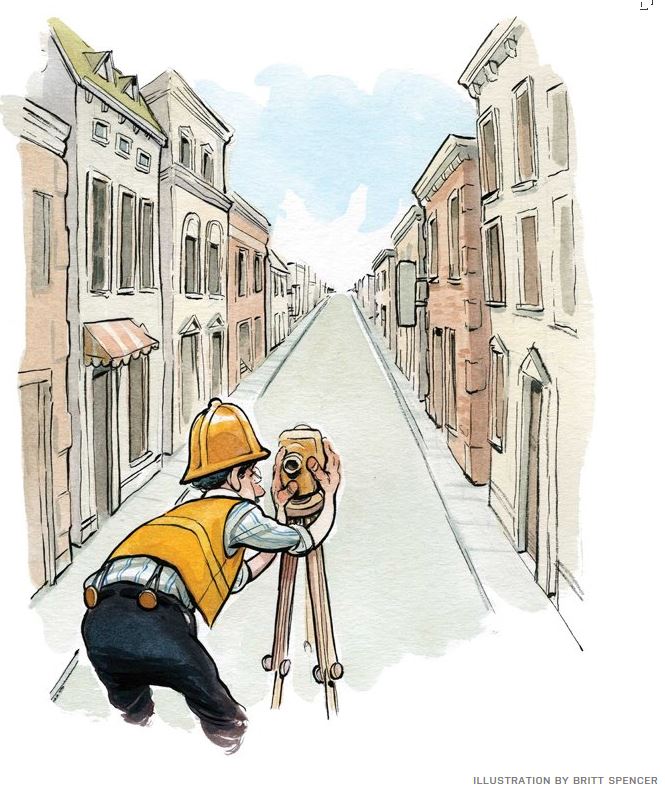
Since its inauguration just two years ago, the Belleville Main Street Marathon may be one of those races beginning to take shape attracting the attention of marathoners from not only the Midwest, but also from around the country.  Located nearly thirty minutes east-southeast of St. Louis, the city of Belleville is the most populated city in the St. Louis metro area as well as southern Illinois.  Sited in close proximity to Scott Air Force Base, Belleville boasts it has the longest continuous Main Street.  Whether that’s an accurate assertion or not is still up for debate, but as I run the course, I will render a decision at that time.

My wife and I departed LAX on a non-stop 3.5-hour American Airlines flight to St. Louis’ Lambert Field (STL), touching down under a glittery star-filled sky with pleasant autumnal temperatures.

We awoke early Friday morning to the unpleasant, obnoxious and unrelenting sounds of lawn mowers, leaf blowers and weed eaters as the hotel property’s landscapers decided to carry out their weekly grounds keeping.  Come on, really?  Such a displeasure and frustration as we needed to rest!

On marathon eve, we budgeted enough time to visit a couple of sites in the St. Louis area prior to heading off to Belleville for packet pick-up.  First “on tap” was a tour of the Anheuser-Busch Brewery, then skyward for an unforgettable ride up to the Gateway Arch observation area at the arch’s keystone.


Free beer is a big draw in any context.  But free beer in addition to an opportunity to get a behind-the-scenes tour at how some of the world’s most popular beer is made?  To some, that’s a hard decision to turn away.

The tour involved a lot of walking with the first stop being the company’s beloved Clydesdale horses and their stables for an up close look at those regal majestic animals.

From there, it’s a trip to the beechwood aging cellar for a peek at the enormous aging and filtering cisterns, holding enough beer to fill over a million cans.  The temperature-controlled cellar is set to a constant 50°F for optimal brewing/fermentation.

Next, the tour group proceeded to a multi-story building for a refreshment break – our first sampling of either Budweiser or Bud Light.  As we sampled, everyone endured a lecture of the brewing process and the ingredients that make up Budweiser and Bud Light.

It was then up several flights of stairs to witness the mash and skimming tanks along with a quick lecture of that process, which was a little tough to hear through all the background noise.

Finally, it was up several flights of escalators to the bottling room where thousands of still unlabeled bottles made their way up and down conveyor belts, squeezes, rinse machines, fillers and capping.  I guess the tour guides thought that the journey up the escalators were enough to call for another sampling of freshly bottled beer – premium, lime or orange flavor?  Upon exiting the bottling floor, each tour participant received a bottle of Bud Light “born on” the date of our tour.  After a short shuttle bus ride, we entered the Biergarten at the main building for another indulgence of the tasty libation and to relax, eat lunch or soak in what we all learned, and to some, sober up.

For those who really care...

Old Statehouse where Dred Scott trial occurred with arch in background
During my formative years, I’ve always been fascinated with St. Louis’ Gateway Arch.  I believe it is one of the motives that inspired me to become an engineer.  Now, as a true engineer, I still revere the arch’s design features, mechanics and structural components.

The famed arch, designed by well-known Finnish architect Eero Saarinen, was completed in 1965 and serves as a testament to the westward expansion of early United States history.

In the for-what-its-worth department, most people believe St. Louis’ internationally recognized symbol assumes the profile of a simple ordinary parabolic curve.  In reality, it is in the shape of a flattened catenary curve taking the same shape as a hanging chain attached between two fixed points.

The only way up to the observation area is via a system of tram “capsules” ingeniously designed in the late 1960s.  Eight capsules each holding five people ascend to the top from either the arch’s north or south side.  Nervous riders wait in front of a pre-assigned sliding door analogous to waiting for an amusement ride at Disneyland.  The four-minute ride is certainly not for the faint of heart or those with claustrophobic predispositions.

Tram system showing capsules

Inside capsule.  Note tight space.


Waiting for the ride

Looking up

At the keystone

Looking down


Dome in old Statehouse
The view from atop the arch is nothing more than amazing with the horizon stretching out more than thirty miles in each direction, with Belleville off in the distance.


Busch Stadium
The quaint downtown area of Belleville is a bustling space with a number of pubs, taverns and eateries, ornamented with white string lights enfolding the decorative streetlights that brighten Main Street every night, giving visitors the impression of a year-long Christmas season.

The historic boulevards and motorways of Belleville are rich with history, with beautiful Victorian homes and buildings contouring the city streets, taking one back to the good ‘ol days.


We checked in to our hotel a few blocks from the race start and had pizza lunch/dinner at Papa Vito’s before picking up our race swag at Toolen’s Running Start.  Personally, I thought the thin crust pizza pie tasted delicious, but that’s only my opinion.


Toolen’s Running Start, in nearby O’Fallon, hosts the marathon “expo” and packet pick-up.  Basically, there was no expo, but only a single table whereby runners check-in and pick up their swag – nice and simple.


As I waited for the minutes to count down to the start, I wondered with a slight grimace if I was feeling well enough to confront the marathon distance.  With my last marathon in July and a half marathon in August, I did have some long runs to prepare myself, so why was I so nervous? 

Since I’ve run between 5 and 15 races per year over the past years, few of them have the special haze that comes with months of daydreaming.  I think some runners in the Marathon Maniacs, who run one or two marathons every weekend for the entire year, wonder how they can enjoy races if they’re a staple of the everyday, like eating or brushing your teeth.  I’m simply going to ease into a rhythm and enjoy what the day has to offer.

It goes without saying, I’m probably the sweatiest person I know as I exercise or carry out some other physical activity.  It seems I start perspiring just standing still in eighty degree temperatures.  I’m not high-strung, don’t have a high body fat percentage, and certainly I don’t want to be sweating – but it still happens. 

I understand that sweating is a normal response to exercise and, from my past experiences, I’ve observed a lot of variation in sweat rates.  As long as I continue to drink fluids and am aware of the signs of heat exhaustion and heat stroke, I take the appropriate steps to protect myself from dehydration.  I’ve also read that sweating earlier and more profusely may be a sign of HIGHER fitness levels.  Athletes and individuals who are aerobically fit are more efficient at releasing heat and tend to sweat earlier in a workout – go figure.

Whether it’s hot or cold, I come back from short four-mile runs looking like I jumped into a lake.  All that water loss leads to a depletion of energy, especially in humid conditions.  In these cases, the sweating process is thrown out of sync because the water in the air doesn’t allow perspiration to evaporate very quickly, the body’s genius way to cool itself.  So in hot and humid races (such as the 26.2 With Donna Marathon in Jacksonville, Florida or the Hilton Head Marathon in Hilton Head, South Carolina) I end up quickly bereft of all energy and overheated.

So it should go without saying that I would avoid any races held in typically hot, humid areas of the country.  I would probably shy away from most summer races altogether unless they were in Canada or along the coastal Pacific Northwest. 

Where I live, summer for me is analogous to what winter is for most runners – that time of year where you just relax and let yourself go because it’s too awful outside to pound the pavement.  You’d think that, even though I ran a very humid race in Kentucky and followed up that with an arduous race experience in Vermont…in July.  Even with rudimentary meteorological terms such as “temperature” and “dew point,” they seem come together in a complex way forcing me to hate the concomitant struggles, but I did it.

So I suppose it was only natural to defy this trend and go for a full marathon in a dissimilar environment – flat, fast and much cooler temperatures.  And why not?  It’s an almost adolescent reflex – if someone tells you, you can’t do something; it just makes you want to do it more.  In this case, that someone was my body.

Even with wildfire smoke infusing California’s central valley air over the summer, I still forced myself out the door and put myself through the many miles of training that goes into a marathon.  I want to at least enjoy the event and not suffer in awful conditions.  I had learned to deal with heat from my previous marathons, but the idea of slogging through another cool laden run called out loudly to me.

Each Run Should Have a Purpose

Whether you’re running three miles on a weeknight or simply pacing a half or full marathon, you should have a purpose every time you lace up your shoes.  Although some may disagree – how often does a five-miler really have its own unique mission?  I’d like to say, hopefully every time.  There exists a debate on “junk miles,” or miles that you run conservatively to rack up a bigger weekly total; however, I resist striking them from my training program.  Many claim running miles simply to rack up mileage may not be as effective as targeted miles.  But, sometimes it’s simply a matter of perspective.  Five miles at marathon pace can either be five junk miles for the hell of it, or five miles to recover from the previous day’s longer run, but I believe they count in some fashion.


In my world, a mile is a mile, 80 chains, 320 rods, 5280 feet or 1.609 kilometers.  No matter how you look at it, it’s the same distance.  But, to improve, you must do tempo runs, fartleks and other forms of speed work.  Lately, I’ve thrown those “other forms” out the window and I find myself running miles just to maintain my base fitness and endurance levels needed to complete 26.2 miles.  Together with my work responsibilities, the dreaded summer’s triple digit temperatures indubitably put a damper on my training miles.

Let’s Get This Show Underway

During the pre-race hours, my brain synapses fired indiscriminately analyzing my pacing strategy.  I settled with a mile pace in the 9:45-10:30 range, accounting for water stops, but realistically, maintaining that strategy is another question.  While I did most of my “long” runs in the 9:45-10:15 margin window, I had to be realistic about the fact that I had not been able to train consistently for most of the hot summer and I did not want to quickly extinguish my internal flame after the half marathon split by plunging out of the starting gate too fast.

However, still reeling from skillfully pacing a half marathon in August, I stepped in to the corral of runners with self-assurance and a positive outlook.  The sun began to shine against an azure-colored sky with temperatures hovering around 50°F.  With a refreshing breeze circulating in and around the buildings fronting Main Street putting just the right amount of nippiness in the early autumnal air, anticipation swept over the crowd of runners – let’s do this!

Approximately 200 runners toed the start line in front of the fountain at Belleville Square at the traffic circle of Illinois Street and Main Street.  Shortly after the playing of our National Anthem and with runners eager to bolt out of the starting line, the race director sounded the air horn promptly at 0700, sending the swarm of bounding runners on their journey. 

The first half:  (9:44, 9:39, 9:41, 9:46, 10:06, 10:06, 10:09, 10:23, 10:52, 11:04, 11:07, 11:38, 11:22)

When runners become more comfortable with the marathon distance, it can be easy to fall into the trap of thinking that after the half marathon split, if you’re feeling good, you can coast through the remaining thirteen like it’s a walk in the park.  I associate it to running ten miles during training – since it’s much shorter than a typical long run, you go into the run thinking it will be a quick, effortless jaunt.  But if you start with that attitude, you may soon find yourself bored or worse, tired, humbled and ticked off at yourself for not performing at your best effort.

Sadly, I went into this race with a similar kind of thinking.  I wasn’t running for a particular time goal, but only for the thrill of a race and finishing in under five hours, nor was I expecting Mother Nature to put up a fight.  The morning air was thick and cool with a slight headwind, but the course ahead was supposed to be flat and fast with some stubborn dispersed hills. 

I stepped over the start mats with a slumped, but easy, stride, as if running were punishment for forgetting to take out the trash.  It really felt like a reprimand for something I did since my left heel began to bother me affecting my stride.  It wasn’t getting worse, but it wasn’t dissipating either.  Just a constant nagging ache, knowing that after the marathon, I’ll be in for a rough afternoon – walking, that is.

There was nothing particularly special about this race that grabbed my attention months ago.  It was simply a small emerging marathon still in its infancy stages garnering good reviews, and the convenience of knocking out Illinois without tangling with Chicago or driving long distances persuaded me to sign up for it.

After dragging myself through that first half-mile, I soon recognized I forgot to start my Garmin as I crossed the starting line.  I also realized that if I wanted to successfully navigate the landscape of southwestern Illinois, I’d have to overcome my own attitude.  That process began by recognizing the challenge that lay ahead and to never assume that any given race is in the bag.  Hubris can be a dangerous thing since it can set up unnecessarily high expectations, and the looming threat of failing to achieve any time goal is increased by perfunctory form.

The first four miles of the course were fairly flat with a few slight rolling hills in and around Belleville Park before joining a short section of the West Belleville Trail eventually leading back onto Main Street.

In keeping with the event’s namesake, Main Street was home for the next few miles until veering off into the Signal Hill neighborhood near Marathon Mile 7.  The tree-lined, island separated boulevard colonized with mature spruce, elm and poplar trees, seemed to be the centerpiece of the community filled with large, elegant homes dating back to the early twentieth century.

Hippie-theme of Signal Hill

Showing support

Signal Hill

Sampling of various signs along course
Runners continued their tour through the chic hippie-themed neighborhood for a short out-and back only to begin a long and wearisome five-mile trek along Main Street to the half-marathon split on North 28th Street, clocking in with a time of 2:15, more or less.

The second half:  (11:37, 11:51, 12:03, 11:35, 11:40, 12:38, 14:15, 12:39, 12:57, 12:14, 11:57, 11:14, 11:09, 10:26 projected pace for the final smidgeon)

I wasn’t at all disappointed with my half split time.  I kept a pretty consistent pace and looked forward to the second half of the marathon.  Besides my dull aching heel pain, I felt pretty good, but it was time to administer two acetaminophen tablets at the nearest water station to take the edge off the discomfort.

The weather definitely cooperated in my favor – cool and breezy with a heavy cloud cover.  The clouds parted ways every so often allowing the sun to shine through, but any heat remained at bay.

Shortly after Marathon Mile 15, runners veered off city streets and onto the Richland Creek Greenway Trail, a two-mile, multi-purpose, pathway meandering through the heart of Belleville.  At Marathon Mile 16, I crossed paths with the two lead runners on their way to the finish line with focused and determined looks on their faces, and in no mood to gesture, “Nice job.”

The Richland Creek Greenway Trail connects to the six-mile unshaded and nearly spectatorless MetroLink Trail paralleling the MetroLink tracks, leading up to Marathon Mile 20 in the Brookhill Estates development, on the southern flank of the Southwestern Illinois College campus.  Fields of dried corn stalks and soy bean plants dominated the scene on one side while looking on as the nearly riderless MetroLink trains zip past on the opposite side.  This section of the course was, I would say, the dullest.

After paying a visit to the enthusiastic and zealous residents of Brookhill, runners charged back out along the same MetroLink Trail for their final ten kilometers to the finish line.  I knew what was in store for the next few miles, but I kept plugging along, knowing that in the end, better scenery awaited at North End Park at Marathon Mile 25, and better yet, the finish line.

I believe the most memorable part of my marathon experience was around Marathon Mile 23 as a toddler approached and began running alongside me, laughing and having a good time.  Amazingly, he ran with me for about a tenth of a mile as his dad made him stop.  He began to cry and said, “But I want to run with that man.”  I stopped, gave the little fella a “low” five and thanked him for the support.

I kept my pace consistent along the uninteresting and repetitive trail until the final five kilometers, and as I entered North End Park, a slew of boisterous spectators and volunteers give me much needed energy and vigor. 

Within the final mile, I constantly monitored my overall time making sure my sub-five hour finish time would become a reality.  I just had to remember to add five minutes to make up for the lost time at the very start.  My pace picked up and as I rounded the final turn back onto Main Street, seeing the finish line off in the distance.  After a short negative gradient into a sag vertical curve, the grade suddenly became positive.  My first thought, Kansas City once again – a tough uphill finish.

One man stood between me and the finish line.  I was not about to let him finish before me so I picked up the pace enough to sneak up behind him and charge ahead over the final 100 meters.

My presence was undeniable as he noticed me and picked up his pace.  I heard some spectator exclaim, “We have a race!”  I glanced over my shoulder to see him closing in, so I gave it all I had with a final kick sprint to eke him by three seconds.  That was my defining moment of the race and worth every effort.

If I had that kind of energy to finish that strong, maybe I needed to give more during the race.  Coulda, shoulda, woulda.  But hey, I succeeded by beating my goal time.

RACE STATS:


Distance: Marathon (26.2 mi) – my Garmin clocked it at 26.29 mi

Date: 29 September 2018

Bib No.: 153

Weather at start: 50°F breezy, under a canopy of clouds

Chip time: 4:56:53.594

Average cadence: 157 steps per minute

Average pace: 11:20 per mile

Overall rank: 134 of 192

Gender rank: 85 of 110

Division rank: 12 of 15

Elevation: 696 ft gain / 650 ft loss

Half split: 2:15:22 (10:21 pace)

Average finish time: 4:35:09

Standard deviation: 0:55:21

Age graded score: 47.88%

Age graded time: 4:16:48

Garmin splits: 9:44, 9:39, 9:41, 9:46, 10:06, 10:06, 10:09, 10:23, 10:52, 11:04, 11:07, 11:38, 11:22, 11:37, 11:51, 12:03, 11:35, 11:40, 12:38, 14:15, 12:39, 12:57, 12:14, 11:57, 11:14, 11:09, 10:26 (projected pace for the final smidgeon)

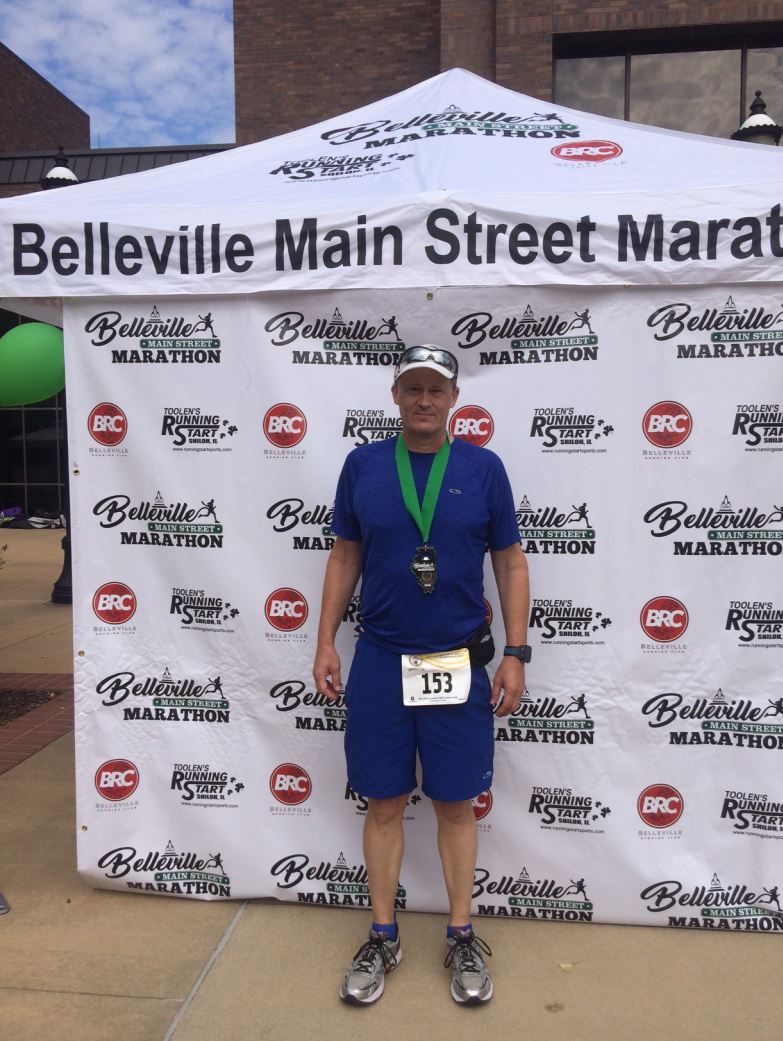
I received my coveted finisher’s medal proud of my accomplishment and wrapping up State 44.  I picked up some post-race food, BBQ chicken sandwich (even though I asked for pulled pork), chocolate milk, water and a mylar blanket, sat down and took a much needed load off my achy dogs.

Definitely not I...but I felt as if I could surely wolf down this burger
Usually, our customary protocol is to supplement a marathon with a delicious juicy burger, fries and an ice cold beer, but time wasn’t on our side.  We cleaned up, changed clothes and charged out of Belleville en route to STL for our late afternoon flight back to LAX.

LIKES / WHAT WORKED:

  • Great course on a portion of the longest Main Street. 
  • Wonderful place to escape the hustle and bustle of the big city.
  • A small, but very well organized event from packet pick-up to the multiple aid stations along the course.
  • Super friendly spectator and volunteer support.
  • Great tech shirts. 
  • Hats off to the great spectators displaying their support!
  • Mostly shady course.
  • Excellent BBQ and beer at the finish
  • Plenty of finish line food.
  • FINISHING!

DISLIKES / WHAT DIDN’T WORK:

  • The out-and-back MetroLink Trail.

Final thoughts:

I was impressed!  Belleville delivered a big small town welcome and support for this professionally organized event.  As soon as runners arrive at the start, it was evident that the staff and volunteers welcome and encourage all the runners.  The course is predominantly flat with some small hills thrown in to make the course interesting and are spaced out enough as not beat up runner’s legs. 

The marathon course basically comprises two segments of an out-and-back configuration with a large segment of the second half run on a pedestrian/bike trail.  The trail can overwhelm a runner’s zeal, but persistence and focus are key to conquering the pathway. 

As a way to distract tedium and fatigue, race organizers and sponsors scatter abundant portable signs with inspirational, funny or amusing messages all along the course.

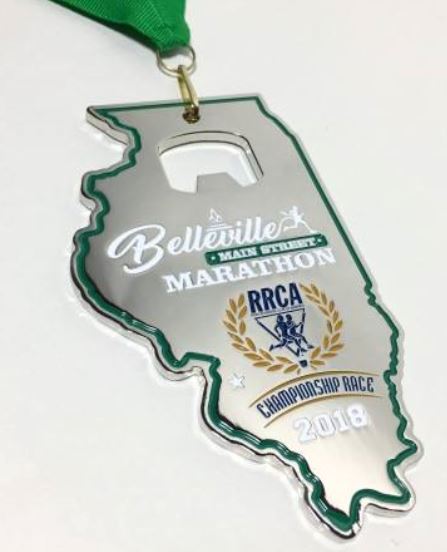
There are more than enough water stops on the course and spectator support (which lined most of the course) was amazing.  To me, each water stop seemed like a mini marathon party, with everyone so energetic and eager to please every runner and make sure they have what they need to continue.  Event shirts featured a great design and finisher’s medals were big and very classy in the shape of the state of Illinois.  Post-race food, BBQ and drink was fantastic and not just grab and go; a far cry from the usual “hot bologna, eggs and gravy” routine seen at too many marathons.  The finish line announcer calls out each person’s name as they come in.  It is so cool to hear your name announced for all to hear acknowledging your hard work!  AMAZING RACE!

Was this the longest continuous Main Street?  Maybe.  I’ll just have to give them the benefit of the doubt.

By running a marathon in all 50 states, there's no better way to explore the country around you than ploughing along on your own two feet, for as long as you can, until you hate yourself and everything around you.  Then you stop, take a deep breath, get a medal, and start over.  Next up, Baltimore and Atlantic City.
Onward and upward!