Friday, June 3, 2016

State Number 24 - Eugene Marathon


State Number 24 – Eugene Marathon, Eugene, OR

1 May 2016

Everyone knows that the Pacific Northwest is notorious for rainy weather throughout any given year.  As atmospheric high pressure ridges sit parked over the southwest, the jet stream forces weather systems and moisture laden clouds over the ridges like water flowing around large rocks in stream beds, thus creating cloudy overcast skies with copious amounts of rainfall, with Eugene averaging over 40 inches per annum.

Normal weather patterns of the northwest region are marked by a great deal of precipitation west of the Cascade Mountains while the eastern side of the range is considerably more arid due to rain shadows produced by the orographic lift of the coastal and Cascade mountain ranges. 

This year, the organizers of the Eugene Marathon worked with the planners of the Oregon State Rain Festival to make the marathon a great success.  The festival planners graciously postponed their weekend festivities by allowing beautiful weather to dominate the Willamette Valley.  It is hoped that the great working relationship between the two events continues into the future.

The trek to Eugene turned out to be an extended weekend drive.  We left our home early Friday morning for a ten and a half hour drive up I-5.  Instead of driving the distance in one day, we decided to spend the night in Medford, OR in an older downtown motel.  The motel was likely a busy place during the 1950s along the historic U.S. Highway 99.  Since then, the rooms have been remodeled with some modern day amenities, but the room layout, size and façade definitely keeps its older charm.

We arrived in Medford around 1530 Friday afternoon after a wearing drive through the Sacramento Valley and over the Siskiyou Mountains.  Mt. Shasta was shrouded in clouds and could not be seen from Interstate 5.  Siskiyou Summit, just north of the state line, reaches an elevation of 4310 feet and claims to be the highest point along the entire stretch of I-5 from Mexico to Canada.  It is believed that the second highest point is Tejon Pass at an elevation of 4144 feet atop the Grapevine where the freeway traverses the San Andreas Fault in Los Angeles County.

Gusty winds coming down off the summit and into the Rogue Valley were a nuisance to vehicles, especially for high profile vehicles.  Extra attention was needed to safely negotiate the sharp highway curves coupled with the wind gusts.  From the looks of it, a weather front was advancing across the region creating cloudy skies and gusty winds.  Weather forecasts predicted the front would move through in time for the marathon.

We were a little hungry after we checked in and settled into our room.  I took out my iPad, logged on to the wi-fi, and looked for, what else – pizza.  Topping the list was Kaleidoscope Pizzeria and Pub on Crater Lake Highway.  It received good reviews, so we gave it a try.

Kaleidoscope is a locally-owned business established in 2004.  Based on the menu, the place features stone-baked pizza and a variety of other menu items.  Artwork from local artisans covered the walls in the colorful open-atmosphere dining space.   

The pizzeria was rather busy, with servers constantly moving about providing great customer service to their patrons.

I ordered a meat calzone and my wife a three-cheese pizza.  I sampled a piece of the three-cheese pizza and wasn’t particularly fond of the flavor.  I thought the essence of parmesan cheese was a little overwhelming.  The calzone was a little different from what I’ve had other times.  I would say it was basically a pizza folded in half and the look of the calzone had no bearing on the taste.  It was quite delicious, but definitely needed more cheese and marinara sauce.

My wife says I have no palette when it comes to food and that everything tastes good or delicious.  It is true that I have no discriminating tastes, but there are foods I do not like and if something doesn’t taste good, I’ll let anyone know.

We made our way back to the motel after the delicious Italian dinner.  We were tired and decided to settle down, have a soda and watch The Amazing Race before retiring for the evening.

Waking up early is a conventional occurrence in our house, whether it’s a work day or weekend day, it doesn’t matter.  Our circadian rhythms have been out-of-whack for some time with the antics of our cat and the regular schedule of the dog’s incessant whining at the same hour of every day.  So, waking up early was especially easy without an external medium.

We grabbed a quick “breakfast” from the lobby consisting of some orange juice, banana, and a Svenhard’s pastry before we left for the three-hour drive to Eugene.  Truly a breakfast of champions.  An early start will afford us an opportunity to do and see things around the Eugene area.

We gassed up at a Mobil station in the vicinity of the Rogue Valley Mall prior to accessing I-5 northbound.  As I was about to exit the car to pump some gas, a station attendant donning a Class III construction vest approaches and asked what grade of fuel we wanted.  The thought came to mind that I was in Oregon and when in Oregon (as well as New Jersey), motorists aren’t allowed to pump their own gas.  For whatever the reason, discrimination against the elderly or disabled or setting yourself on fire, banning self-service is a preposterous rule.  Oregon needs to wake up and see the light.  In California, each station has an ADA call button located somewhere on or near the pump that alerts an employee for assistance if needed, so discrimination is not really an issue.

Once we passed through the city of Grants Pass, Douglas fir (Pseudotsuga menziesii) stands covering the hillsides became plentiful.  Passersby can see the many parcels of land that have been recently logged or in years past.  It was evident that new generations of timber were growing back in the clear cut areas and will once again be logged for the structural lumber Douglas fir trees provide.

We decided to make a pit stop in Roseburg for a couple of liters of bottled water needed to hydrate ourselves before the marathon.  The most troubling thing about driving I-5 was that Oregon sets the speed limit at 65 and trucks at 55.  State troopers parked in their brown units along the freeway were busy using their radar catching speeders.  We were forced to use cruise control since neither one of us wanted to be lit up with bright blue lights.  The troopers were slick, though.  They would park on steep downhill grades, five to six percent, and nab drivers going too fast.  It’s hard to control the vehicle’s speed on such steep grades without heating up the brakes.  They must be desperate for a revenue stream.  I get tired of hearing, “It’s not about revenue – it’s about safety.”  Yeah, right!

The State of California is one of seven states with differential speed limits (65/55).  The maximum truck speed is set 55 mph with other vehicles at 65 (70 on some freeways).  I have always contended that these differential speed limits could create safety issues with car-truck collisions as opposed to truck-car collisions. 

Typically, with only two travel lanes, traffic often gets congested and snarled when a big rig moving at 55 mph attempts to pass another, the probability of a collision is much more likely.  Based on my observation in other states, such as Nevada and Arizona, trucks do not have differential speed (uniform) limits and traffic flows smoothly and unobstructed.

An FHWA study concluded that car-truck collisions (rear-end) in 65/55 limits were nearly 30 percent higher than states with uniform speed limits.  In my driving experience, I would be in accord with that conclusion. 

When we arrived in Eugene, our first order of business was a stop at the race expo held at Hayward Field.  Parking in and around the University of Oregon was limited meter or permit parking.  However, race organizers provided free parking at the Civic Stadium across from South Eugene High School off Amazon Parkway.  From there, shuttle buses provided transportation to and from the expo at regular intervals.

Large white tents were set up on the synthetic turn of the lacrosse/soccer fields adjacent to Hayward Field.  A great touch to the expo was a listing of each runner’s name and city under their home state, or country, at the tent’s entrance.  All fifty states and a few countries were represented.  The tents not only served as the expo, but also for the finish line services for runners, family and friends.

The expo was simple and efficient with a decent quantity vendors and easy packet and t-shirt pick-up.  We tasted some of the free samples, took some pictures of Hayward Field and the finish line and even opted for a free tattoo – a temporary air brush type, of course. 

Agate Street Gate
A beer garden featuring a variety of craft beers from the Hop Valley Brewing Company was set up adjacent to the Krusteaz pancakes kitchen.  The finish line festivities from the Run TT 5K and the Kids Duck Dash was just wrapping up as we arrived at the expo and some of the runners were eating their pancakes and syrup along with a beer.  Yum, what a combination!  A meal like that wouldn’t sit too well in my stomach.

Hayward Field is one of the world's best-known historic track and field stadiums and is a popular venue for the U.S. track and field Olympic trials.  Nearly a century in age, it has been the home of the University of Oregon's track and field teams since 1921, and was the on-campus home of Oregon’s football team from 1919 through 1966.  

We walked down into the track area and snapped some pictures of the finish line and the famous Agate Street entrance gate.  It was truly a wonderful experience being in a stadium and on a track where great athletes once competed, including the legendary Steve “Pre” Prefontaine.  We walked around the expo for about an hour and a half and it was time to board the bus back to the parking lot. 

Pre's Rock Memorial
The university was the home of Pre who was killed in an automobile crash in 1975.  On Skyline Boulevard, not far from the university, lies a memorial known as Pre’s Rock and is an eternal reminder of the site where the famous runner was killed. 

We drove up the knoll just east of the university to visit the area to pay homage to the great runner.  Dispersed alongside Pre’s Rock are various shoes, finisher’s medals, running singlets, photographs, and bibs.  The memorial at the base of Pre’s Rock features a stone plaque with an etched portrait and an adage that reads:


For your dedication and loyalty
To your principles and beliefs...
For your love, warmth, and friendship
For your family and friends...
You are missed by so many
And you will never be forgotten...

Pre once said, “The best pace is a suicide pace.  Today feels like a good day to die.”  He was famous for going out hard and fast not relinquishing his lead forcing his competitors to run on pure guts if they wanted to win.  He raced that fateful day, I wonder if that thought crossed his mind.

Eugene from Hendricks Park
On our way down Skyline Boulevard, we happened to stumble across Hendricks Park, known for its rhododendron garden.  Walking the paths in the cool urban forested area of the park and listening of the songs of the different species of birds was a refreshing treat.  Many variations of rhododendrons and native flora were in bloom that painted the park in a diversity of pastel colors.

We were getting hungry, so it was time to drive into Springfield to check in to our hotel, the Super 8 off Beltline Drive, and find a good place to eat.  The Holiday Inn Express served as a shuttle bus stop to Hayward Field, and was a short convenient walk from the Super 8.  Buses ran from 0530 to 0640 and departed every ten to fifteen minutes, more or less, so by leaving our car at the hotel parking lot, it was a resourceful use of our time not worrying about finding parking around the university.

We inquired about a late check-out, but the clerk would only give us until noon.  A one o’clock check-out would have cost an extra ten dollars.  What a rip off, so we decided to just check-out in the morning and to change clothes and wash up in a restroom just off the hotel’s lobby before driving home.

Ciao Pizza Trattoria served as our dinner establishment Saturday afternoon.  I was faced with a big decision, do I order a calzone or a Stromboli?  I settled on the Stromboli complete with smoked Italian sausage, smoked salmon, jalapeños and artichoke hearts.  Wow!  What a combination of ingredients some might say, but I thought it was quite delicious.  Crushed red peppers added an extra touch of flavor.

We turned in early Saturday evening after a long day traveling and the need for rest for the upcoming strenuous day.  Because of our whacked circadian rhythms, we had no problem waking up early enough to catch the 0600 shuttle bus.    

Sunday morning was tranquil with cool crisp temperatures under a cloudless sky.  It was perfect running weather for me, but I was cautiously optimistic is was not going to be hot.  The forecast was for sunny skies with temperatures to be in the low 70s. 

Ample shade was dispersed throughout the course, but there were a few unshaded areas with only direct sunlight – naturally for the last three miles.  I was confident that I trained well enough to get through the sunlit sections before the heat set in.

The race course has changed over the past nine years.  It wasn’t until the last couple of years that the finish line was moved to Hayward Field and included the tag line, “Running in the Footsteps of Legends.”  I was enthusiastic and looking forward to running through the Agate Street gate and onto the track finishing in the shadows of world class runners.

About twenty minutes before start time, my wife and I both made one final trip to the porta potties.  We found an isolated facility with a short line, so we waited there instead of the long lines where the majority of the facilities were located.  We all noticed the unit was a little tipsy from the uneven ground it sat upon.  Some people seemed fearful the unit would fall over, so someone would stand near to stabilize it.  I had to interject by saying I was an engineer and that the resisting moment is significantly higher than the overturning moment associated with the movement of the person inside, thus resulting in a high factor of safety against overturning and that the unit was not going to tip over.  In my professional opinion, because of the low center of mass, the unit was stable and no one had to fear the misfortune of a capsized porta potty.

Roughly thirty minutes prior to start time, approximately 4500 to 5000 runners of both the half and full marathon began gathering in their assigned corrals designated on their bibs.  As with most races, half marathon runners outnumber the full, so I would place an educated guess of a 60-40 split between the two, respectively. 

The tenth running of this marathon began promptly at 0700 at the corner of 15th Avenue and Agate Street in front of Hayward Field.  The horn sounded after a great delivery of the National Anthem.  My strategy going into the race was to finish the first half around 1:55 and hopefully keep the pace long enough to finish in around 4:20, slightly under a ten minute overall pace.  No, I did not tear out of the starting gate with a suicide pace as Pre would have.

The first mile of the race included a slight uphill gradient in advance of a downhill plunge into South Eugene towards Amazon Park and along East Amazon Drive where runners began a modest uphill climb that peaked just past Marathon Mile 4.5.  I was keeping a steady 8:50 pace trying not to aggravate my adductor brevis muscle too much, which has been a ubiquitous annoyance for me for the past couple of years.

Runners then crossed over to West Amazon Drive for a refreshing downhill for the next three miles right to another, probably the steepest ascent of the course on E. 19th Avenue towards the university. 

By the time I passed through the start line on Agate Street, half marathon runners were already entering the gate onto Hayward Field on their way to the finish line.  Those runners were at least four miles ahead of me.  The course led everyone through Franklin City Park along the Willamette River and across the Knickerbocker footbridge to Pre’s Trail to the half marathon split in Alton Baker Park.  I passed through ten miles in 1:27 (8:42 pace).

I was comfortable with my pace and enjoyed the shaded bike path through the park and onto the city streets of Springfield.  I crossed the half marathon split as I turned onto Centennial Blvd with a time of 1:56 (8:53 pace), almost meeting my goal time.  Barring any unforeseen circumstances and knowing the second half is ALWAYS slower, I was on target for a 4:20 marathon finish.

Just before the split, I grabbed some water so I could self-administer some acetaminophen and caffeine after crossing the timing mat, knowing the next water stop is another mile and a half away.

Not long after making my way onto Centennial Blvd., I noticed several drops of blood; still wet, spattered on an 8-inch white left-turn pocket channelizing line, Detail 38A in California’s amendment to the MUTCD.  My immediate thought was someone suffered a bloody nose, but I didn’t think anything more of it.

Shortly before Marathon Mile 16, the course departed city streets and once again, took runners on Eugene’s scenic bike paths in Alton Baker Park near Autzen Stadium and the baseball park on Leo Harris Parkway.  The North Bank Trail led runners for the next five miles along the Willamette River, back behind the Valley River Center mall and through the well-known wildlife haven of the Delta Ponds.

The ponds were created in the 1950s as a result of gravel mining.  Since then, the city opened up the mine’s protective berms along the river front in an effort to restore water flow, thus creating more suitable habitats for fish, wildlife and native plants.  The North Bank Trail crosses the ponds with a wooden raised causeway complete with informational placards and viewing platforms.   The area was very placid and scenic and the wood-surfaced causeway provided a more comfortable running surface than the asphalt-concrete bike path.

I crossed the Marathon Mile 20 timing mat with a split time of 3:08 (9:24 pace).  I thought to myself, with 10K left, I needed to finish in 1 hr 12 min.  I was set to meet my 4:20 goal time.

Owosso Bike Bridge over Willamette River
The Owosso Bike Bridge spanning the Willamette River at River Mile 178.7 was just ahead.  As I came up to a curved section of the trail, a pink box of doughnuts sat on a little table stand just off the pavement edge.  A runner stopped in front of me and immediately grabbed one to munch on while thanking the folks for supplying the doughnuts.  The thought of eating a doughnut, much less watching the guy eat one in front of me, turned my stomach.  That’s not the kind of energy I needed and that ghastly thought quickly faded as I began up the approach to the bridge to the aptly named, South Bank Trail, for the final homestretch.

Once on the south side of the river, the runners cruised through the forested trail and through Maurie Jacobs Park, Owen Rose Garden, Kiwanis Park, and Skinner Butte Park.  After the parks, the trail led runners into the sunny portion of the course with about a mile and a half remaining.  Shade was very limited and it was beginning to heat up and my pace noticeably slowed.

Numerous cyclists were sharing the bike path with runners.  All but a handful were courteous and yielded to runners, but, of course, there are always the idiots.  Some cyclists just charged ahead at high rates of speed and bellowed out to runners to get out of the way.  The last thing I needed was to be hit and injured by a bicycle, so I moved to the outside of the trail and yielded to them.  The endless sound of bicycle bells reminded me of the poem from Edgar Allan Poe, “The tintinnabulation that so musically wells / From the bells, bells, bells, bells…/ From the jingling and the tinkling of the bells.”

What about that blood I saw earlier?  Between Marathon Miles 23 and 24, I received a text from my wife informing me that she had fallen on the course and was in the medical tent being tended to.  That blood spatter immediately came to mind – it was hers.  I thought how bad was she injured?  Will she need stiches?  Any broken bones?  If she could finish, it mustn’t be too bad, I thought.  Wash and cleanse the wound, apply a dressing and go about your day.  Surely she would have told me if it was serious.  I wasn’t worried too much and shifted my focus to finishing as fast as I could.

When I left the Ruth Bascom Bike Path through the Riverfront Research Park and into the final stretch down Agate Street, I could taste the entrance into Hayward Field.  The cheering spectators lifted my spirits and gave me the needed energy to finish strong.  I was a little behind my goal time, likely a casualty of the sun and heat a mile back, but I wasn’t complaining.  I was about to finally experience what the half marathoners experienced some seventeen miles earlier.

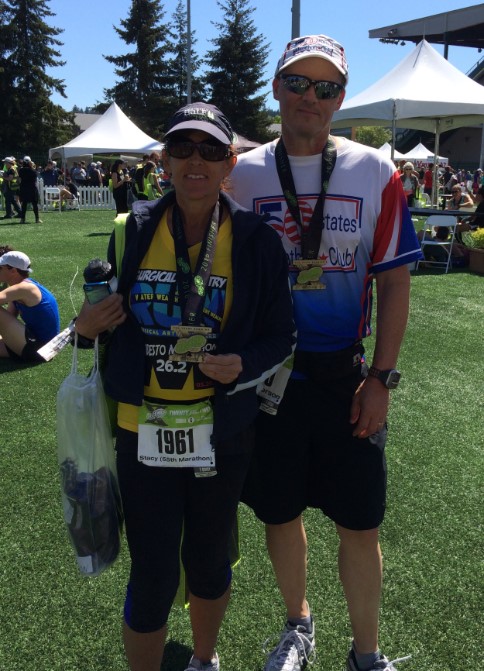
I saw the entrance to the field and the finish line – what a sight!  I didn’t push myself too much as I didn’t want to cause my calf muscle to cramp, as what usually happens.  The soft spongy feel of the track was amazing.  I struck a pose for the cameraman and finished in a time of 4:22:02 (10:00 pace).  My Garmin read 26.44 miles.

Age graded score: 53.88%

Age graded time: 3:55:23

The coveted finisher's medal
I received my finisher’s medal and made the walk up the ramp and out of the stadium area and collected my goody bag given to each finisher.  I looked around for my wife and couldn’t spot her amongst all the runners and family members.  I walked over to the medical tent and made use of the shade so I could see my phone display.  Just as I was texting, I noticed my wife walking to me.  I could tell she was in pain by the limp and the patched elbow.

She said stitches weren’t necessary, but a deep laceration to the bony prominence of the ulna, olecranon, can take a long time to heal because of the constant straightening and bending of the arm.  Because it is positioned directly under the skin and lacks protection from muscles and other soft tissues, the bone can easily break if one falls directly on the elbow.  She was fortunate the bone did not break.

I was getting hungry, so I made my way over to have some pancakes and maple syrup.  It didn’t take long for the sweet nature of the food to upset my stomach.  I love a nice cold beer after a great run – even a not-so-great run, but pancakes and beer – not a good combination.

Delicious marionberry
After I finished my pancakes, we walked up to the shuttle bus stop for a ride back to the hotel.  As I seated myself, the temperature in the bus was quite muggy and hot.  I immediately opened the window, but that didn’t provide much relief until due to the lack of cross ventilation.  Once the bus moved, the air was much better.  The bus first stopped at Autzen Stadium where most runners disembarked. 

When we arrived back to our car, we grabbed our clothes and used the hotel’s restroom facility to take a quick PTA wash-down, for those in-the-know, and changed into dry clothes.

At this time, we were getting hungry.  Before heading south on I-5, we drove across the street to Café Yumm! to order a quick lunch to go.  We brought the lunch over to a nearby McDonald’s to eat before we each ordered a scoop or two of Tillamook ice cream for desert.  For me, a scoop of marionberry, a blackberry indigenous to Oregon, hit the spot.

Around 1330, we departed Springfield for the five and a half hour drive to Redding, where we would spend the night and visit family before the drive home Monday afternoon.

My name is listed here!
The City of Eugene, aka Track Town, USA, organized a great marathon.  Everything about the race was well planned and organized and the pre-race logistics went along without a hitch.  The hassle-free parking at the shuttle bus lot was worth the time without the aggravation of finding a parking spot around the university.  The expo was average, but nothing special and featured a variety of vendors and free samples.  It was awesome to see all the runners’ names on the “Running in the Footsteps of Legends” mural outside the expo tent’s entrance. 

Being able to walk out onto Hayward Field and soak in the history of the facility was amazing.  Normally, the field is closed during the expo time for personnel to set up portable fencing, banners, finish line equipment, etc., but no one stopped race participants from venturing out and snapping a few photos for posterity. 

Abundant porta potties were available at the start line area.  As usual, as start time approached, wait times increased exponentially.  I just wished the race organizers allowed runners to use the potties set up in the finish line area instead of staff yelling at runners not to use them.

The course includes only two “significant” hills – the first one beginning at Marathon Mile 3 and the second coming at Marathon Mile 7.5.  The inclines are only around 3-4 percent per se, but really don’t pose a problem since they come early in the marathon and runners have enough energy and stamina to conquer them.  After passing through the university, the course is rather flat with a few ups and downs now and then.

The law enforcement agencies of the cities of Eugene and Springfield did an excellent job with traffic control and provided great support to the runners and participants were not in danger of being run over by vehicles.  The course was well marked with plenty of water/aid stations stocked with water, Gatorade, bananas, oranges and other goodies for nourishment.  Of course, one unofficial aid station provided adult nourishment in the form of beer after Marathon Mile 22.  I’d recommend skipping any doughnuts along the course.

Once runners are cleared of city streets, the scenery along the Willamette River is amazing.  Marathon day was cloaked in bright sunshine glistening off the water of the river.  The cool shaded areas along the bike trail provided needed refreshment for runners not adapted to running in the heat and sunshine. 


Wood duck
Great blue heron
Gadwall
A noteworthy area along the river are the acclaimed delta ponds.  A wood viaduct traverses areas of the ponds providing for great views of the wildlife and the different ecosystems.  I was able to spot a great blue heron (Ardea herodias), gadwall (Anas strepera) and the ever-colorful wood duck (Aix sponsa).

While on the South Bank Trail, participants must be vigilant of the numerous bicycles sharing the trail with runners.  Some forge ahead at high speeds dodging around the platoons of runners and seem to be exasperated by the inconvenience.  On the whole, most cyclists yield and provide a courtesy warning with their bicycle bells.

The familiar "O"
The final stretch down Agate Street was lined with cheering spectators and lifted spirits of many runners who were tired, struggling or just completing their first marathon.  Entering the main gate into the stadium provided a sense of exuberance to all participants, whether it is from the sense of being in the footsteps of elite athletes on a great track, obtaining a PR, or from just finishing a great long run. 

The finish line area was a great place to meet with family or friends and since it was a bright beautiful sunny day, a perfect opportunity to kick off your shoes and relax after a hard day’s work.  Eating pancakes loaded with syrup is probably not the best after marathon recovery meal, but they tasted great – even though I suffered a stomach ache.  For those into craft beers, the beer garden is a great place to unwind.  Overall, the marathon event was well done and I would recommend it to anyone.  Thank you to all!
Finished!!

Wednesday, May 11, 2016

State Number 22 - Garden Spot Village Marathon


State Number 22 – Garden Spot Village Marathon, New Holland, PA

9 April 2016

Why did the chicken cross the road?  We all know the answer to this: to get to the other side.  But what if the road was covered in slushy snow with hundreds of runners?  Would the chicken get very far then?  And should it even take that risk?

Over the years I’ve run in various climatic conditions such as heat, cold, rain and wind.  Prior to embarking on our marathon excursions, it is customary for my wife and I to monitor weather conditions at the host location so we can prepare accordingly.  In the days leading up to our trip to New Holland, PA, weather forecasts varied depending on what web site we looked at.  But one thing was consistent – it was going to be cold with a chance of some kind of precipitation.  Some said rain/snow mix while others (particularly the local television stations) predicted a chance of snow.  Naturally, we prepared for the worst case scenario – snow.

Several years ago, I embarked on a red-eye flight from Maui (OGG) to LAX, so I had an idea such a flight had in store.  The first leg of this journey wasn’t much different, but instead, involved a non-stop Alaska Airlines red-eye from LAX to Baltimore-Washington International Airport (BWI). 

Being as tall as I am, sleeping in an aircraft seat is difficult for me since they don’t recline much and I can’t get comfortable due to the seat and leg clearances.  One thing I found troubling were the flight attendants waking people asking if they would like a drink or something to eat.  Really?  Awakened with a question like that I’m sure didn’t sit too well with other passengers.

We landed at BWI Friday morning around 0610 EDT.  The sun was beginning to rise over the eastern horizon with partly cloudy skies.  We were a bit sleepy-eyed coming off the plane (not to be confused with Johnny Horton’s 1961 hit “Sleepy-eyed John”), but walking through the airport provided some sense of alertness and awareness.

The restaurants, shops and kiosks in the airport’s concourse were all closed and there was an eerie quiet except for the PA broadcasts.  I found it surprising how many people were at the airport at that time of morning, either coming off a red-eye or voyaging off to some destination.

We caught a shuttle bus just outside of baggage claim to the Alamo rental car facility located just off the airport grounds where we claimed a Chevy Sonic for our marathon expedition.  Before taking possession of our car, we informed the good-humored Alamo attendant that we hailed from California and weren’t used to the colder weather, let alone, snowy conditions.  He said that if it does snow, it wouldn’t stick to the road since it is too warm and we shouldn’t worry.  He informed us that he used to be a cop and said if we kept speeds under 10 mph over the speed limit, we wouldn’t be lit up.  That was comforting to know.  Nevertheless, we just had to be aware of speed cameras in and around construction zones along the interstate freeways.

Typically, our excursions include running two marathons in two different states as a way to minimize travel.  Saturday’s Garden Spot Marathon was in New Holland and Sunday’s marathon was the Runners Marathon of Reston (RMR) in Reston, VA, northeast of Dulles Airport (IAD), about three hours apart.

We left the rental car facility around 0645 and headed north on I-195 to I-83 via the Baltimore Beltway that led us into Pennsylvania.  The sun was low on the horizon and gave us fits with glare.  The visors didn’t help due to the sun’s low angle and we needed to be careful during the morning’s peak hour rush in the Baltimore metro area.

I knew of a Pennsylvania Welcome Center/rest area just past the state line and suggested we stop there to take a short nap before proceeding.  Besides, we had oodles of time to kill before packet pick-up in New Holland, so the extra rest wouldn’t hurt.

We exited I-83 into the Welcome Center a couple of miles past the Pennsylvania state line.  At the visitor center, I picked up a Pennsylvania map and some visitor guides to Lancaster County and City for ideas of things to see and do as well as a Whatchamacallit candy bar and a 20-ounce Diet Coke from the facility’s vending machines to take the edge off the hunger pangs we were experiencing.

For the time being, the snack quelled the beast inside me.  Perusing the visitor guide, I found that James Buchanan, the nation’s fifteenth President, lived and is buried in Lancaster.  The city is also home to another attraction, the Rock Ford Plantation.  We made it a point to see these landmarks on our way to New Holland.

Now that our hunger was curtailed, it was siesta time.  We both reclined our seats and tried to get some shuteye.  I found it difficult with the sun shining through the window so I put a coat over my face, but the sun only warmed the coat which warmed my face and made for an uncomfortable nap.  We, maybe, managed about a half hour nap, but that was better than none.

After our rest stop, we drove north on I-83 through the City of York and onto eastbound U.S. 30 towards Lancaster.  Our first stop was President Buchanan’s Wheatland estate.  Soon after we turned into the parking area, it began snowing lightly.  The car was so warm, we ended up taking a second short nap before venturing out.

After our brief catnap, we walked over to the Lancaster Historical Center to use the restroom facilities and to peruse whatever seemed interesting.  A tour of Wheatland mansion set back the ordinary soul $15 per person, so we decided not to tour the mansion.  We instead walked the grounds and peeked into the windows, took a few pictures and can now say we’ve been there and done that.  The skies were clouding up and it was turning cold and windy, so it was time to dash over to Rock Ford Plantation.

I set the address into my iPhone Google Maps app and followed Siri’s directions.  On the way to the plantation, I noticed a sign that read “President Buchanan’s Grave” at the Woodward Hill Cemetery’s Chesapeake Street entrance.  I made a note of the location so we could see the place following our visit through Lancaster Central Park and the Plantation.

Lancaster County Central Park is the largest park in the area spanning about 500 acres and located on the southern edge of Lancaster City in West Lampeter Township.  The beautiful park setting is home to many activities for residents and visitors such as a large pool, trails, gardens, skate park, environmental center and the most popular attraction, the Garden of Five Senses with its beautiful settings of flowering plants, trees, and a water fountain fed by a stream running down the hillside with energy attenuators used to reduce in-channel water velocities.  This garden lives up to its name by stimulating all the senses.  Interpretive signs, also written in Braille, along the garden's meandering walkway explain how each of our senses works and how we and other animals use them to survive.  Our visit to this garden was short lived due to the cold and windy conditions.  Only a few brave souls were out and about.

Just beyond the Garden of Five Senses sits Rock Ford Plantation.  The mansion is the preserved 18th century home of Edward Hand who served as Adjutant General to George Washington during the American Revolution and sits on 33 acres at the southeastern edge of Lancaster City surrounded by Lancaster County Central Park.  Rock Ford is widely considered to be one of the best preserved examples of Georgian domestic architecture surviving in Pennsylvania and the most intact building predating 1800 in Lancaster County.  Rock Ford offers visitors an example of sophisticated country living during the early years of our country.

We decided not to tour or walk around the mansion grounds based on some signs indicating that the area is private property and reservations may be required.  No photos were to be taken, however, we did sneak in some photos on our way out.

After leaving the park, we drove back to the cemetery to see Buchanan’s gravesite.  The cemetery holds graves dating back to the 1850s.  The curvy narrow lanes and inadequate signage made the mission of finding the gravesite rather challenging.  I noticed a hill/high point on the grounds and it would only seem logical that a president would be buried at the top of the hill.  I was right.  At the foot of his gravestone was a square and compass with an inscription that he was a member of Lancaster’s Masonic Lodge No. 43.

It was time to have some lunch.  My wife did some prior research for places to eat in Lancaster and found Salt and Pepper Italian Bistro and Pizza.  I entered the address into Google Maps and followed Siri’s directions.  Unfortunately, she guided us to a wrong location into a condominium development on the southeasterly side of Oregon Pike.  The correct location was actually on the northwesterly side of Oregon Pike tucked in a rather new residential loft/commercial development. 

Unique to this establishment, I noticed various salt and pepper displays and light fixtures made from salt and pepper shakers, pasta strainers and pizza plates.  The menu consisted of many scrumptious Italian dishes.  I decided on a Philly cheesesteak, wiz wit, hoping it was as delicious as a cheesesteak I once had at Geno’s in Philadelphia.  My wife had a slice of cheese pizza and a plate of manicotti.  Unfortunately, the cheesesteak was not as good as Geno’s, but was rather delicious.  I seem to compare cheesesteaks to Geno’s and will hopefully find a place that serves better steaks than Geno’s.

We left the restaurant around 1230 and had ample time to spare before the marathon’s expo at 1400.  We found a Walgreens where we picked up a few odds and ends for the weekend before heading east on U.S. 222 towards Ephrata where we stopped at a McDonald’s for a dollar drink and to burn time before the expo opening.  Three teen-age girls giddy about receiving their first McDonald’s pay check provided some entertainment in the meantime.

Around 1400, we left Ephrata for the twenty minute drive towards New Holland.  The Garden Spot Village complex was just off Kinzer Road and was very easy to find, given that New Holland has around 6000 residents.

Various tents were set up on the village grounds in preparation for the marathon event.  Packet pick-up was quick and easy.  Since my wife was pacing, her special packet and specially made pace sign was at another table.

Each participant was given two distinct race shirts.  One was a tech shirt to wear running and the other shirt was for running around in.  The saying on the shirt read “The road is my happy place.”  I think it should read “The road is my happy pace” as a play on words as one can run whatever pace they feel like to be happy.

New Holland, Seischwamm in Pennsylvania Dutch, lies in the heart of Lancaster County in Amish Country.  The city is bisected by Main Street with other local and collector streets and roads.  The agricultural rich area encompasses endless farm land, barns, silos and stables covering the rolling terrain throughout the county.

After we left the Garden Spot Village complex, we drove to the Bird-in-Hand Family Inn in the hamlet of Bird-in-Hand just west of the city of Intercourse.  The hotel stay was complimentary to marathon pacers, so who could pass up a free night’s lodging?

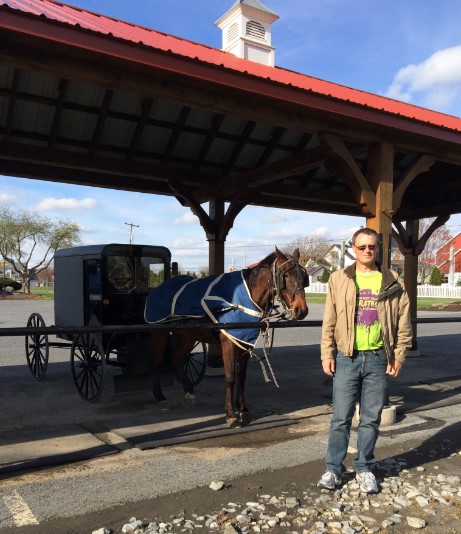
On our way, we encountered several Amish horse and buggies sharing the road with other vehicular traffic.  Each one had the distinctive red reflectorized triangle on the back side complete with turn signal lights.  I found this mode of travel quite interesting and was fascinated with the Amish culture.

During my college days, I took a course in geography as part of my general education requirement.  The professor I had completed his doctoral research on the Amish culture.  He lived in Lancaster County during that time and was always lecturing about his experiences with the Amish and that if one ever had an opportunity to visit the county and the people, it was a must.  I haven’t forgotten that geography class nor the professor’s lectures, and nearly thirty years later, that opportunity came knocking with the running of this marathon.  The visit to Lancaster County was truly a treat.

After we checked into the hotel, we strolled over to the Bird-in-Hand Family Restaurant for a dessert treat.  The restaurant was famous for Pennsylvania Dutch home cooking.  It looked to be a busy place with many patrons either at the smörgasbord or ordering a la carte.  The restaurant gift shop displayed a variety of locally made Amish foods, quilts and arts and crafts available for sale.

As I browsed the menu, shoo fly pie immediately caught my eye.  I heard about this pie from my geography class lectures, so I couldn’t pass up on the opportunity.

The molasses pie traditional with the Amish derives its name from the sweet molasses odor that attracts flies and, hence, must be shooed away.

I ordered a warmed-up wet bottom version topped with whipped cream over the gooey custard-like pie filling.  I had visions of it tasting like dark Karo Syrup my late uncle once poured on his pancakes, so I was a little apprehensive at first.  But after the first bite, the pie exceeded my expectations and was absolutely delightful. 

My wife ordered a slice of carrot cake with cream cheese frosting with a side of vanilla ice cream.  The piece was rather large, but she said it was really good.  Too bad I only had one slice of pie, I could have eaten the whole pie – but I wouldn’t want to know the subsequent consequences of partaking in such indulgence.

On our way back to the room, we noticed a horse and buggy parked under a parking structure for such vehicles.  I didn’t realize specialized parking areas proliferate at area businesses.  Duh, it’s Amish country.  Where else can one park a horse?

Parking for one-horsepower vehicles
Before entering the hotel building, we noticed a maintenance worker loading tools into his van.  My wife declared we were from California and were not used to the cold weather, as she was bundled up in multiple layers.  He chuckled and surmised we must have been from Florida.

After our passing encounter, we entered the indoor pool area complete with two pools and a large hot tub.  The temperature in the pool area was hot, steamy and muggy, but was better than being outside.  There was also an outdoor pool, but needless to say, it was closed for the season.

The hot tub was relaxing with powerful jets to relieve aching muscles.  My wife had too much jet time which caused her muscles to be a little sore afterwards.  I had to get out within a half hour because I was sweating and getting overheated.

The day was pretty much over and we were getting tired from all the traveling and excitement the day brought.  I don’t know if it was just being overtired, from the in-room refrigerator noise, or from the heater, but we didn’t get much sleep that night.  The marathon started at 0800, so being able to “sleep in” was pleasant.

When we woke up, I looked outside to find it wasn’t snowing at the moment.  I had hopes that the forecasted Alberta clipper would hold off.  The news channels forecasted the front to come through the Harrisburg area around 0830, so the likelihood of a snow storm was a real possibility.  All I knew is that it was an experience we wouldn’t forget.

When we arrived at the parking area, volunteers were directing traffic to a grassy area at the Garden Spot Village complex.  That had me concerned.  What would happen if it snowed and all the half marathon traffic leaving the area caused a muddy mess?  Would we be able to get out easily?  That turned out to be the monkey on my back throughout the marathon.

We parked about 45 minutes before the start time.  The snow was just starting to fall and was beginning to accumulate on the lawn area.  We made a quick trip to the porta potties, but that only made our shoes wet and feet cold.  I knew that we were in for a fun day in the snow.  We spent as much time as possible in the car, as were many other runners, keeping warm as time permitted.

Just before the start time, we walked over to a warming tent where we donned our plastic parkas to be used for warmth and protection from the elements.  The snow was beginning to become more intense with larger and larger flakes.  Visibility was declining and accumulations were accelerating at a rapid rate.  The roads remained free of slush, though.

We all gathered at the start and a representative of the Garden Spot Village retirement complex offered a nice prayer and sang “God Bless America” in lieu of the National Anthem.  Many runners were singing along which made it kind of special.

With the snow continuing to fall, the horn sounded and the marathon was underway, right on time.  The course was fairly flat at the beginning with the first hill coming at Marathon Mile 4.  It wasn’t steep, but rather a long steady climb for over a mile or so.  A slushy snow was accumulating on the road on the downhill grade beyond the summit which made for slick conditions and it was real important to watch your footing.  The lead half marathoners were making their way up the hill as we were coming down.


That downhill section was part of the famous “hill” on the return part of the course.  At least I got to observe it early on to get an idea of what the return trip will be like.  Using the “free” energy, I charged down the hill.

At the half marathon turn around just after Marathon Mile 7, the crowd of runners immediately thinned out to just a handful of marathoners.  A nice lady dressed as a Holstein cow ringing a cow bell at the turn around was full of enthusiasm and cheering all who passed by.  She told me that she will see me on the return.  I thought, “Ya, you won’t remember me.”

The East Earl Township landscape was beautiful with all the snow.  There was a quiet in the air, excluding the headwinds whistling in the ears, which made the course quite serene. 

Idiot drivers made use of all the slush on the roadways by willfully speeding up and driving through slush and standing water creating unwelcomed cold showers for runners.  I managed two showers from such idiots. 

With the soundless air, one could easily hear horses approaching runners.  They each had beautiful gaits and were so graceful and regal pulling the Amish buggies behind them.  With all the horse traffic, ruts in the pavement were a common feature, but did not affect my running.

The weather turned a little colder as the clipper moved east which caused the Gatorade and water at the aid stations to partially freeze.  The snow made the Gatorade have a slushy consistency which made for an especially cold refreshing drink.  Of course, runners were able to just open their mouths anytime and let the snow provide water or grab a handful of snow from the side of the road.  I know that’s bad advice since that can lead to lower body temperatures and in a cold wet environment, hypothermia is a possibility.

I crossed the half marathon point in 2:14, slightly ahead of my wife’s 2:20 pace time.  I was running pretty much on my own occasionally encountering another solo runner.  Any conversations were short-lived since our paces didn’t match.  Some runners were interested in my 50-state quest and how many I’ve completed while others talked about memorable marathons and experiences.  What else do runners talk about?

The snow intensity waxed and waned several times, but the roads remained free of accumulated snow for the most part.  However, the winds kept blowing and it was nice to occasionally experience a tail wind.  When I approached the half marathon turnaround point, I noticed the “cow lady” still cheering the runners.  I have to say, she did remember me as I passed by and told me so.

During my approach to Marathon Mile 21, I saw the infamous “hill” everyone talks about.  It was easy going down, but now I had to pay the piper for that “free” gravitational energy that assisted me earlier. 

Since I still have a few miles left, I wanted to conserve my energy, so I walked up the hill.  I could have slowly jogged, but it would have been the same speed as walking.  As I cleared the steepest section, I began to run again up the slight incline for another mile or so.  A few people told me that it is all downhill once I reached the top.  That’s what I was looking forward to.

I conquered the hill and reached the summit.  My pace increased through the forested section of the course as I headed down into the farm lands.  The Garden Spot Village complex could be seen in the distance and the finish line was getting ever closer.  The snow was still falling, but seemed to become wetter over the past hour as the air temperatures began to rise.  I was amazed that I was able to keep my plastic parka throughout the entire run.

As I approached the village complex, the anticipation of finishing fueled my legs for a faster pace.  When I turned off Kinzer Road and into the complex, I felt my calf begin cramp when I push too hard.  I had to immediately walk and hold back before it became incapacitating.  For the final 100 meters or so, I was running with a limp trying not to aggravate the muscle too much.  I must have looked ridiculous, but I finished with a time of 4:38:24.

Age graded score: 50.72%

Age graded time: 4:10:05

As I walked around the finish line fence, I noticed my wife finishing right behind me fulfilling her pacing job requirements. 

After receiving our finisher medals and grabbing a thermal mylar blanket, we immediately walked into the athlete’s tent for some food and refreshments.  There were all sorts of food vendors, dishing out chocolate milk and milkshakes, soup, omelets, sandwiches, cookies, chili, recovery drinks, etc.

It wasn’t long before we began to shiver after we sat down in the food tent for some much needed recovery food.  Getting out of our wet clothes was our first priority.  We headed over to the medical tent for some warm air, coffee, hot water and heat packets instead of walking to the car.  The warm air from the portable heaters felt great and the exothermic reactions of those heat packets created incredible heat and had the potential to burn sensitive skin.

The EMTs and medical staff were so accommodating and helpful to everyone trying to avoid hypothermia.  Some people were copiously shivering, while others were not.  We were not at that point, but needed a little warmth before we made the onerous trek back to the car.  It was such a joy to have helpful and supportive staff and I expressed my appreciation to them as we exited the tent.

The walk, or should I say run, back to the car was rather difficult.  The cold air and wet clothes immediately caused us to shiver.  Once we entered the car, I turned on the heater, but that took a while for the engine to warm up enough. 

Getting out of wet clothes in a car is not easy, but we had no choice.  But once in dry clothes and with heat coming out the dashboard vents, we felt like a million bucks…a few bucks at least.

Feeling like a few bucks
As expected, vehicles leaving the grassy parking area created a muddy corridor.  I wasn’t too concerned since the car had front-wheel drive and if I didn’t stop, we would get out.  I stepped on the gas and didn’t let up.  Mud was flying all over and when we finally reached the pavement, I was relieved.  We made it!  All that was left was the three hour drive to Reston, VA via Gettysburg.  After a few final pictures in the snow, we were on our way to the RMR.

On our way out of New Holland, we stopped at Palermo Pizza and Italian Restaurant for a bathroom break.  The odor of pizza permeated the surrounding area and made me hungry, but we forged ahead and resisted the enticement.  After a stop at a McDonald’s drive-through for a dollar drink, we headed down PA Highway 23 (aka New Holland Pike) towards Lancaster.  We noticed the sodas were not very cold and contained very little ice, so I stopped at a nearby parking lot and loaded our cups with snow for a slushy diet coke.  How resourceful is that?  It hit the spot.

Overall, the Garden Spot Village Marathon is a smaller but super wonderful event on a beautiful course through the Amish farmlands.  The organizers do a fantastic job of taking care of the runners with swag and amenities usually not found at other marathons.  The proceeds of the marathon help fund the Garden Spot Village Benevolent Fund to help cover living expenses for residents who face difficult and unexpected challenges.

The medical personnel, staff, and the numerous volunteers were exceptional with generous aid stations complete with Gatorade, water, energy gels and goodies.  Spectators were pretty much scarce; however, which led to some lonely times on the roads.  But, hey, as the shirt says, “The road is my happy place.”

Although the weather conditions were unquestionably less than ideal, I still had a great time and I’m glad I ran the marathon and wouldn’t trade the experience for anything.  The few idiot drivers splashing water on runners as they drove by were quite rude, but then again, I guess those folks needed something to excite their mirth.  I hope they got their just delight in their exploits.

Don’t take too lightly the rolling hills in the area.  Without adequate hill training, they can zap your energy for the final push, especially challenging the “hill” at Marathon Mile 21.  I wouldn’t say this course is a BQ course, but if property trained, one could either PR or BQ.  The saying on the finisher’s medal, “I conquered the hill” is apropos.

Stay alert for the horse and buggies.  Runners can usually hear the clippity clop of the horses as they march down the roadway in a majestic fashion, assuming they are not tuned into to their devices.  There are road apples on the road, but the wet weather caused them to dissolve into the water and wash away, so they weren’t a problem.  But in dry weather, they could be a nuisance.

Finally, I give high marks for the race director who made sure his pacers were well taken care of with complimentary lodging and allowing my wife to pace a great marathon.  If I lived in or around Pennsylvania, I would make this marathon an annual event. 

What about the chicken?  In order to avoid the risky behavior of crossing the road, it stayed in the coop out of the elements.  Smart…very smart.

Es gebt viele schwatze kieh, awwer sie gewwe all weissi millich.  Gott segen eich.